


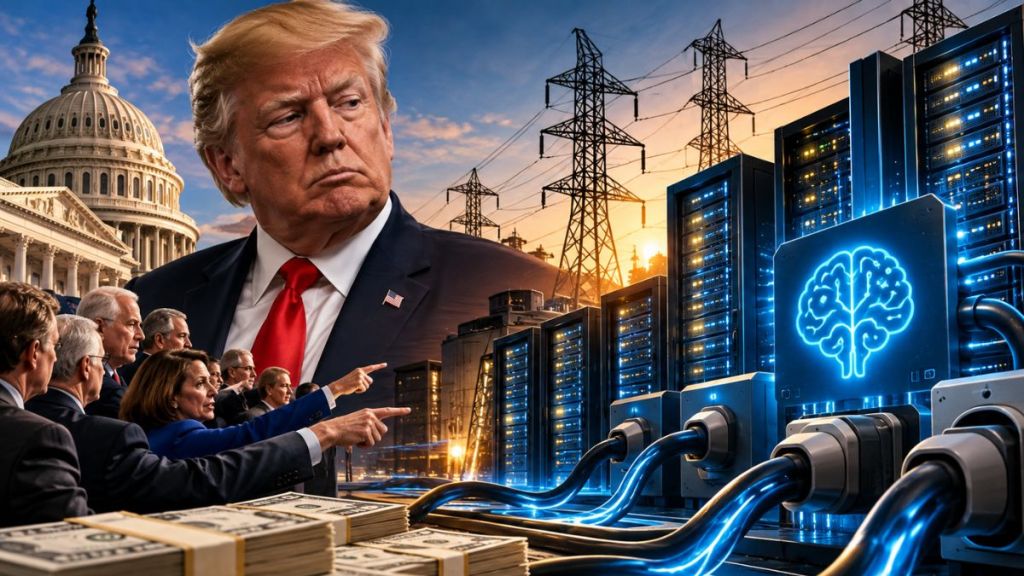

The Senate is expected to take up legislation this week that would seek to protect US households and small businesses from paying for electricity infrastructure needed by large AI data centers.
The Ratepayer Protection Act, which has already passed the House with overwhelming bipartisan support, would require states to consider rules ensuring that large data centers pay the full cost of new electricity generation, transmission and distribution upgrades needed to serve their facilities.
The House passed the bill 417-3 on September 16. Three Democrats, Summer Lee of Pennsylvania, Delia Ramirez of Illinois and Rashida Tlaib of Michigan, voted against it, while 12 lawmakers abstained. The bill still needs to pass the Senate and be signed by President Donald Trump before it can become law.
What the bill would do
The legislation would apply to large electricity users with peak demand of 100 megawatts or more. This would cover large AI data centers, which require significant amounts of electricity to operate.
The bill would require utilities to recover the full incremental cost of infrastructure upgrades from these large-load customers. It would also recommend special rate structures or other agreements to ensure that large electricity users pay for additional grid costs.
The measure would also seek to prevent existing ratepayers from being left with infrastructure costs if a large customer reduces its operations or leaves the electricity system. Representative Gabe Evans, a Colorado Republican who sponsored the House bill, said the measure would protect consumers while allowing the country to expand its AI infrastructure.
“America can lead the world in AI without forcing families, farmers, seniors, and small businesses to foot the bill for the massive energy demands of data centers,” Evans wrote on X following the vote. The bill has 42 cosponsors, including 35 Republicans and seven Democrats, in addition to Evans.
Senate faces opposition
The Senate previously refused to approve the Ratepayer Protection Act under unanimous consent on September 17. Senator Martin Heinrich of New Mexico, the top Democrat on the Senate Energy and Natural Resources Committee, said the proposal did not provide enough protection for consumers.
“Congress needs to pass real legislation with real teeth,” he wrote on X. Senate Minority Leader Chuck Schumer of New York has also opposed the bill. He called the proposal “fraud” and argued that its provisions are voluntary because state utility commissions would only have to consider the standards.
“Sen. Husted’s bill is a fraud, it’s voluntary, no company has to do it. The bill we have is mandatory. It is much stronger, and it is what is needed,” Schumer said last week. A separate proposal from Heinrich, the GRID Savings Act, would require very large electricity users, including AI data centers using 150 megawatts or more, to pay for the grid upgrades needed to connect them. The bill would also give the Federal Energy Regulatory Commission clearer authority over these connections and establish standards for studies, timelines, phased service and cost allocation.
Growing pressure from data centers
The debate comes as data centers expand rapidly across the US. Their growing electricity demand has raised concerns about the effect on household power bills and local infrastructure.
The Environmental and Energy Study Institute reported that average US electricity prices rose to 19 cents per kilowatt-hour by the end of 2025, up 27 percent from 2019. Data center operators had requested 700 gigawatts of power connection development from utilities across the country in 2025.
In states with large concentrations of data centers, electricity costs have also risen sharply. A Bloomberg analysis found that in some states, including Virginia, electricity now costs up to 267 percent more for a single month than it did five years ago.
The impact can vary depending on the size and location of a data center. Large facilities can use as much electricity each day as a small or medium-sized city.
Water use raises concerns
Data centers also require large amounts of water, mainly for cooling their servers and indirectly through the electricity needed to operate them. A medium-sized data center can use up to about 110 million gallons of water a year for cooling, according to the Environmental and Energy Study Institute. Larger facilities can use as much as 5 million gallons a day.
The US currently has more than 3,000 operational data centers, with thousands more under construction. There have not been reports of water shortages caused by data centers so far. Concerns remain because many planned facilities are being developed in areas that have experienced drought conditions in recent years.
Housing impact remains uncertain
The rapid expansion of data centers has also raised questions about housing markets in communities where new facilities are being built. Research so far has not found a meaningful change in home values near newly opened data centers. An analysis by Realtor.com found that home prices in these areas kept pace with comparable neighborhoods.
Housing supply showed a different pattern. Three years after a large data center opened, nearby ZIP codes retained 66 percent of their previous inventory of homes for sale, compared with 43 percent in comparable areas without a data center. The reasons for the difference remain unclear. It could impact homes taking longer to sell, more homeowners putting their properties on the market or a combination of both.
A growing political issue
The cost of powering AI data centers has become a larger issue for lawmakers as electricity demand rises. Supporters of the Ratepayer Protection Act say large technology companies should not shift the cost of new power infrastructure to households and small businesses.
Critics argue that the bill does not go far enough. Jim Walsh, policy director with Food and Water Watch, told The Guardian that “the bill is posing as a consumer protection measure when in reality it will increase costs on consumers across the board.” The Senate’s next steps will determine whether the legislation can move forward after its earlier failure to pass by unanimous consent.