


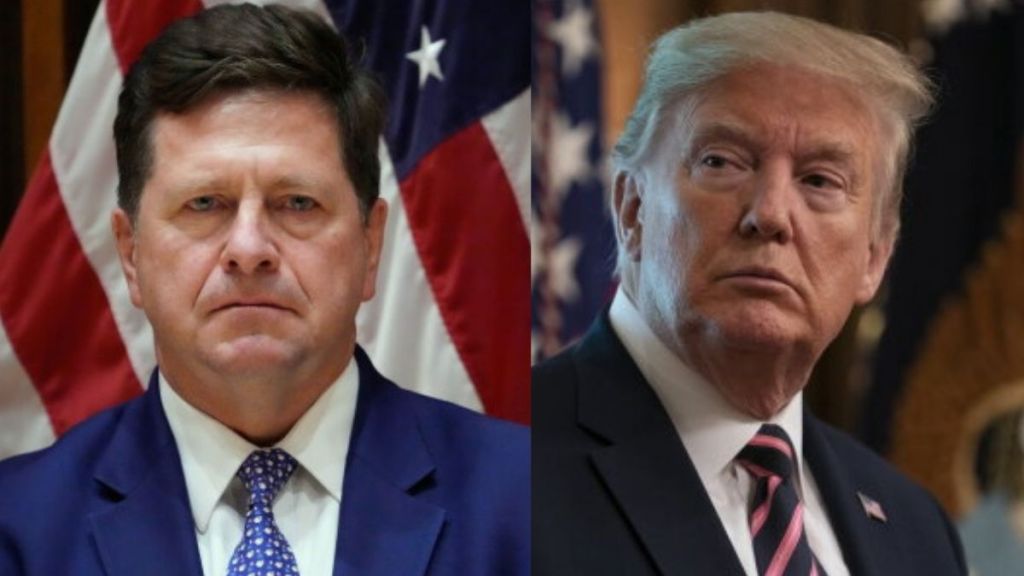

US President Donald Trump has chosen Director of National Intelligence Jay Clayton to lead a new federal task force focused on artificial intelligence, giving one of the country’s top intelligence officials a central role in the administration’s AI strategy.
Trump has named the initiative the “Super Intelligence Force” (SIF). Clayton will coordinate federal efforts to keep the US at the forefront of the global AI race, while the task force examines the risks and opportunities created by the technology.
Trump announced the force in a post on Truth Social. “Following the Historic White House Accord on Super Intelligence, where the World’s most important Technology Companies came together, and confirmed their responsibilities to the American People, I am announcing the formation of the Super Intelligence Force (SIF),” Trump wrote.
He said the group would work to “ensure that America continues to lead the World in Super Intelligence” and “protect the interests, and improve the lives, of all Americans.”
The group has 120 days to produce a report on AI risks, opportunities and the role of the federal government. The task force will work with AI companies, consumers, public interest groups, religious organisations and critical infrastructure providers.
Who is Jay Clayton?
Clayton is not an AI researcher or technology executive. His career has spanned corporate law, financial regulation, cybersecurity and national security.
According to the official biography of the Office of the Director of National Intelligence (ODNI), Clayton was sworn in as the ninth Director of National Intelligence on August 3, 2026.
The DNI heads the US Intelligence Community and serves as the president’s principal intelligence adviser. Clayton oversees the National Intelligence Program and coordinates intelligence activities across US intelligence agencies.
Before joining the intelligence community, Clayton spent more than two decades at law firm Sullivan & Cromwell, where he became a partner in 2001 and later co-headed its Corporate Practice. He also helped establish and lead the firm’s cybersecurity practice.
Clayton was Trump’s SEC chairman
Clayton became a prominent Washington figure during Trump’s first presidency. Trump nominated him to lead the US Securities and Exchange Commission (SEC), where he served as chairman from May 2017 to December 2020.
According to the ODNI biography, the SEC brought more than 2,300 enforcement actions during Clayton’s tenure, resulting in more than $10 billion in penalties and disgorgement and more than $3 billion returned to investors.
Clayton also dealt with issues including cybersecurity, digital assets, market integrity, retail investors and US-China economic relations.
After leaving the SEC, he returned to the private sector, including serving as chairman of the board of Apollo Global Management.
He later served as US Attorney for the Southern District of New York, handling cases involving terrorism, espionage, money laundering, bribery, extortion and threats to critical infrastructure.
Why has Trump picked Clayton for AI?
Clayton’s appointment gives Trump’s AI strategy a strong national-security focus.
AI is increasingly tied to cybersecurity, intelligence, military capabilities, critical infrastructure and the US-China technology competition. Clayton already oversees the US intelligence community and has a background in cybersecurity and financial infrastructure.
Clayton told The Wall Street Journal, “The risk of not being first is high.”
The Trump administration said that excessive regulation could undermine US competitiveness against China. The new task force is expected to examine how the government can support AI development while addressing the technology’s risks.
What is Trump’s ‘Super Intelligence Force’?
Trump has named the new initiative the Super Intelligence Force, reflecting his administration’s focus on what it calls “super intelligence”.
The task force will not function as an AI research laboratory or technology company. Its role will be to coordinate government policy and assess how federal agencies should respond to increasingly capable AI systems.
Clayton’s group will have 120 days to prepare its report, reported Reuters.
The task force will examine existing government systems for reporting AI-related incidents, including breaches and hacks, and recommend ways to improve the federal government’s response using existing legal authorities.
The group will report directly to Trump and White House Chief of Staff Susie Wiles.
Clayton’s education and technology background
Clayton has an academic background spanning engineering, economics and law. According to the ODNI, he earned a Bachelor of Science in Engineering from the University of Pennsylvania, graduating summa cum laude. He also earned bachelor’s and master’s degrees in economics from the University of Cambridge as a Thouron Scholar.
He later earned a Juris Doctor from the University of Pennsylvania Law School, graduating cum laude and earning membership in the Order of the Coif. Clayton has also taught at the University of Pennsylvania’s Carey Law School and Wharton School and co-chaired the university’s Institute for Law and Economics from 2022 to 2025.
Clayton’s cybersecurity experience
Cybersecurity is another part of Clayton’s background that could become relevant to his new role.
At Sullivan & Cromwell, he helped establish and lead the firm’s cybersecurity practice. The ODNI says he also worked with government cybersecurity agencies and advised the Intelligence Community on national-security issues.
That experience is relevant because AI systems can create both new cybersecurity capabilities and new vulnerabilities.
The administration’s task force will therefore be looking beyond the commercial AI industry to issues involving critical infrastructure, cyber defence and national security.