


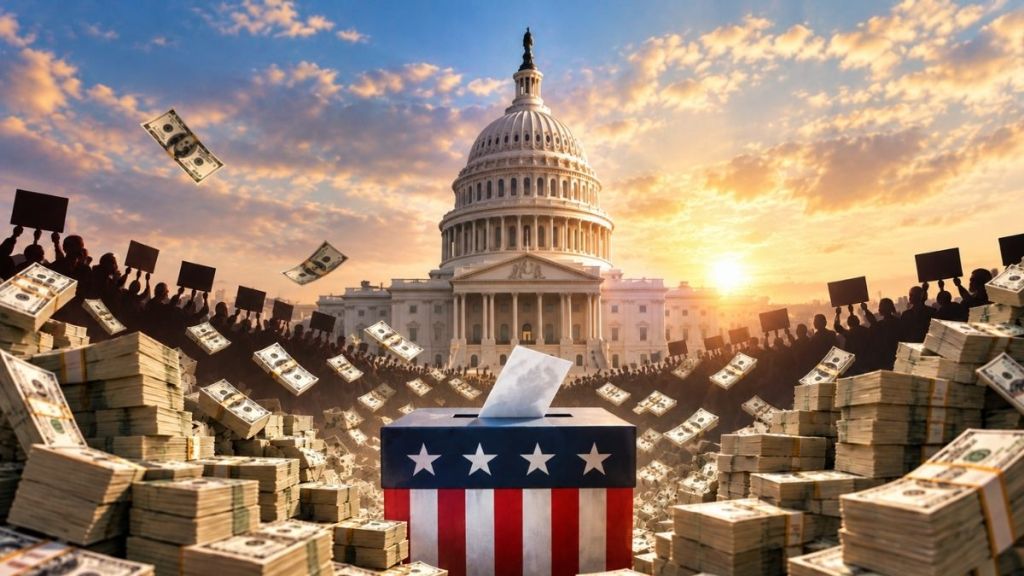

The money race for the 2026 US mid-term elections has entered a crucial phase. More than $130 million in advertising has been reserved by groups aligned with President Donald Trump, according to AdImpact data cited by The Associated Press. Across Senate races, about $390 million in advertising had already been allocated after Labor Day, according to AdImpact data reported by US-media outlet Axios.
Some individual races also involve huge sums. In Michigan, Senate Majority PAC has committed about $30 million to the contest after adding another $10 million, reported Axios. In Texas, Democrat James Talarico has reported $88.2 million in fundraising, while Georgia Senator Jon Ossoff had about $42 million available to spend in the earlier battleground-Senate comparison by The Washington Post.
These figures do not all measure the same thing. Candidate fundraising refers to money raised by a campaign. Advertising commitments can come from campaigns, political parties or outside groups. Super PACs can also spend independently in support of or against candidates.
National political organisations are directing large amounts of money into individual races. Trump had said he planned to allocate $400 million to $500 million from his political operation for the mid-term elections, reported Reuters. Trump’s No Going Back PAC had already reserved more than $74 million in television advertising for competitive House and Senate contests.
Here are seven races where the scale or direction of campaign spending has made them important parts of the 2026 congressional money battle.
1. Texas Senate – Talarico vs Paxton
The Texas Senate race has become one of the most closely watched contests in the country, with Democrat James Talarico facing Republican Ken Paxton.
The race has attracted major spending from national political groups. Trump’s MAGA Inc. had put about $10 million into the Texas contest, while Elon Musk’s America PAC had also spent money to support Paxton, reported Reuters. Musk’s PAC had allocated about $2.6 million to the race.
Musk’s involvement had started before the September spending surge. America PAC had spent more than $800,000 supporting Republican candidates in competitive congressional races, reported Reuters. Its largest individual expenditure at that point was $247,595 for Paxton’s Senate campaign.
Talarico, meanwhile, built a substantial campaign operation of his own. He raised $28 million during the second quarter, putting him among the leading Democratic Senate fundraisers in competitive races, reported The Washington Post. The Houston Chronicle has since reported a total fundraising figure of about $88.2 million for Talarico.
The Texas contest therefore brings together two different sources of campaign money. Talarico has built a large candidate fundraising operation, while Republican-aligned outside groups have committed significant sums to support Paxton.
The race also carries a Trump connection. Trump endorsed Paxton in the Republican contest after backing him over incumbent Senator John Cornyn. Trump later said he planned to put hundreds of millions of dollars into the broader midterm effort.
2. Michigan Senate – El-Sayed vs Rogers
Michigan is another major target for national political spending. Democrat Abdul El-Sayed is facing Republican Mike Rogers in the race for the Senate seat being vacated by Democrat Gary Peters.
The contest has attracted major outside spending from both parties. The Associated Press reported on September 16 that Trump’s affiliated groups had reserved more than $130 million in advertising across the midterm map. One of those groups, No Going Back, has committed substantial money to competitive Senate races, including Michigan.
Senate Majority PAC had committed another $10 million to Michigan. That brought its total commitment in the race to $30 million, reported Axios.
The spending in Michigan has taken several forms during the campaign. Earlier in the year, outside groups also played a major role in the Democratic primary. Axios reported in July that super PACs backing Haley Stevens had reserved $26.9 million in television advertising compared with $2.1 million for El-Sayed during the final weeks before the August primary.
El-Sayed ultimately emerged as the Democratic candidate and now faces Rogers in the general election.
The Michigan race has therefore attracted money at both the primary and general-election stages. National organisations have treated the contest as an important Senate spending target, adding to the financial resources available to the candidates.
3. Ohio Senate – Husted vs Brown
Ohio has also emerged as a major Senate spending battleground. Republican Senator Jon Husted faces Democrat Sherrod Brown, who is seeking a return to the Senate.
Ohio was among the most expensive Senate contests in the 2026 election cycle, reported Axios. The broader Senate advertising market had reached about $390 million after Labor Day, with Ohio among the states receiving heavy spending.
Republican groups had already increased spending in Ohio earlier in the campaign. One Nation, a conservative group aligned with Senate Majority Leader John Thune, had reserved $28 million in television advertising for Ohio, reported Axios.
The race has also generated a large volume of negative advertising. FactCheck.org examined Democratic advertisements that sought to connect Husted to a bribery scandal. The organisation said the advertisements made the connection even though Husted had not been charged with wrongdoing.
The financial stakes are also clear from the amount of national money entering the state. Ohio was once viewed as a state where Republicans had a strong position, but the 2026 Senate race has attracted enough spending to make it one of the most expensive contests on the national map.
4. Georgia Senate – Ossoff’s huge war chest
Georgia Senator Jon Ossoff has one of the largest individual campaign war chests among candidates in competitive 2026 Senate races.
Ossoff had raised about $42 million, the highest amount among the battleground Senate candidates covered in its comparison at that time, reported The Washington Post.
A later Washington Post report put his cash on hand at about $42.6 million as of June 30. The report said Ossoff raised $20 million during the second quarter. His Republican opponent, Mike Collins, had about $2 million in his campaign account at the time.
Ossoff’s fundraising figure shows why candidate money remains important even as outside groups spend heavily.
But the Washington Post also cautioned that a candidate’s own funds do not provide a complete picture of a race. Super PACs and party organisations can spend separately.
The national Republican Senate super PAC had $239 million on hand compared with $126 million for the equivalent Democratic group, according to disclosures cited by The Washington Post in July.
Georgia therefore illustrates the wider financial structure of the 2026 election. A candidate can have a large personal campaign account, while national organisations hold separate funds that can be deployed across multiple states.
5. North Carolina Senate – Cooper vs Whatley
North Carolina is another major Senate contest attracting national attention. Democrat Roy Cooper, the former governor, is running against Republican Michael Whatley.
The race has also become an important stop for Trump’s mid-term campaign. Trump travelled to North Carolina to support Whatley and seek support from voters who backed him in the 2024 presidential election, reported Reuters.
Trump’s involvement adds another layer to the financial contest because his political organisations are spending heavily across the broader Senate map.
Trump’s No Going Back PAC had reserved more than $74 million in television advertising for competitive House and Senate races across six states, reported Reuters. The PAC had also committed $15.7 million to Michigan, while MAGA Inc. and Musk’s America PAC had put money into Texas.
North Carolina is therefore part of a larger national strategy rather than an isolated state race. National organisations can move money between competitive contests as the campaign develops.
The state also has significance because of the Senate seat itself. Cooper is a well-known statewide political figure, while Whatley has Trump’s backing.
6. New York’s 17th Congressional District
The money battle is not limited to Senate races. New York’s 17th Congressional District has also become a target for outside spending.
Republican Representative Mike Lawler is facing Democrat Cait Conley in the district. Trump’s affiliated political groups were putting more than $130 million into advertising across the mid-term campaign, with House contests among the targets, reported AP.
Trump-aligned groups have created separate spending vehicles for different parts of the campaign. Safety and Affordability PAC was focusing on House races, including efforts to protect vulnerable Republican incumbents such as Lawler, reported AP.
The contest has also generated direct campaign advertising. Lawler released an advertisement attacking Conley over the issue of AI data centres, reported The New York Post.
That issue gives the race a local economic dimension while national groups focus on the broader political battle.
The district shows how money from national political organisations can enter individual House contests. It also demonstrates the difference between a candidate’s own fundraising and the wider advertising market surrounding the race.
7. Iowa House races – where Iran is changing spending equation
Iowa provides another example of how a national issue can affect individual House races. Republican Representatives Zach Nunn and Mariannette Miller-Meeks joined Democrats and other Republicans in backing a resolution that sought to limit Trump’s authority to continue military action in Iran without congressional approval, reported AP.
The issue has created a difficult political calculation for lawmakers in competitive districts. Their votes on Iran can become part of campaign advertising and fundraising efforts as the November election approaches.
The money surrounding Iowa is also part of a broader Republican effort to defend congressional seats. One Nation had reserved $11 million in television advertising for Iowa as part of a wider effort to protect Republican Senate seats and strengthen the party’s position in states that have traditionally leaned Republican, reported Axios.
The Iowa House races therefore show how campaign spending can follow political issues. National organisations do not have to spend only on the traditional themes of taxes, immigration or the economy. Foreign policy can also become part of the advertising battle when lawmakers take positions that differ from the president or their party leadership.
Across these seven contests, the money comes from several sources. Candidates raise money through their own campaigns. Political parties maintain national funds. Super PACs make independent expenditures. Wealthy donors can also provide large sums to political organisations.
The figures also change quickly. Advertising reservations can be increased, cancelled or shifted to another market. A campaign’s fundraising total and its advertising spending are therefore different measures.
The final totals will depend on spending decisions made before Election Day on November 3. The figures available in September show where candidates and political organisations have committed money so far, but they are not the final cost of the 2026 US mid-term elections.
Disclaimer: This Financial Express Digital article is based on publicly available campaign-finance data and reports from agencies and official sources. Advertising reservations, fundraising totals and outside spending can change as the 2026 US mid-term campaign progresses. Financial Express Digital does not predict or endorse any election outcome. Polling, fundraising and campaign dynamics can change before voting takes place.