


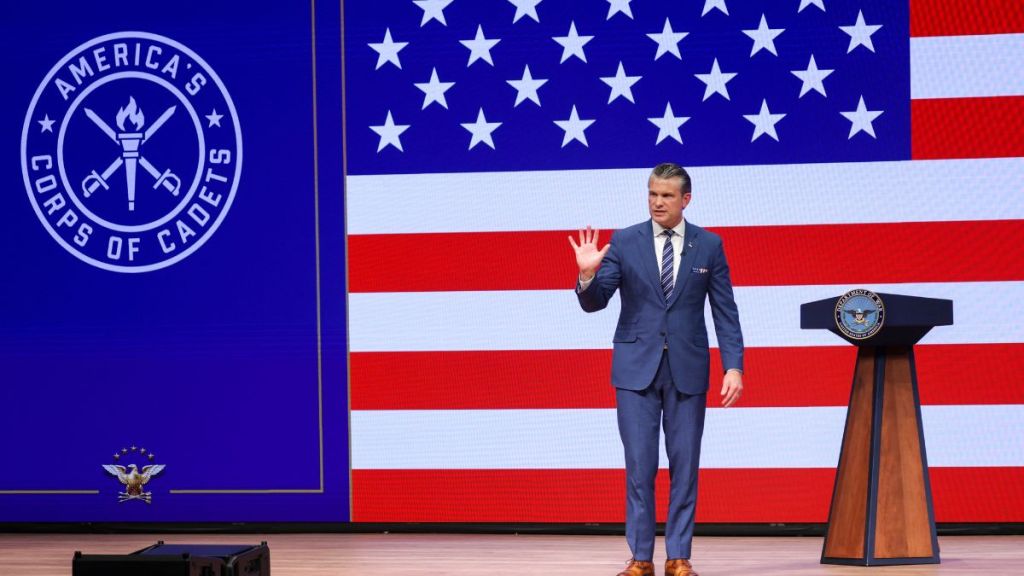

A day after US President Donald Trump unveiled his new AI chatbot called ‘America.gov,’ Defence Secretary Pete Hegseth announced the creation of a new US military command to expand artificial intelligence and drone capabilities.
Intended to focus on robotic and drone warfare, the creation of the ‘Autonomous Warfare Command’ marks a rare move; the last time the United States made a similar move was when US Space Command was launched in 2019. Currently, the US military has 11 combatant commands for specific regions and tasks.
Pentagon to switch out costly conventional weapons with AI systems
Given the rise of artificial intelligence, which Trump has now renamed ‘Super Intelligence’ in a new order signed on Tuesday, the Pentagon’s decision highlights a shift towards cheaper, AI-driven autonomous systems. While announcing it amid hundreds of officers and enlisted personnel at Quantico, Virginia, Hegseth said that the command would be headed by a four-star officer.
In a speech called the “State of the Force,” he asserted that war’s path is “changing faster than the process to support it,” adding, “Cheap compute, superintelligence, and advanced commercial manufacturing have enabled the proliferation of low-cost, high-precision strike.”
Drone warfare has especially made headlines in relation to Russia’s war in Ukraine. When overshadowed by the other side in conventional armour and aircraft, Ukraine chose to rely on cheaper unmanned systems. According to figures listed by Reuters, drones were responsible for an estimated 70% of Russian casualties.
US doubles down on AI despite safety concerns
This month has especially seen the Trump administration commit to artificial intelligence despite AI workers and frontier companies flagging serious safety concerns tied to the technology’s unregulated development.
Earlier this week, the MAGA leader sat down with leading tech executives, including Meta’s Mark Zuckerberg, Anthropic’s Dario Amodei, Nvidia’s Jensen Huang and Google’s Sundar Pichai, and reiterated his support for data centre expansion even as his fellow lawmakers continue to raise alarms about AI safety.
Amid rising calls for AI safeguards, Trump repeatedly asserted that companies already have enough guardrails. This week’s meeting saw a slew of tech executives and the POTUS sign a “morally binding” accord on artificial intelligence at the White House.
The White House luncheon, in turn, happened hot on the heels of Trump’s state dinner alongside Chinese leader Xi Jinping in Washington, D.C. AI talks also figured into conversations Xi and Trump had over the course of the Asian leader’s multi-day US visit.
While this week’s development documented Anthropic CEO and co-founder Dario Amodei and Trump on cordial terms at the White House, both started the year on completely different terms. A rift deepened between the AI firm and the White House after Anthropic refused to allow the military to use its AI models for tasks involving surveillance or autonomous weapons.
Consequently, Hegseth and the Department of Defense at large designated the startup a supply chain risk. In its counter-response, Anthropic filed a lawsuit, arguing that the top Trump administration official overstepped his authority with the designation. A US District Judge ultimately ruled in August that the administration illegally retaliated against the company.