



An US military strike close to Venezuela has come under extensive scrutiny in recent days — sparking bipartisan debate about legality and accountability. US President Donald Trump also admitted on Tuesday that he “did not know” about the secondary strike authorised by his Secretary of War. The remarks came mere hours after the White House explained that the ‘double tap’ attack was authorised by Pete Hegseth but vehemently denied reports that he had sought to “kill everybody”. on the allegedly drug-carrying Venezuelan boat. Hegseth for his part cited the “fog of war” to defend his decision when asked by reporters during a Cabinet briefing on Tuesday.
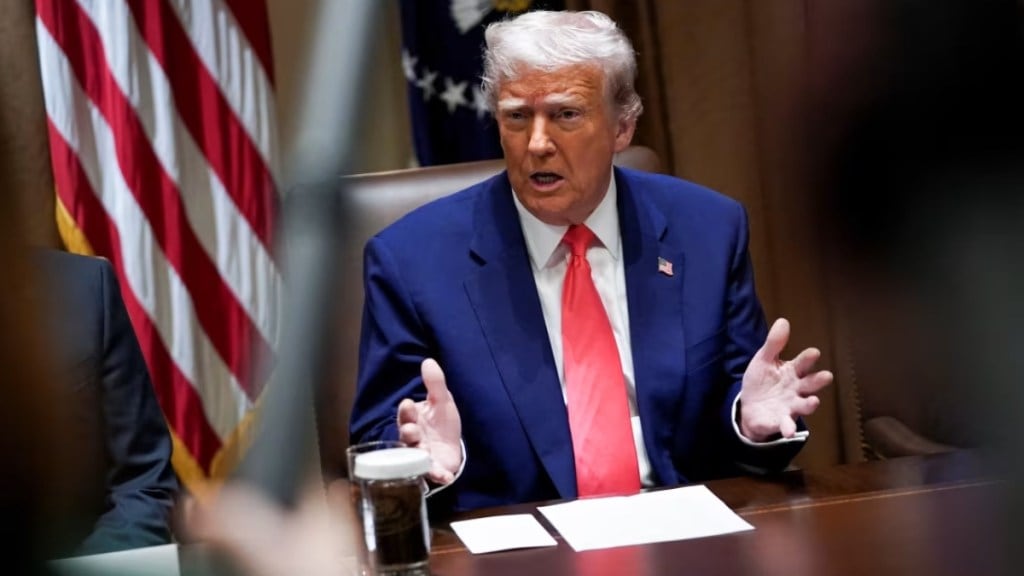
“I still haven’t gotten a lot of information because I rely on Pete. But to me, it was an attack. It wasn’t one strike, two strikes three strikes. Somebody asked me a question about the second strike. I didn’t know about the second strike. I didn’t know anything about people. I wasn’t involved in it. I knew they took out a boat….” Trump said on Tuesday.
He also insisted that Hegseth “didn’t know about second attack having to do with two people” during the Cabinet briefing. According to a recent Washington Post report, two people had survived the first blast on September 2. They were reportedly clinging to the burning vessel when they were killed.
Hegseth cites fog of war
Meanwhile Defense Secretary Pete Hegseth cited the “fog of war” while defending the follow-up strike he had authorised on the allegedly drug-carrying boat in the Caribbean Sea. During a Cabinet meeting at the White House, Hegseth said he did not see any survivors in the water, saying the vessel “exploded in fire, smoke, you can’t see anything. … This is called the fog of war.”
Hegseth also said he “didn’t stick around” for the remainder of the Sept. 2 mission following the initial strike and the admiral in charge “made the right call” in ordering the second hit, which he “had complete authority to do.”
Bipartisan outrage
Republican-led congressional committees have launched investigations of the U.S. military campaign off the coast of Venezuela — the second time in recent days members of Trump’s party have voiced concerns about one of his policy initiatives. Lawmakers have cited concern about the administration conducting a months-long campaign without congressional approval as well as the report suggesting Hegseth ordered a second strike on a boat to kill survivors of a first strike, which could violate international law.
A few have also tried unsuccessfully (and repeatedly) to make Trump obtain Congressional approval for the military the campaign — citing the Constitutional requirement that only Congress, not the president, has the power to declare war. Trump’s Republicans in the Senate blocked a resolution in November that would have prevented him from attacking Venezuelan territory without congressional authorization. In October, Senate Republicans blocked a resolution that would have stopped the boat strikes.
Senator Mike Rounds, a South Dakota Republican who is on the Armed Services and Intelligence committees, said he is still trying to ascertain the facts of the strike as well as the laws affecting it.
“But my understanding is that we may have a problem if you’re killing survivors in the water after a strike. Once we get the facts, then we can start making determinations that need to be made,” Rounds told reporters on Tuesday.
US troops have carried out at least 21 strikes on alleged drug boats in the Caribbean and Pacific in the past three months, killing at least 83 people as Trump escalates a military buildup against Venezuelan President Nicolas Maduro’s government.
What has the White House said?
White House spokeswoman Karoline Leavitt admitted on Monday that Hegseth had authorized Admiral Frank Bradley to conduct the strikes on September 2. She said the strikes were conducted to protect US interests, took place in international waters and were in line with the law of armed conflict.