


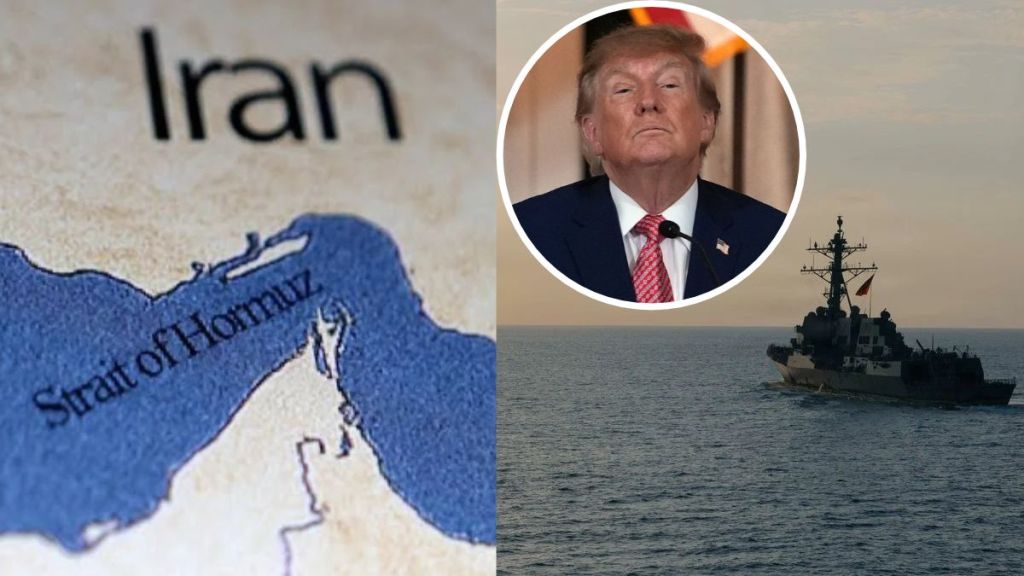

Despite international reports of attacks on vessels in and around the Strait of Hormuz surging to an all-time high, the United States has maintained its narrative that the critical waterway is open. Sitting down for an interview with Fox News, US Central Command spokesperson and US Navy Captain Tim Hawkins said that a “vast majority” of Iran’s attempted attacks have been “unsuccessful,” resulting in nearly all ships safely transiting the crucial maritime route without being hit by any strikes.
“The vast majority of Iran’s attempted attacks on innocent civilian mariners transiting an international waterway, being the Strait of Hormuz, they are unsuccessful,” Hawkins told Fox News.
Noting how the US military has assisted in providing coordinated protection for many ships that have safely crossed the pathway, the US official called out the Islamic Revolutionary Guard Corps’ continued spate of attacks in the Hormuz region. Asserting the IRGC won’t achieve its objective of closing the critical strait, which generally allows the passage of 20% of the world’s oil and LNG supply, Hawkins said Iran’s efforts to close the Strait of Hormuz will be in vain.
US-Iran fight over Strait of Hormuz’s authority
Crediting US efforts to the passage of ship traffic through the Hormuz route, US Navy Captain Tim Hawkins said, “That translates to about 97% of the ships that have sought to transit the Strait of Hormuz have done so successfully without being hit by an Iranian projectile.”
“It is open, it is available for transit and we’ve seen that transit continue this very day,” Hawkins added, revealing that more than 50,000 US service members are stationed across the Middle East. In a separate statement to NBC News, a White House official reiterated that while there’s no passage to Iran through the strait, it is “completely open” for everyone else and is “controlled by the United States Navy.”
Contrary to US claims, the IRGC recently issued a fresh statement, reiterating, “We maintain full control and intelligence oversight over the area east of the Strait of Hormuz, the Arabian Sea and the Gulf of Oman.”
Meanwhile, US CENTCOM Commander Admiral Brad Cooper recently said that Iran has lost $25 billion as its oil exports remain affected, while $350 million in cryptocurrency remains frozen.
The Central Command spokesperson’s remarks come after US forces said a Singapore-flagged, Cyprus-owned container ship, GFS Pride, was attacked by an Iranian projectile in the Strait of Hormuz on Wednesday. The ship is said to have sunk as it was being towed ashore due to a fire on board.
Before Hawkins stepped out for his recent Fox interview, the CENTCOM Commander also noted in a Friday update that the IRGC’s repeated attack on merchant ships crossing Hormuz had claimed the lives of many “innocent civilian mariners.”
“The International Maritime Organization reports that more than 20 civilian mariners have been killed by Iran’s attacks against commercial shipping since February,” Cooper said.
“Over the last seven days alone, about 400 merchant ships have sailed through the Strait. U.S. forces have also assisted Gulf partners in shipping over 100 million barrels of crude oil during the same period, adding to the more than 1.3 billion barrels of crude we have helped regional allies ship through the Strait in recent months.”
Where do oil prices stand now?
Shipments through the Strait of Hormuz have been severely impacted since the US-Israel war on Iran broke out February 28, 2026. According to the real-time Hormuz Strait Monitor website, it has been 232 days since operations through the maritime passage were affected in the aftermath of the joint military action on Tehran in late February.
The price of the international benchmark, Brent crude oil, has stayed above $100 per barrel, 65% higher than the start of the year, since September started. Before the war kicked off, the prices were approximately $65 and $70 a barrel. At the time of writing (3:14 pm, October 18 IST), Brent prices had jumped to $109.860 a barrel.
Latest figures on Hormuz attacks and maritime traffic
As the US and Iran continue to tussle over authority on the strait, experts told NBC News that the recent jump in attacks is Tehran’s way to reassert control over maritime trade in the region and secure leverage in negotiations.
The U.S. is “actually responding favorably by not getting involved in this game that’s really being played right now by the Iranians,” Mehran Haghirian, director of research and programs at the Bourse & Bazaar Foundation, a London-based think tank, told NBC News.
On Thursday, the U.K. Maritime Trade Operations Agency’s (UKMTO) Joint Maritime Information Centre said, “The threat to merchant shipping remains SEVERE.”
Armed attacks, in addition to persistent drone overflights and targeted surveillance, demonstrate “Iran’s intent to assert presence along key transit lanes and maintain pressure on transiting vessels,” it added.
New data released by the British military showed that more than two dozen ships have already reported being attacked in October near the Strait of Hormuz. UKMTO further stated that 12 vessels, including 10 in the waterway itself, reported attacks in the week ending Friday. It is the largest number of weekly strikes reported to the UKMTO since the war started in February.
Of the attacks happening over the past week, six occurred in a single day (October 11).
11 attack reports emerged in the previous week, bringing the month’s tally close to the total for the whole of March, the war’s first month.
The surging attacks have especially emerged as a major blow to markets after Gulf exports returned to close to pre-war levels for half of September. Late last month, JPMorgan analysts said in a note that total Middle East oil exports were just 11% below where they stood when the US began the war with Iran. The numbers were in part based on tracking data from Kpler, NBC News reported.