


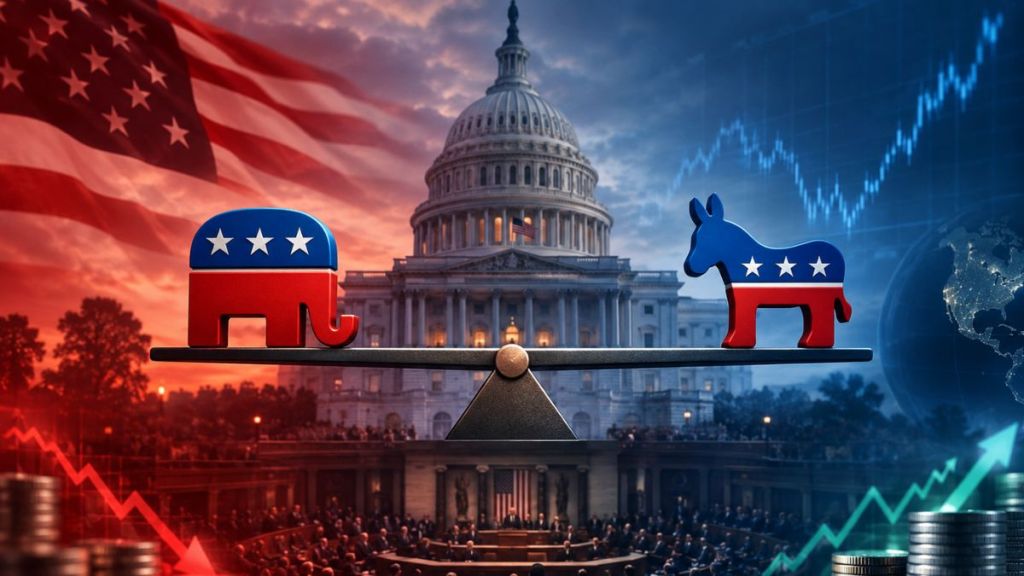

Every two years, Americans vote to decide who controls Congress. The 2026 midterm elections could be especially important because either party could take control of both the House of Representatives and the Senate. A new investor report from the Ameriprise Investment Research Group says the outcome could influence major areas such as taxes, government spending and regulation over the next two years.
Congress is closely divided
The numbers show just how close the race could be. According to data cited by Ameriprise’s Global Asset Allocation Committee, Republicans currently have 218 seats in the House, Democrats have 212. There are also four vacancies and one independent.
All 435 House seats will be contested in the 2026 elections, as happens every two years. A relatively small change in the number of seats could therefore be enough to give either party control of the chamber.
The Senate is also closely watched. Republicans currently have 53 seats. Of the 35 Senate seats being contested in 2026, Democrats are defending 20 seats, while Republicans are defending 15.
This means Democrats have more seats at risk in this election. A relatively small change in seats could still change which party controls the Senate.
Control of Congress matters because the party with the majority gets more power to decide the legislative agenda. It can also make it easier or harder to pass changes to taxes, government spending and regulations.
Markets can become more volatile before elections
Ameriprise’s research suggests investors could see more market uncertainty around the 2026 midterms.
The firm’s Investment Research Group studied S&P 500 returns going back to 1946. The research found that stocks have generally recorded weaker gains during the early part of midterm election years compared with years without midterm elections. Markets have often stayed relatively flat through the spring before gaining strength later in the year.
Volatility also tends to rise during midterm years. Ameriprise found that 30-day market volatility is usually higher during these years than in other years, particularly as the summer approaches and again in October.
A separate analysis looked at the CBOE Volatility Index, or VIX, across election cycles from 1992 to 2022. It found that market volatility usually reaches its highest point around two to three weeks before Election Day.
Volatility tends to fall in the weeks after the election as investors get a clearer picture of who will control Congress and what that could mean for policy.
Stocks have historically done better after midterms
The period after a midterm election has historically been stronger for the stock market. Ameriprise’s data shows that the S&P 500 gained an average of 3.0% nine months before a midterm election. The average gain was 0.7% six months before the election and 1.4% three months before it.
The picture changed after the election. The S&P 500 gained an average of 8.8% three months after a midterm election, 15.9% six months after and 20.1% nine months after.
Looking at a longer period, Ameriprise found that the S&P 500 gained an average of 15.4% in the 12 months following a midterm election. This data goes back to 1950.
The report says one reason for this pattern could be that investors get more clarity about the makeup of Congress and what it could mean for fiscal policy after the election results are known.
The presidential cycle also matters
Midterm elections take place halfway through a president’s four-year term. Ameriprise’s research suggests the timing of the election can also affect market performance.
For presidents in their first term, S&P 500 returns have averaged 11.1% in the first year, based on data going back to 1945. Returns have then fallen to an average of 8.9% in the second year, which is the midterm year.
The firm links this weaker performance partly to political uncertainty and legislative gridlock ahead of the midterm elections.
Returns have historically improved in the third and fourth years of a president’s first term. They have averaged 16.2% in the third year and 15.3% in the fourth year.
Second presidential terms have followed a different pattern. Returns averaged 13.5% in the first year and 20.4% in the second year of a second term. They then fell to an average of 5.6% in the third year and 4.1% in the fourth year.
Ameriprise says investors may become more uncertain during the later years of a second term because they start thinking about who could become the next president.
Party control does not always decide market performance
One of the biggest findings in the report is that the political party in power does not appear to have a clear long-term impact on stock market returns.
Ameriprise’s Global Asset Allocation Committee studied eight different combinations of presidential, House and Senate control using data going back to 1945.
The results varied widely. Periods of full Democratic control produced average annual S&P 500 returns of 15%, while periods of full Republican control produced average annual returns of 13%.
Mixed political control produced some of the highest and lowest results. Average annual returns across the different combinations ranged from 19% to -17%. The -17% result occurred only once, under a Republican president with a split Senate and a Republican-controlled House.
Across all political configurations since 1945, the S&P 500 has returned about 12% a year on average. Split government also produced an average return of 12%.
Economic growth also depends on more than politics
GDP growth shows a similar pattern. Ameriprise studied the same eight political combinations using Federal Reserve data through the end of 2025. Average economic growth across these different political setups ranged from 1.2% to 4.0%.
The overall average growth rate since 1945 was 2.7%. Since 2000, the average has been lower at 1.9%.
As per report, investors should stay focused on their long-term investment strategy. Elections can affect market sentiment and cause short-term price movements, but those movements should not necessarily change a long-term investment plan.
Investors should also be prepared for higher volatility around the election. If election-related market swings create attractive opportunities, the firm says investors could consider putting some unused cash to work.