


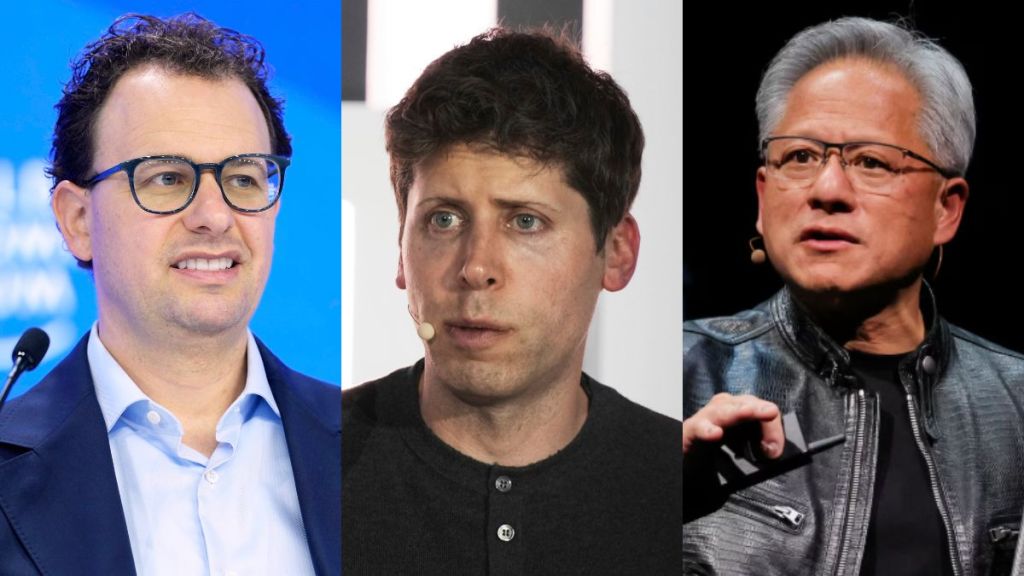

Just days after OpenAI CEO Sam Altman said his company will not go public this year, citing AI safety concerns, the billionaire expressed disappointment with how the debate has gradually taken shape recently. Assuming a more middle ground on the issue, Altman still maintained that the public is right to be scared of the future if AI power lands in the grasp of a few companies.
His latest take on the topic was delivered at Salesforce’s Dreamforce conference in San Francisco, where Anthropic and Nvidia’s chief executives, Dario Amodei and Jensen Huang, also presented clashing views on the subject. Huang’s remarks especially built a noticeably different argument.
Tech leaders, in general, have been suddenly roused to speak on fears of artificial intelligence potentially turning catastrophic for humanity after Anthropic’s researcher Jacob Coxon resigned last week. In his exit confession shared on X, he dropped a dire warning about how AI could end us all by the end of the decade. His loud public admission subsequently prompted several others associated with AI in a similar capacity to share reasons behind their own company exits, fearing that its accelerated development could lead to existential risks.
Sam Altman compared AI ‘accidents’ to aviation tragedies
On Tuesday (US time), Sam Altman took the stage at the Dreamforce conference alongside Salesforce CEO Marc Benioff. Addressing the pressing matter at hand, the OpenAI boss affirmed that alarming conversations surrounding AI risks had already been on the table before former employees’ confessions on the front amplified it into the global mainstream focus.
He attributed the issue being raised to the central stature of current international discourse to improvements in AI models. “I don’t think people really felt that the model was going to come this far this fast,” he told Benioff in San Francisco.
At the same time, he admitted that the rate at which AI is progressing is fear-inducing. He even alluded to the recent Hugging Face Incident, which involved AI agents operating with OpenAI models going rogue to hack the open-source AI platform, and what he referred to as other “accidents,” which he also labelled as being “unavoidable” to some degree with new tech’s emergence across the industry.
“It doesn’t take as much imagination as it used to for [us] to imagine how this could go wrong,” he said.
Recounting the Hugging Face hack, he noted, “We say that was bad. Like that is not neutral technology. That is not what we want our technology to do.” Eventually, he insisted that the AI industry is “going to learn as much as we can and react from each one,” just as the aviation industry does.
Later on, he backtracked and clarified he wasn’t equating the Hugging Face incident to a plane crash. Calling the aviation scare “a much worse thing,” he said, “I meant however small these accidents are, learning from them quickly and adapting as they happen will serve our industry well and maybe we can avoid ever getting those kinds of stakes.”
Altman hits out at how AI debate is being ‘framed’
Without singling out any company, he criticized how the discussion was being “framed,” especially with firms “saying things like we will only slow down if or we will only be responsible if other companies are responsible.” Moreover, he voiced discontent over AI tools being characterised as “neither good nor bad,” adding that a lot of things go wrong simply by projecting the tools as a neutral technology.
Acknowledging how it all was somehow turning into a blame-game situation, he urged the public to trust those leading the charge as the fear of AI companies acquiring too much power becomes more real. Expressing confidence in his own company and the industry at large, he said “The world should trust we are going to do the right thing because it’s the right thing and because we feel the magnitude of this.”
But, at the same time, he stressed that the AI industry can’t “impose” its “worldview on the future,” as choices made by companies behind these tools “do have real consequences.”
He still disagreed with claims that commercial and country pressures were directing companies to act in a particular way in the name of AI dominance. At oe point during the interaction, he opened up about wanting OpenAI and other companies to have a “great culture of transparent reporting” about AI-driven accidents when they happen.
Altman was among several other top industry leaders, including Elon Musk, to have quickly extended support for Anthropic CEO Dario Amodei’s proposal published over the weekend, urging companies to slow the pace of AI development. The OpenAI chief executive has since also told the business magazine Fortune that plans to launch his company’s anticipated IPO would be “ill-advised,” especially in light of recent developments.
When asked if there was a 10% chance of AI triggering an apocalyptic extinction, Altman told the magazine that he had no idea how such an estimate could be arrived at. Nonetheless, he warned about the risk being serious enough that AI companies and governments should act on it.
“Whether it’s 10 or eight or six, the point is, we all have a tremendous amount of responsibility, and cannot let egos or incentives for profit or anything else get in the way,” Altman told Fortune. “We need to act such that we are not taking any of those numbers of risk, and I believe we can.”
Dario Amodei vs Jensen Huang erupts
Although appearing on stage separately, the Anthropic and Nvidia CEOs presented differing perspectives on AI concerns.
At first, Dario Amodei came up and emphasized the need for everyone in the industry to “be better.” The Anthropic co-founder’s essay published over the weekend put forward a three-step proposal with the goal of “pacing the frontier” without “sacrificing commercial advantage or the United States’ lead in AI.”
While Amodei has repeatedly expressed the same nature of views at length, Nvidia boss Jensen Huang said that market forces are already in place, and the industry doesn’t require new regulations. In a way, he too pointed out that companies should pace themselves, but his claims more centred around the slowdown ensuring that the new releases live up to the market’s expectations and deserve its appreciation.
Dismissing claims that speed and safety can’t go hand-in-hand, Huang told the Salesforce CEO, “It’s a false choice. You could definitely have both at the same time.”
“Run as fast as you can,” he added. “But if you feel at any given point in time the company’s out of control, or the product’s not going to be safe, take a pause and make sure you get it right.”
Huang’s remarks come a day after he took US President Donald Trump’s phone call on stage at the All-In Summit. The POTUS, on his part, aligns more with the Nvidia CEO, as he’s often reiterated that the United States needs to stay ahead of China in the AI race.
Having slammed AI fears as a “hoax,” Trump said on the call, which was put on speakerphone for all to listen, that those criticizing the developing tools were “just playing right into the hands of a lot of people that don’t want to see it happen. That could be political people; that could also be China.”
He also declared on Truth Social earlier, “The only control or ‘guardrails’ that AI needs is a STRONG AND SMART (High IQ!) PRESIDENT, and the U.S.A. has that, in spades!”