


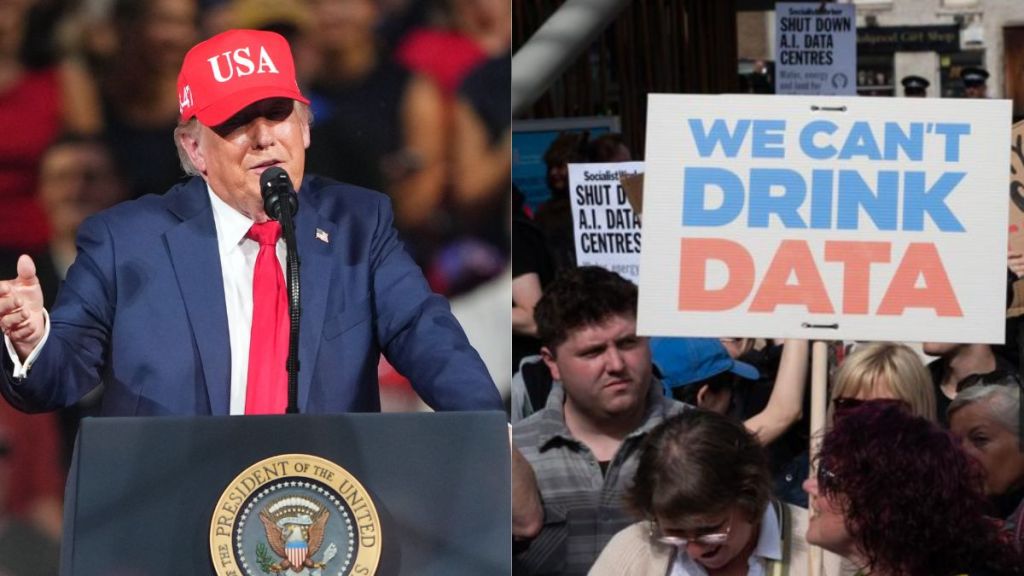

In what has emerged as a thought-provoking week for the artificial intelligence industry, the US House of Representatives on Wednesday (US time) passed a bill establishing safeguards for consumers plagued by higher energy costs tied to new data centres being built in their communities.
Called the Ratepayer Protection Act, the bill advanced in the US House following a nearly unanimous 417-3 vote over a week after AI researcher Jacob Coxon, who had also worked at OpenAI previously, quit Anthropic, citing potential existential threats posed by AI.
This was the only AI-related legislation scheduled for a vote this week as lawmakers heed apocalyptic warnings about the booming tech industry dropped by Coxon and several other former AI workers. A Republican-led majority advanced the bill before an early recess ahead of the November 3 elections.
Many top tech executives leading the charge at frontier AI companies have also echoed the dire warnings and called on the US government to immediately “pace the frontier” as firms continue to face intense pressure to speed up AI development. US President Donald Trump, however, dismissed the criticism surrounding AI safety concerns. Not only has he called AI fears a hoax, he has also hailed data centres as the “oil of the next 20, 25 years,” despite the massive data centre boom emerging as significantly unpopular among American adults.
A recent NBC News poll found 70% of the 7,105 surveyed adults opposed the construction of AI data centres in their neighbourhoods. Similar results were recorded by a poll by the University of Massachusetts Amherst published this week, showing that just 11% of Americans would support an AI data centre being built in their community.
What is the Ratepayer Protection Act?
Mostly described as a rather “modest” effort, the Ratepayer Protection Act or House Resolution 9340, was primarily co-sponsored by US Rep. Gabe Evans (Republican) and Kathy Castor (Democratic), both members of the Energy and Commerce Committee, and introduced on June 18, 2026. The bill requires state public utility commissions to consider a strategy to make data centres pay their own way, instead of passing such costs onto American consumers.
As a result, HR 9340 would help extend protections to customers against rate increases caused by data centre construction, pushing data centres drawing more than 100 MW of power to pay for the full incremental costs to serve their loads. The recently passed legislation draws on existing Public Utility Regulatory Policies Act authorities (Sec. 111(d)) to provide a federal recommendation while preserving state power to regulate electricity markets.
It would help establish large-load standards so that American states can ensure that families “are not left footing the bill for AI data centre growth, while still encouraging industry growth.”
Upon its advancement by the US House, Congressman Evans said that hardworking families shouldn’t be forced to “subsidize the energy demands of data centers.” Echoing Trump’s remarks on the US leading China in the AI race, the lawmaker stressed, “America needs the infrastructure to lead the world in AI and outcompete Communist China, but we cannot have that growth at the expense of hardworking families, farmers, seniors, and small businesses.”
Meanwhile, an Electric Power Research Institute analysis previously estimated data centres’ share of US power use could climb from about 4.5% today to 9% and 17% by 2030, a steeper shift than the group projected two years ago.
Hot on the heels of the new figures released in late February, Trump hosted top tech executives at a March 4 meeting. Consequently, a list of big firms (Amazon, Google, Meta, Microsoft, OpenAI, Oracle and xAI) signed the ‘Ratepayer Protection Pledge,’ agreeing to “build, bring, or buy new generation resources and cover the cost of all power delivery infrastructure upgrades required for their data centers, ensuring such expenses are not passed to American households.”
Who opposed HR 9340?
Only three ended up voting against the bill — all Democrats. The trio of progressives against the legislation were Pennsylvania’s Summer Lee, Illinois’ Delia Ramirez and Michigan’s Rashida Tlaib.
Explaining the rationale behind her opposition, Tlaib said on X before the vote that it “fails to meaningfully protect our communities.” She believes that the “strongest action” Congress can move ahead with is to “pass a national moratorium on data centres and enact a prohibition on federal lands.”
Consumer rights non-profit Public Citizen similarly stated that the bill didn’t go far enough to protect Americans.
As quoted by Reuters, “The Ratepayer Protection Act has very limited ability to actually protect consumers from higher utility rates, as it simply asks states to ‘consider’ requiring data centers to pay for certain grid interconnection costs,” Tyson Slocum, director of the group’s energy program, said in a statement. “While a federal mandate forcing states to consider such a step provides opportunities for advocates to press for consumer protections, there are a myriad of other consumer and community impacts from data centers unaddressed in this bill.”
What’s next for the bill?
It will now proceed to the Senate. Ahead of the forthcoming elections, it has three weeks of legislative session to pass the bill. Senate Majority Leader John Thune has already hinted at the Senate potentially green-lighting the bill.
Even after that, however, implementation wouldn’t be as swift as one would expect. The bill is not likely to come into full force for two years, The Washington Post reported.
Trump’s take on data centres
Despite multiple polls and surveys reflecting the growing distaste for data centres among American adults, President Trump has seriously championed them as a top priority in his second term. Last year, he even signed an executive order expediting federal permission and facilitating their construction on federal land.
More recently, he has repeatedly defended both AI and data centres in social media posts. In a surprise call with Nvidia CEO Jensen Huang, who then put Trump on speaker, the US president said data centres make people and states wealthy. He also insisted that those criticizing AI development were “playing right into the hands of a lot of people that don’t want to see it happen, and that could be political people, that could also be China.”
Contradicting Big Tech’s requests for AI to be regulated, he wrote on Truth Social, “The only control or ‘guardrails’ that AI needs is a STRONG AND SMART (High IQ!) PRESIDENT, and the U.S.A. has that, in spades!”
Vice President JD Vance is on the same page as Trump. Speaking to reporters earlier this week, he expressed skepticism towards AI executives calling on the US government to regulate the industry.