


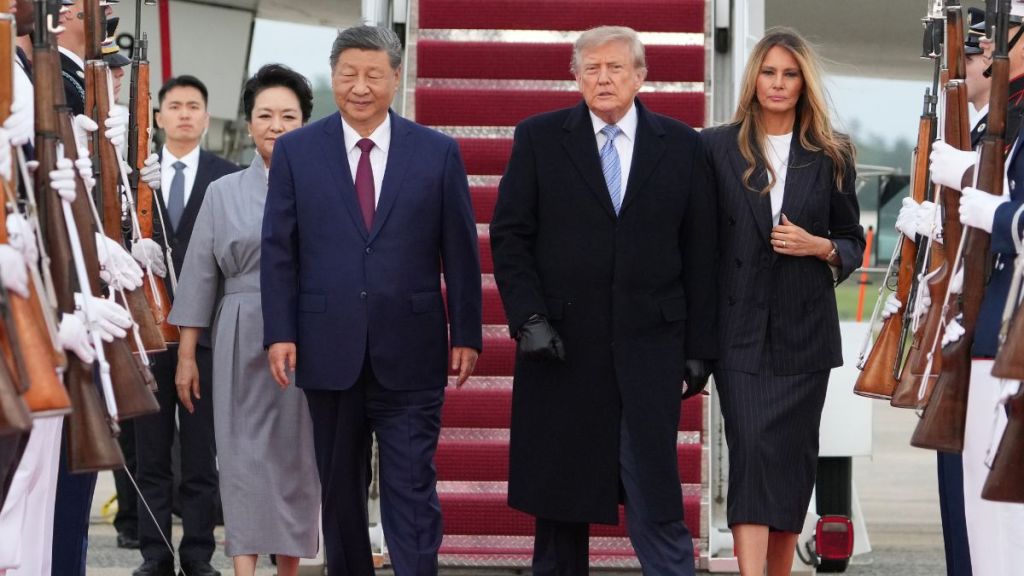

Ahead of the scheduled talks between US President Donald Trump and Chinese leader Xi Jinping, American lawmakers proposed bipartisan legislation seeking to put a federal process that bars Chinese technology from the US market under review.
The bill pushed by Republican chair of the US House Energy and Commerce Committee, Brett Guthrie, and the panel’s top Democrat, Frank Pallone, seeks to update and improve the Secure and Trusted Communications Network Act of 2019. Called the Communications and Technology Transparency Act of 2026, the legislation focuses on reworking procedures backing the Federal Communications Commission’s (FCC) ‘Covered List.’
According to the official government website, the so-called list mentions communications equipment and services that pose an “unacceptable risk to US national security.” Using this tool, Washington ramped up its efforts to block Chinese technology from entering the US on national security grounds. However, Pallone and Guthrie’s new bill now puts how the FCC’s authority is being used to restrict Chinese tech under scrutiny.
The development comes as artificial intelligence and technology, in general, are expected to loom large in Trump-Xi talks on Thursday (US time). Leaders of both countries have refused to slow down AI development despite surging calls to “pace the frontier” as AI researchers sound the alarm on the booming technology potentially being responsible for the end of human life in the near future.
What we know about the Communications and Technology Transparency Act of 2026
In a joint statement, Representatives Brett Guthrie and Frank Pallone argued that the FCC’s current process to expand the ‘Covered List’ “lacks the transparency, consistency and clarity needed to meet our long-term national security needs as technology rapidly advances,” as seen in a press release published on the Energy and Commerce website on Wednesday (US time).
The proposed bill suggests enhancing congressional oversight regarding what gets added to and removed from the list. As a result, the Commerce Department would need to provide input before making certain determinations about foreign equipment. The commission would also have to report to the US Congress at least seven days in advance before adding anything to the Covered List, according to the ‘Section-by-Section’ breakdown of the proposed act.
Its fifth section would necessitate the FCC to only place those information and communications technologies or services on its covered list if they are produced by an entity controlled by a “foreign adversary.”
“Consistent with federal law, a “foreign adversary” means the People’s Republic of China, the Russian Federation, the Islamic Republic of Iran, and the Democratic People’s Republic of North Korea,” the official document states.
Chinese equipment flagged in FCC’s ‘Covered List’
The FCC has used the ‘Covered List’ to ban Chinese drones, robots, power inverters and other equipment from Chinese firms in the past. A Reuters report published last month suggested that the commission was working on a measure to ban imports of new Chinese optical transceivers, which serve a key role in data centre infrastructure.
Months back, the Federal Communications Commission used the same list to bar the import of equipment from a group of Chinese telecommunications companies, including Huawei, Dahua, ZTE and Hikvision, despite prior approval.
Trump-Xi meet for the second time in 2026
On Wednesday evening, Donald Trump welcomed Xi Jinping to the US, marking the first time a POTUS has welcomed a foreign leader at Joint Base Andrews in over a decade. According to C-SPAN, former President Barack Obama was the last to have done it in 2015 during Pope Francis’ visit.
Xi’s US visit presents an opportunity for high-stakes diplomacy amid strained ties between the two countries, with tensions prominently related to trade issues, including rare earth minerals’ supplies, tariff wars, the ongoing Iran war, and Taiwan.
As the Chinese leader arrived for a three-day visit to the country, US Treasury Secretary Scott Bessent also announced that the US and China will extend their trade truce to January. The agreement was set to expire on November 10. Before the Trump-Xi summit, Bessent met with Chinese Vice-Premier He Lifeng, and they discussed the possibility of a more substantive trade deal between Washington and Beijing.
According to a written statement carried by China’s state news agency Xinhua, Xi said both countries are “great nations, and their people are great people.” He especially asserted that the US and China “should be partners rather than rivals.”