


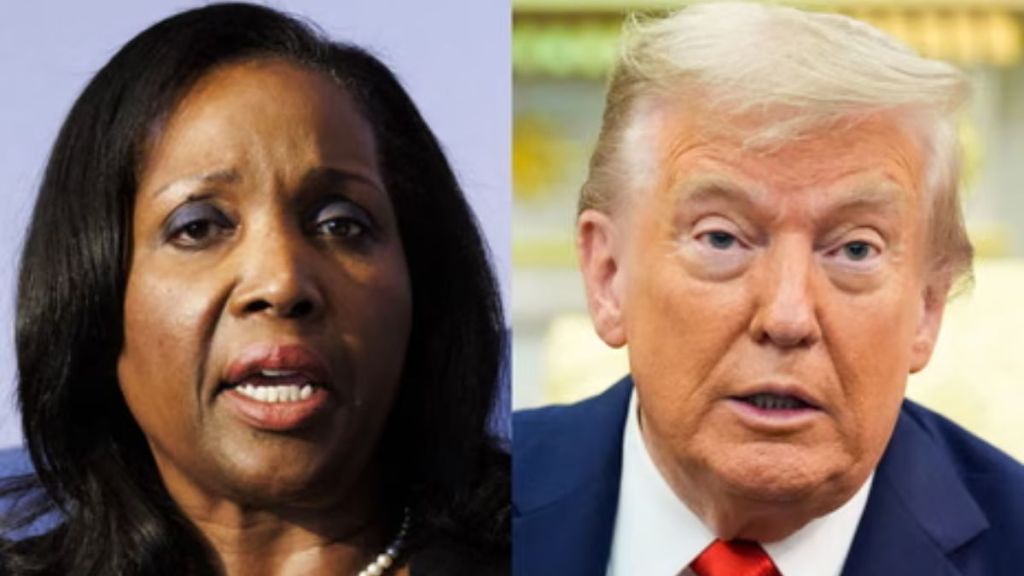

US President Donald Trump has set up a committee to investigate Federal Reserve Governor Lisa Cook over allegations of mortgage fraud, renewing his efforts to remove her from the central bank regardless of a Supreme Court ruling that found his earlier attempt unconstitutional.
According to a notice published on the White House website on Friday, October 7, the committee will consult Justice Department officials and report to Trump on whether there is sufficient cause to remove Cook from her position.
The White House will hold a closed, in-person hearing on November 5 to examine the allegations against Cook. The hearing will not be open to the public, but a transcript will be published. Cook will be allowed to submit a written statement and present evidence in her defence. She will also be questioned by White House representatives, committee members or Justice Department officials for up to four hours, according to the presidential memorandum.
“As President, it is my job to ensure the laws are faithfully executed, including by firing subordinates who cannot be trusted to tell the truth and follow the law,” Trump said in a statement published on the White House website.
Cook’s legal team denies allegations
Cook’s lawyers have denied the allegations and said there is no legal basis for removing her from the Federal Reserve Board. “If the hearing is “anything close to objective, the conclusion will be that Governor Cook did not commit mortgage fraud, leaving no cause to remove her from the Federal Reserve Board,” Cook’s lawyers Abbe Lowell and Norm Eisen said in a statement. “Governor Cook welcomes the opportunity to present the facts so she can clear her name and demonstrate there is no legal basis to fire her.”
Her legal team has previously accused the White House of “cherrypicking” facts, arguing that the allegations are based on unrelated clerical errors.
The allegations relate to two properties in Georgia and Michigan that Cook allegedly listed as her primary residences. Trump has also accused her of failing to report rental income from a property in Atlanta. Cook has maintained her position while challenging the administration’s actions in court.
Supreme Court had blocked Trump’s earlier attempt
Trump first tried to remove Cook in August 2025, accusing her of mortgage fraud. Cook immediately filed a lawsuit against the administration. The Supreme Court subsequently allowed her to remain in office while she challenged the allegations. In June, the court ruled that Trump’s attempt to fire her was unconstitutional because he had not followed the required procedure or given her an opportunity to respond to the allegations before removing her.
The ruling left Cook in her position and sent the case back to a federal district court. No US president had previously attempted to remove a sitting Federal Reserve governor, making the case an unprecedented challenge to the central bank’s independence.
Cook’s background and appointment
Former President Joe Biden appointed Cook to the Federal Reserve Board in 2022. She became the first Black woman to serve as a governor of the US central bank. Cook was reappointed in 2023 to a term that runs until 2038. Before joining the Federal Reserve, she taught at Harvard University and Stanford University and served on former President Barack Obama’s Council of Economic Advisers.
Trump has repeatedly challenged the Fed’s independence
The dispute over Cook’s position comes amid Trump’s wider campaign to influence the Federal Reserve’s interest rate decisions. Trump has repeatedly criticised the central bank for not quickly cutting interest rates. He also launched a Justice Department investigation into then-Federal Reserve Chair Jerome Powell. The investigation was dropped in April.
The Federal Reserve was established by Congress as an independent institution responsible for setting monetary policy. Economists agree that keeping central banks independent of political pressure is important for economic stability, particularly when decisions on interest rates are required to control inflation.
Kevin Warsh, who succeeded Powell as Federal Reserve chair, has faced questions about how he will protect the institution’s independence. Before Trump selected him for the role, Warsh had echoed the president’s calls for lower interest rates.
However, persistent inflation pressures linked to the war in the Middle East led the Federal Reserve to raise interest rates at its latest meeting, drawing criticism from the White House.
The latest move against Cook comes just weeks before the US midterm elections, which will determine whether Trump’s Republican Party retains control of Congress. The dispute has renewed concerns about the administration’s efforts to exert greater influence over the central bank.