


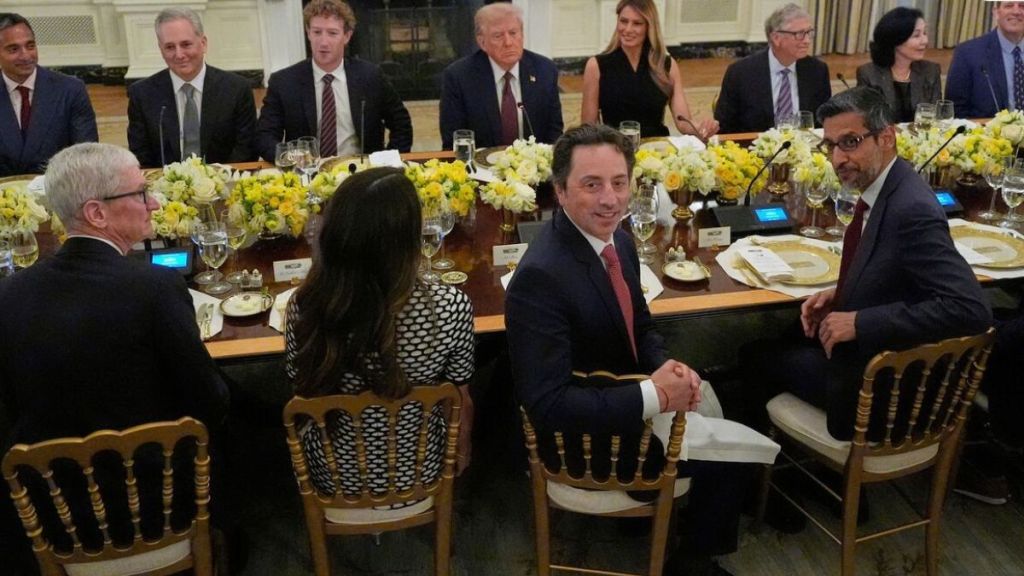

US President Donald Trump on Tuesday backed a new name for artificial intelligence, calling it “super intelligence”, as the heads of some of the world’s biggest technology companies joined him at the White House to sign a voluntary AI safety agreement.
Trump described the agreement as “morally binding”, while also acknowledging that it is not legally enforceable. “It’s not artificial. We all agree on that,” Trump told reporters after the meeting, according to Fox News.
Trump also signed an executive order directing federal agencies to use “super intelligence”, often shortened to “SI”, instead of artificial intelligence in official government communication.
The order covers government correspondence, public communications, websites, reports and other documents that are not part of federal law. It also gives Trump’s science and technology adviser 60 days to propose legislative language that would define the new term.
Tech companies agree to safety checks
The agreement, called the White House Accord on Super Intelligence, was posted by Trump on Truth Social.
It was signed by Trump along with Google CEO Sundar Pichai, Anthropic CEO Dario Amodei, Meta CEO Mark Zuckerberg, OpenAI President Greg Brockman, xAI and Tesla chief Elon Musk and Nvidia CEO Jensen Huang.
Under the agreement, the companies have committed to “four layers of controls and audits” covering the way advanced AI models are developed and deployed.
The first requires companies to put in place strong internal controls to monitor their AI models during training and deployment. These checks will cover areas such as cybersecurity, biosecurity and chemical threats. Companies will also have to make sure their models do not hack into or access technical systems in unintended ways.
The second layer requires each company to have an internal team that checks whether these controls, monitoring systems and detection tools are working as intended. The team will also be responsible for making sure problems that are found are fixed.
The third layer involves an independent outside auditor or evaluator. This person or organisation will independently check whether the company’s controls, monitoring and detection systems are working properly.
The fourth layer involves the company’s board of directors. Each company will designate an independent board committee to oversee the teams running these safety controls, as well as the internal and external auditors and evaluators.
The board committee will also receive reports from these teams and make sure that any problems identified are addressed.
The agreement also says the participating companies will meet regularly to develop common safety standards and best practices as AI systems become more capable.
Importantly, the companies left the door open to government regulation in the future.
Musk predicts an ‘age of abundance’
Musk, who sat beside Trump, said AI and robots could eventually lead to higher incomes and better living standards rather than economic hardship.
“I think by far the most likely outcome is an age of abundance where we don’t have just universal basic income, we have universal high income,” Musk said in remarks shared on his X account.
He said the changes could also transform healthcare.
“When you have robots and you have superintelligence, it means that everyone in the world can have better medical care than anyone here, including me,” Musk said. “And wouldn’t that be wonderful?”
Musk also spoke about the effect of AI on jobs. He said work would change, but argued that technology has always replaced some types of work.
“Being a computer used to be a job,” Musk said, referring to the time when people worked in large groups to carry out calculations that computers now perform. “I don’t think anyone is pining to go back and do calculations all day,” he said.
Musk also said unemployment has not risen, as Trump has pointed out, and that “there’s a tremendous demand for people.” He described the most likely outcome of AI as “incredibly beneficial” and said it would create a future “you would want.”
Later on Tuesday, while speaking at the launch of America.gov, Musk gave a simpler description of the companies’ commitments.
The companies had agreed to joint monitoring, special committees at the board level and “grading each other’s homework”, he said.
Zuckerberg calls the agreement ‘a start’
Meta CEO Mark Zuckerberg said the agreement was aimed at giving Americans and customers confidence that AI systems would work as intended.
“The idea isn’t that this is the only thing that we will ever do,” Zuckerberg said. ABC News quoted Zuckerberg as calling the agreement “a start and an accord that the whole industry could come to.”
He also said the companies had agreed to several layers of audits and controls, including detailed internal evaluations and external audits.
Anthropic CEO Dario Amodei focused on both the potential benefits and risks of AI.
“We can win safely if we do this right,” Amodei said. Brandon Daniels, CEO of Exiger, who was seated next to Amodei, told Fox News that Amodei raised safety concerns during the discussion.
Nvidia says AI is creating jobs
Nvidia CEO Jensen Huang said the huge investment going into chip plants, computing facilities and AI startups is creating jobs across the US.
“This is the largest industrial revolution in history,” Huang said, according to ANI. Google’s Pichai and OpenAI’s Brockman also signed the agreement.
Daniels told CNN that the group had discussed an idea put forward by Huang and Zuckerberg.
The idea was for the industry to agree on a “superseding” set of principles and standards that could be reviewed over time and could eventually form the basis for executive orders or regulation.
Trump says US must stay ahead of China
Trump has repeatedly said that the US needs to maintain its lead over China in AI because of the technology’s importance to national security and the economy.
Trump hosted Chinese President Xi Jinping for a state visit last week. He said the two leaders did not spend much time discussing AI partnerships or competition. Xi had said that both countries had a responsibility to develop AI while keeping “the well-being of the people” in mind.
But Trump used a more competitive tone at Tuesday’s event, which was attended by technology executives and members of his cabinet. “You’re going to have a winner, or you’re going to have a loser,” Trump said.
Trump has also strongly backed the construction of data centres across the US as companies spend billions to build the infrastructure needed for AI.