


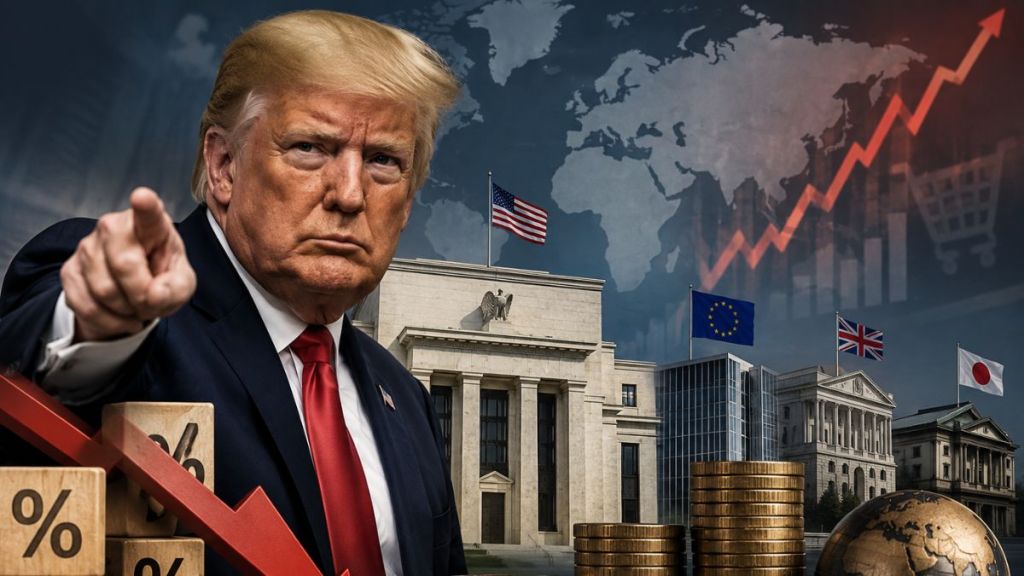

US President Donald Trump said on Sunday that no country should have lower interest rates than the United States, stepping up pressure on the Federal Reserve days before its next policy meeting as central banks around the world face renewed inflation risks.
Speaking to reporters at the Irish Open golf tournament, Trump said he did not know whether the Federal Reserve would raise interest rates at its meeting this week. He argued that the United States should have the lowest borrowing costs in the world, regardless of what economic and inflation data showed.
Trump said the US “should be paying the lowest interest rate in the world” and argued that the country’s strong credit position justified lower rates. “I know more about formulas than anybody, and with the best credit in the world, we make other countries rich,” Trump said on Sunday.
The Federal Reserve is due to announce its latest interest rate decision this week, with policymakers facing a difficult choice between persistent inflation pressures and concerns about the impact of high borrowing costs on the US economy.
The meeting comes after data showed a renewed rise in US inflation. A key measure of underlying inflation, the Consumer Price Index, posted its largest increase in four months on Friday, strengthening expectations that policymakers could consider higher interest rates.
Inflation puts pressure on the Fed
US inflation has remained above the Federal Reserve’s 2% target for more than five years. Annual US inflation stood at 3.4% in the latest data.
Rising oil prices have added to the inflation risks. Crude prices moved above $100 a barrel last week for the first time since July as the conflict involving the United States and Iran intensified, the Strait of Hormuz remained largely closed to tanker traffic and Houthi rebels threatened Saudi oil supplies.
Higher energy prices can feed into the economy by increasing transportation, production and household costs. A sustained rise in oil prices could therefore make it harder for the Federal Reserve to bring inflation back to its target.
Fed Chair Kevin Warsh is also facing pressure from Trump. Warsh was selected by the president and took charge of the central bank earlier this year, replacing Powell.
Trump has been a frequent critic of the Fed’s interest rate policy and has increasingly made his demand for lower rates explicit.
“LOWER THE RATE OR I’LL STOP TRADING WITH COUNTRIES WITH WHICH WE HAVE A DEFICIT,” Trump posted on social media two weeks ago.
Trump has also argued that high US interest rates benefit other countries at the expense of the United States by making it more expensive for the US government, businesses and consumers to borrow.
Warsh faces a test of Fed independence
The latest pressure puts Warsh in a difficult position as the central bank prepares for its policy meeting. Trump has been more supportive of the Fed’s leadership since Warsh, his own pick, became chair. His recent comments, however, have made clear that he still expects the central bank to follow a lower-rate path.
National Economic Council Director Kevin Hassett said Trump would defend Warsh’s independence regardless of the Fed’s decision. “Trump “will defend the independence of Kevin Warsh above all” no matter what the Fed does with interest rates,” Hassett told “Fox News Sunday.”
Hassett also acknowledged Trump’s preference for lower borrowing costs. “if it’s a rate hike … I’m sure he’s not going to be super happy about it,” Hassett said. The Fed’s decision will come only weeks before US midterm elections, when voters will decide whether Republicans retain their slim majorities in both chambers of Congress.
Higher interest rates could add to concerns about affordability among voters, particularly as households continue to deal with elevated prices. Recent Reuters/Ipsos polls have shown concerns over the cost of living, while Trump’s approval ratings have fallen as inflation has persisted.
Oil prices add to inflation risks
The rise in oil prices has complicated the outlook for central banks beyond the United States. Crude prices rose sharply last week as the conflict in the Middle East disrupted concerns about global energy supplies. The Strait of Hormuz, a critical route for global oil shipments, remained largely closed to tanker traffic, while attacks involving Houthi forces added to fears over supplies from Saudi Arabia.
Oil prices eased on Friday on hopes of talks to reopen the waterway but remained significantly higher than during the summer, when tensions in the Middle East had temporarily eased.
The increase in energy costs creates a difficult problem for central banks. Higher oil prices can push inflation higher even as they weaken household purchasing power and increase costs for businesses.
Federal Reserve policymakers therefore face the challenge of balancing the need to control inflation against the risks that tighter monetary policy could put further pressure on economic activity.
Bank of England weighs inflation and growth
The Bank of England is also facing renewed questions over interest rates. The British central bank is widely expected to keep its policy rate at 3.75% when policymakers meet on Thursday. Governor Andrew Bailey has taken a relatively calm approach to inflation that remains above target, arguing that higher mortgage rates have already done some of the work normally achieved through an interest rate increase.
Three of the nine members of the Bank of England’s Monetary Policy Committee voted for a rate increase in July. Stronger-than-expected economic growth data released on Friday could increase concerns about inflation and strengthen the case for tighter policy.
Thomas Pugh, chief economist at consultancy RSM, told The Guardian the latest increase in energy prices had “materially increased the chance that the MPC will eventually follow other major central banks and raise rates”.
Markets are now pricing in four UK rate increases over the next 12 months, compared with three expected before the latest surge in oil prices.
The Bank of England could therefore leave rates unchanged this week while taking a tougher position on inflation, a combination that would amount to what economists describe as a “hawkish hold”.
Japan moves towards higher rates
The Bank of Japan is also expected to raise interest rates this week. Japanese policymakers will announce their decision on Friday, with markets widely expecting a quarter-point increase that would take the policy rate to 1.25%.
Such a move would take Japanese interest rates to their highest level in more than 30 years, as the country continues its long shift away from the ultra-low interest rate policies used during its prolonged battle with deflation. The expected increase has also supported the Japanese yen in foreign exchange markets.
The US Treasury intervened with Japanese authorities in the foreign exchange market in July to support the yen. Treasury Secretary Scott Bessent has also made clear that he expects Japanese interest rates to rise.
“When we intervene with the Japanese yen, I have pretty good insight into what the Bank of Japan is going to do, what Japanese policymakers are going to do. I have asymmetric information. I am the house now. You can bet against me if you want,” Bessent said at an event at Southern Methodist University in Texas on Tuesday.
Global rate outlook becomes more uncertain
The European Central Bank raised interest rates on Thursday and warned that the Middle East conflict was adding to inflation pressures. ECB President Christine Lagarde said: “The conflict in the Middle East continues to generate inflation pressures, and inflation is set to remain well above target for an extended period.”
The contrasting pressures facing the world’s major central banks highlight the uncertainty confronting policymakers. Inflation remains above target in several major economies, while higher energy prices threaten to push it higher. At the same time, elevated interest rates are weighing on borrowing costs and economic activity. The Federal Reserve’s decision will be watched particularly closely because of Trump’s repeated calls for lower rates and the political pressure surrounding the US economy.
The major question for Fed is whether inflation has eased enough to allow borrowing costs to fall or whether renewed price pressures, particularly from energy, require a tighter policy stance. Trump has made his preference clear. The central bank must now decide how far it is willing to move against those demands while keeping its focus on its inflation and economic objectives.