


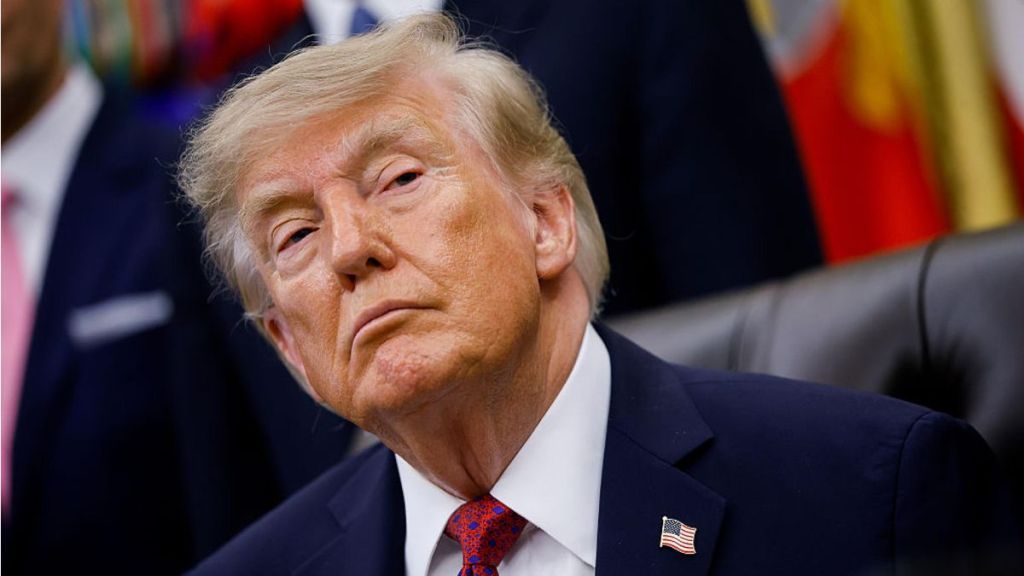

US President Donald Trump has initiated a new round of cuts to previously approved federal spending, with the White House putting the total value at nearly $1 billion.
In a statement issued on September 25, the White House said Trump was using a presidential authority known as a “pocket rescission” to stop funding for programmes that his administration considers “wasteful and harmful”. The targeted funding covers areas including healthcare, immigration services, education, housing, foreign programmes and research.
The largest proposed cut is $567 million from a Health and Human Services (HHS) funding account that the White House said supported services for refugees, asylum seekers and other non-citizens.
What is a ‘pocket rescission’?
A rescission means cancelling federal money that Congress had previously approved for a government programme. In other words, the money was already authorized for spending, but the administration seeks to take it back before it is spent.
A pocket rescission is a specific mechanism under the US Impoundment Control Act. Under this process, the president proposes cancelling previously approved funds and the money can be held back while the rescission process takes place.
It is therefore different from simply cutting a programme in the annual federal budget.
The White House says Trump used the same authority last year, describing that move as the first “pocket rescission” in 50 years. The latest announcement is another use of the same mechanism.
The administration says it is using the authority to prevent money from being spent on programmes it believes are unnecessary or do not fit its priorities.
How does the process work?
The money targeted by Trump was originally approved by Congress, which controls federal spending through legislation.
A president cannot simply rewrite every congressional spending decision. The Impoundment Control Act provides a legal process through which the president can ask for previously appropriated money to be rescinded.
In the latest case, the White House has identified specific programmes and amounts it wants removed from federal spending.
For example, the administration says $567 million in HHS funding is no longer required because of changes in the number of people crossing the US border. It has also targeted programmes involving migrant education, legal services for undocumented immigrants, international education and housing counselling.
The White House’s explanations are the administration’s stated reasons for seeking the cuts. They should not be treated as independent findings that the affected programmes or organisations were unlawful or had violated federal law.
Where is nearly $1 billion being cut?
The White House says the package covers funding across several departments and programmes.
- $567 million — HHS: Funding for programmes serving refugees, asylum seekers and other non-citizens.
- $15 million — Department of Homeland Security: Programmes that the White House says provided legal services, mental health services and cultural orientation to undocumented immigrants, asylum seekers and other non-citizens.
- $10 million — DHS: Funding for organisations providing legal services to undocumented immigrants.
- $25 million — Education Department: Special programmes for migrant students.
- $15 million — Justice Department: Community Relations Service funding, which the White House says is unnecessary because the agency was previously shut down.
- $9 million — Treasury: A programme linked to debt relief for foreign countries in exchange for climate-related domestic investments.
- $10 million — Minority Business Development Agency: Funding that the administration has targeted as part of its broader policy changes.
- $70 million — international education: Programmes supporting institutions that bring foreign students and faculty to the US.
- $28 million — HHS research: Programmes that the administration describes as wasteful, duplicative or ideological.
- $56 million — HUD: Housing counselling programmes funded through grants to non-governmental organisations.
- $5 million — HHS Office of Minority Health: Funding from the office’s programmes.
The White House also identified individual grants and recipients under some of these funding accounts. Those descriptions come from the administration and explain where it says some of the money had previously been allocated.
Why is Trump using this authority?
The White House says the move is part of Trump’s wider effort to reduce government spending. “President Trump is committed to utilizing all possible tools to cut wasteful and harmful government spending that does not benefit American citizens,” the White House said.
The administration has described the targeted programmes as wasteful, harmful or inconsistent with its priorities.
However, those are policy judgments made by the Trump administration. The White House statement does not say that all the programmes targeted in the package were illegal.
Hence, a rescission is about cancelling previously approved funding. It does not by itself mean that the programme or organisation receiving that funding was unlawful.
What does this mean for US federal spending?
The immediate impact is that the Trump administration is seeking to remove nearly $1 billion in previously approved federal funding from the programmes listed in the package.
The targeted areas also show where the administration’s spending priorities have shifted – particularly immigration services, migrant education, housing counselling, international education, research and diversity-related programmes.
The practical impact on individual programmes and their beneficiaries will depend on how the rescission process proceeds. The September 25 White House statement gives the amounts and the administration’s reasons for the cuts, but does not provide a detailed assessment of how each programme or its beneficiaries will be affected.