


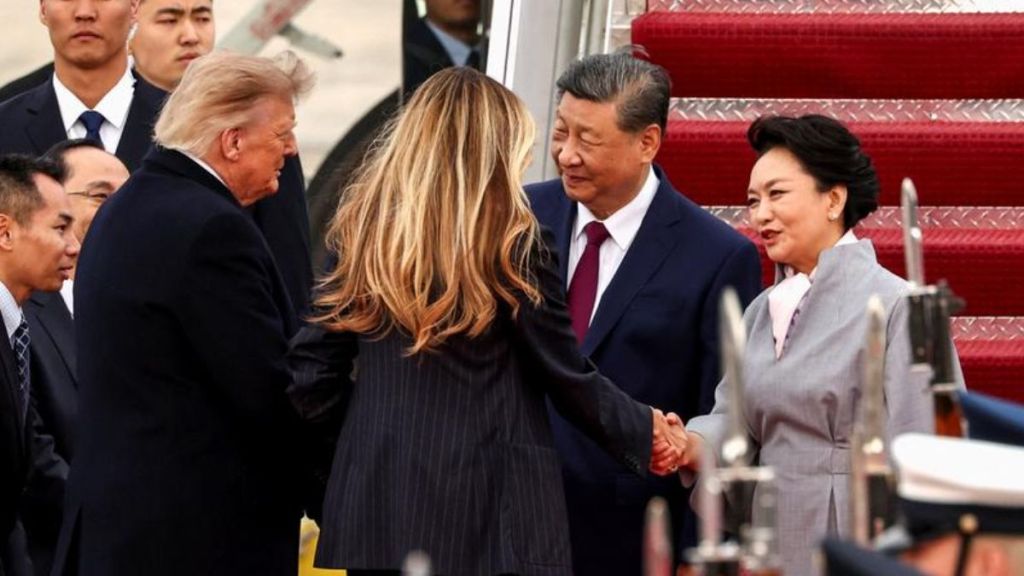

Chinese President Xi Jinping arrived in the United States on Wednesday for a three-day visit, with US President Donald Trump and First Lady Melania Trump breaking usual protocol to personally welcome him and his wife, Peng Liyuan, at the airport.
Xi’s aircraft landed at Joint Base Andrews on Wednesday evening, local time, marking the start of a closely watched visit that comes at a crucial time for US-China ties.
This is Xi’s second summit with Trump in less than six months. The two leaders are expected to discuss trade, technology, critical minerals and the broader relationship between the US and China.
Ahead of their talks, Washington and Beijing have also agreed to extend their trade tariff truce until January.
US and China extend trade truce
The welcome came as Washington and Beijing reached a fresh understanding on their trade dispute.
US Treasury Secretary Scott Bessent said the US and China had agreed to extend their trade war truce until January 10. The agreement had been due to expire on November 10.
The announcement followed several rounds of talks between Bessent and Chinese Vice Premier He Lifeng. The two officials held marathon discussions in New York on Sunday and again in Washington on Wednesday.
The announcement came just as Xi arrived in the US for his high-stakes meeting with Trump.
“We have agreed today that we will extend what we call the Busan agreement, the economic detente between the two countries that was scheduled to end on November 10th,” Bessent told Fox News.
“That is going to be extended until January 10th to give us more time to see what we can do on the economic front.”
Bessent later said the two sides had met to see whether they could reach a bigger deal instead of continuing with a series of smaller agreements.
“We met today to see if we could do a bigger deal as opposed to just a series of smaller things,” Bessent said. “We have agreed today that we will extend what we call the Busan agreement.”
What is the Busan agreement?
The Busan agreement refers to the trade truce that Trump and Xi agreed to in Busan, South Korea, in October last year. Under the agreement, the US and China agreed to reduce some of the tariffs they had imposed on each other. Washington also agreed to extend certain tariff exclusions.
The US had also agreed to suspend responsive actions following an investigation into China’s shipbuilding sector.
Bessent said on Wednesday that the two countries were also looking at the possibility of reducing tariffs on around $30 billion worth of goods that are considered non-sensitive.
The extension of the truce gives Washington and Beijing more time to work on their economic relationship as Trump and Xi begin their latest talks.
The two leaders are now expected to hold talks on the future of US-China relations, with trade and economic issues likely to remain central to their discussions.
What Trump and Xi are expected to discuss
Trade will be one of the main issues on the table, but the talks are expected to cover several other sensitive areas as well. The two leaders are expected to discuss chip export licences, although no final decision has been made on the issue so far.
Washington has already ruled out giving up its export controls on rare earth flows in exchange for concessions from Beijing, US officials told Reuters.
At the same time, officials are working on possible tariff cuts on a limited group of “non-strategic” goods. Such a move could benefit businesses in both countries.
Artificial intelligence is also expected to be an important part of the talks. The two sides have been discussing ideas that have not yet been agreed upon. These could include giving each side a preview of new AI models or extending oversight to Chinese open-source AI systems.
Fentanyl and Americans held in China
Washington is also continuing to pressure Beijing over the flow of chemicals used to make fentanyl.US officials are pressing China over the movement of fentanyl precursor chemicals to drug cartels in Mexico.
Trump is also expected to raise the cases of Americans who are being held in Chinese prisons during his talks with Xi.
Xi’s US visit comes just months after Trump travelled to Beijing in May. During that visit, Xi hosted Trump at the Great Hall of the People. The two leaders then agreed to what they described as a “constructive, strategic and stable relationship”.