


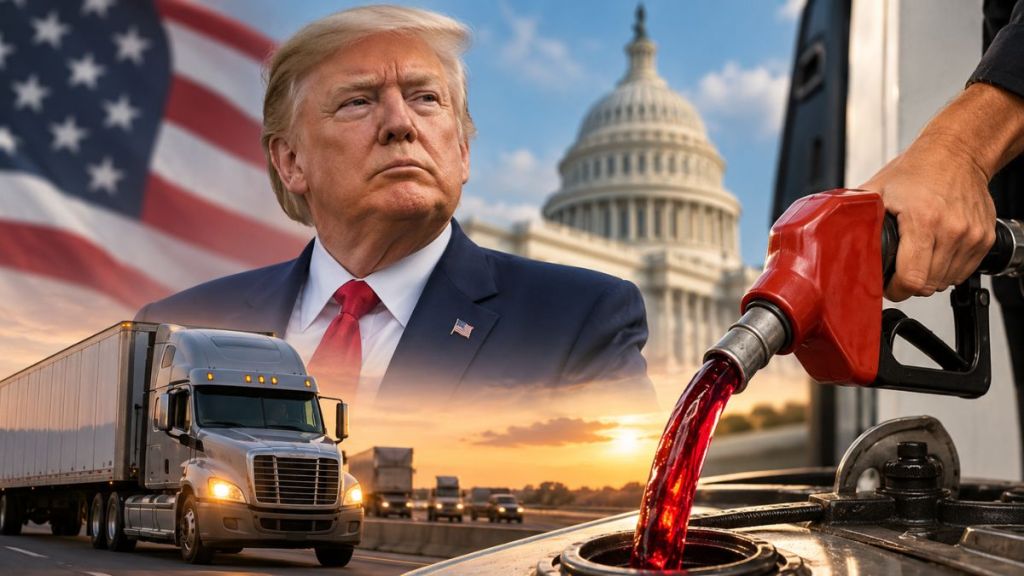

US President Donald Trump has signed an executive order temporarily expanding access to tax-exempt diesel as the country deals with sharply higher fuel prices.
The order allows off-road, red-dyed diesel to be used more widely, including for highway use; the federal excise tax normally applied to highway diesel will be deferred through the end of 2026. This is aimed at reducing fuel costs for truckers, farmers and other fuel users.
The White House said the measure is needed because of restricted global diesel supplies and rising prices. The US Energy Information Administration said the average US retail price of on-highway diesel was $6.38 per gallon on September 28, up $2.63 from a year earlier. Here is what the tax-exempt diesel policy means and why it is important
What is red-dyed diesel?
Red-dyed diesel is diesel fuel that is chemically dyed red to show that it is meant for uses that are normally exempt from federal fuel taxes.
The fuel is commonly used in farm equipment, construction machinery, heating and other off-road applications. It is cheaper than regular highway diesel because it is generally not subject to the federal excise tax imposed on fuel used on public roads.
The Internal Revenue Service says diesel fuel can qualify for the exemption when it is intended for a nontaxable use and is properly dyed. The dye allows authorities to identify the fuel and enforce rules against its illegal use. The distinction is important because regular highway diesel is taxed, while diesel intended for exempt uses is not.
Why is tax-exempt diesel cheaper?
The main reason is the federal fuel tax. The federal excise tax on diesel for highway use is generally 24.4 cents per gallon. The tax is made up of a 24.3-cent federal diesel tax and a 0.1-cent tax that finances the Leaking Underground Storage Tank Trust Fund.
State fuel taxes can also apply. A driver who normally buys highway diesel therefore pays the fuel price plus applicable federal and state taxes. A farmer buying properly dyed diesel for an eligible off-road use generally does not pay the federal highway fuel tax. The tax difference can become significant for people who use large amounts of diesel.
For example, 500 gallons of diesel would normally carry about $122 in federal fuel taxes at the 24.4-cent rate. The White House said the temporary relief could save truckers more than $100 per refill.
Why is Trump allowing it for highway use?
This comes as diesel prices have risen sharply in the US. According to the EIA, the national average price of on-highway diesel reached $6.53 per gallon on September 21 before easing to $6.38 per gallon on September 28. Prices include taxes.
Diesel is particularly important for the US economy because it powers a large part of the trucking and freight sector. It is also widely used in agriculture and other industries.
Higher diesel prices can increase the cost of transporting goods. The EIA has said high diesel prices can contribute to higher on-road and rail freight costs for goods.
The White House said restricted global diesel supply, the Russia-Ukraine war and a lack of refining capacity have contributed to higher prices.
Reuters has also reported that attacks and disruptions linked to the conflicts involving Iran and Russia have put pressure on refinery operations and global diesel supplies.
What exactly has Trump ordered?
Trump signed the executive order on October 5. The order directs the Treasury secretary to determine whether existing legal authority can be used to defer certain federal diesel tax payments for fuel used between October 5 and December 31, 2026.
If the relief is authorised, the deferred taxes would not carry penalties or interest. The order also directs the Treasury to explore ways to eliminate the obligation to pay the deferred taxes altogether.
The order also directs the Internal Revenue Service to announce that it will not impose certain penalties when dyed diesel is sold for or used on highways during the relief period.
The White House fact sheet describes the measure as a way to “temporarily allow off-road “dyed” diesel for highway use and defer the applicable Federal excise tax”.
Why is the tax normally imposed?
The tax system is designed to distinguish between fuel used on public roads and fuel used for exempt purposes. Highway users contribute through fuel taxes that help fund transportation infrastructure. Farmers and other users of off-road equipment generally receive tax treatment that reflects the fact that their vehicles and machinery are not using public highways in the same way.
Red dye makes the distinction easier to enforce. The IRS says penalties can apply when dyed fuel is knowingly used for a taxable purpose. Under normal rules, the back-up tax on dyed diesel delivered into the fuel tank of a diesel-powered highway vehicle is generally 24.4 cents per gallon. The current executive order provides temporary relief from those rules during the specified period.
Who could benefit from the change?
Truckers are one of the main groups expected to benefit because diesel is a major operating cost for long-haul transportation. Farmers could also benefit, particularly in areas where demand for diesel is high. The order directs the Agriculture Department to work with agricultural cooperatives, rural fuel distributors and other groups to ensure adequate supplies of dyed diesel in high-demand areas.
The Transportation Department has also been directed to coordinate with state governments, industry groups and labour organisations on implementation. The White House said the policy is intended to put money back into the pockets of “American farmers, truckers, and workers.”
Does this mean all diesel will become tax-free?
No. The measure is temporary and applies to the specific relief provided under the executive order and subsequent Treasury guidance.
The order covers the period from October 5 through December 31, 2026, subject to the legal authority and conditions determined by the Treasury Department. The Treasury is also required to issue guidance explaining who qualifies, which liabilities are covered and when any deferred taxes would otherwise have to be paid. The administration has asked the Treasury to explore whether the deferred taxes can ultimately be eliminated.
Why does the policy matter for consumers?
The immediate benefit is aimed at people and businesses that consume large amounts of diesel. Truckers use diesel to move goods across the country. Higher trucking costs can feed into the prices of goods because transportation is part of the supply chain.
The EIA has noted that diesel prices are affected by crude oil costs, refining margins, distribution costs and taxes. It also said tight global distillate supplies and higher crude prices have pushed diesel prices higher in recent months.
The White House therefore argues that reducing the tax burden on diesel users could help lower transportation costs.
The extent to which consumers ultimately see lower prices will depend on several factors, including diesel supply, refinery capacity, crude oil prices, state taxes and how much of the tax saving is passed through to customers.
What is the government doing beyond the tax relief?
The diesel order is part of a wider effort to address fuel prices. The White House has pointed to measures involving domestic energy production and support for farmers and truckers. Separately, the Group of Seven countries have agreed to release 100 million barrels of crude oil and diesel from emergency reserves, following pressure from Trump to increase fuel supplies. Reuters reported that it was not immediately clear how much of that release would represent additional supplies.
The administration’s diesel policy therefore addresses one part of the problem: the tax paid on highway fuel. It does not directly solve shortages of crude oil, refinery capacity or disruptions in global fuel markets.