


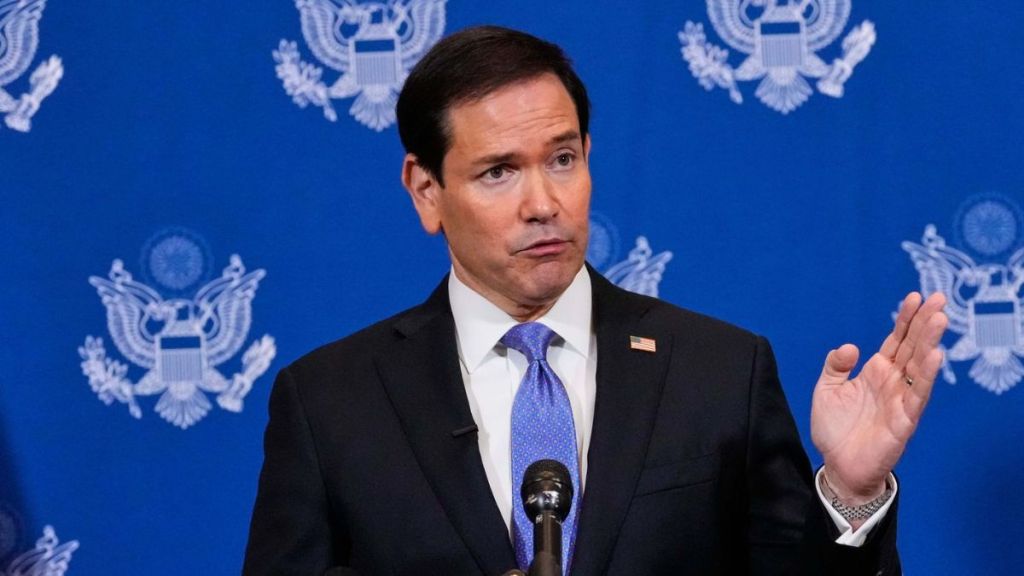

US Secretary of State Marco Rubio and External Affairs Minister S Jaishankar put forward two very different views on the global order during the UN General Assembly week in New York.
While Rubio said the international system was failing to deal with major conflicts, Jaishankar raised India’s concerns over a new US law that could allow Washington to impose higher tariffs on countries buying Russian energy. The two ministers also discussed the situation in the Gulf and Ukraine.
The developments came as world leaders gathered for the 81st session of the UN General Assembly, with wars, sanctions and questions over the future of the international system dominating discussions.
Rubio says international system ‘is not in good shape’
Speaking to reporters in New York, Rubio said the current international system was not doing enough to deal with major conflicts and crises.
“The international system is not in good shape right now…it would be great if we had a functional international system,” Rubio said.
He pointed to several conflicts and tensions, including the fighting between Thailand and Cambodia, the possibility of conflict between India and Pakistan, the situation involving the Democratic Republic of Congo and Rwanda, and Sudan and Iran in the straits.
“Right now, we don’t seem to have a functional international system that can address it. And in the absence of that, nation-states will act in their national interest… We will never put the international order above the interest of the United States,” Rubio said.
Rubio also said several world leaders had raised similar concerns. According to him, they believe the international system has moved beyond its original mandate and is now involved in issues it was not meant to handle.
He said the system has become unable to solve “virtually any major conflict in the world.”
Rubio’s reference to India and Pakistan comes against the backdrop of the military tensions between the two countries in 2025 following the Pahalgam terror attack in Jammu and Kashmir, in which 26 people were killed.
India launched Operation Sindoor on May 7, 2025, targeting terror infrastructure in Pakistan and Pakistan-occupied Jammu and Kashmir.
US President Donald Trump has repeatedly claimed credit for helping stop the hostilities. New Delhi has rejected that claim and maintained that the understanding to stop the fighting was reached through direct India-Pakistan channels.
Jaishankar raises India’s concerns over Russia sanctions law
On the same day, Jaishankar met Rubio on the sidelines of the UN General Assembly.
The main issue for India was the newly enacted Lindsey O. Graham Sanctioning Russia and Iran Act of 2026, also known as SRIA. President Donald Trump signed the law on September 18. The law expands US sanctions against Russia and Iran and gives the US president additional tariff powers.
After the meeting, Jaishankar said he had “reiterated India’s interests and concerns with regard to SRIA (Sanctioning Russia and Iran Act).”
The two ministers also discussed the situations in the Gulf and Ukraine.
The law allows the US president to impose tariffs of up to 100% under specified conditions on goods from countries that continue certain purchases of Russian energy. However, the law does not automatically put a 100% tariff on Indian goods. Any such move would require the Trump administration to use the powers provided under the law and meet the conditions set out in it.
India has already raised concerns with Washington, particularly over the possible impact on bilateral trade, ties and energy security. New Delhi has maintained that its energy decisions are linked to the need to protect the energy needs of its 1.4 billion people and are based on available supplies and market conditions.
How the Russia sanctions law reached Trump
The legislation cleared both chambers of the US Congress before Trump signed it.
The House of Representatives passed it 262-159 on September 16, while the Senate had passed it 86-11 in August.
The Russia-related provisions target Russian officials, financial institutions, the energy sector and vessels linked to the movement of Russian oil. The law also extends the US sanctions framework against Iran.
The White House said the law expands sanctions, tariffs and other restrictions related to Russia and extends existing sanctions on Iran.
The issue has also drawn attention from Ukrainian President Volodymyr Zelenskyy.
Zelenskyy has been calling on India, China and Turkey to reduce their energy ties with Russia. His argument is that Russia depends heavily on energy trade with these countries to support its economy and continue the war in Ukraine.
Rubio keeps public tone positive after Jaishankar meeting
Despite India’s concerns over the new sanctions law, Rubio’s public message after meeting Jaishankar focused on continuing cooperation.
In a post on X, Rubio said: “Great to meet with Indian External Affairs Minister @DrSJaishankar in New York today. Together, we are building on the US-India strategic partnership and coordinating on key regional priorities and upcoming multilateral efforts.”
Rubio is also expected to visit India again in October. Indian Express reported that preparations were underway for the visit, while other reports have put the visit in the third week of October.
Jaishankar pushes for UN Security Council reform
Jaishankar’s UNGA agenda went beyond the meeting with Rubio.
He also pushed India’s long-standing demand for reform of the UN Security Council. At a ministerial meeting involving the L.69 group, India argued that the UN has not been able to respond effectively to several major global conflicts and challenges.
Jaishankar has argued that continued delays in Security Council reform amount to a continuation of historical injustice. Members of the L.69 and C.10 groups are working together to keep the reform effort moving.
Jaishankar also spoke about India’s growing ties with Pacific Island countries through FIPIC and the India-UN Development Partnership Fund. He said 12 Pacific nations have asked India for 20 sea ambulances, with work already underway and deliveries expected by late March. India has also proposed training programmes based on the needs of these countries, with participants travelling to India for training.