


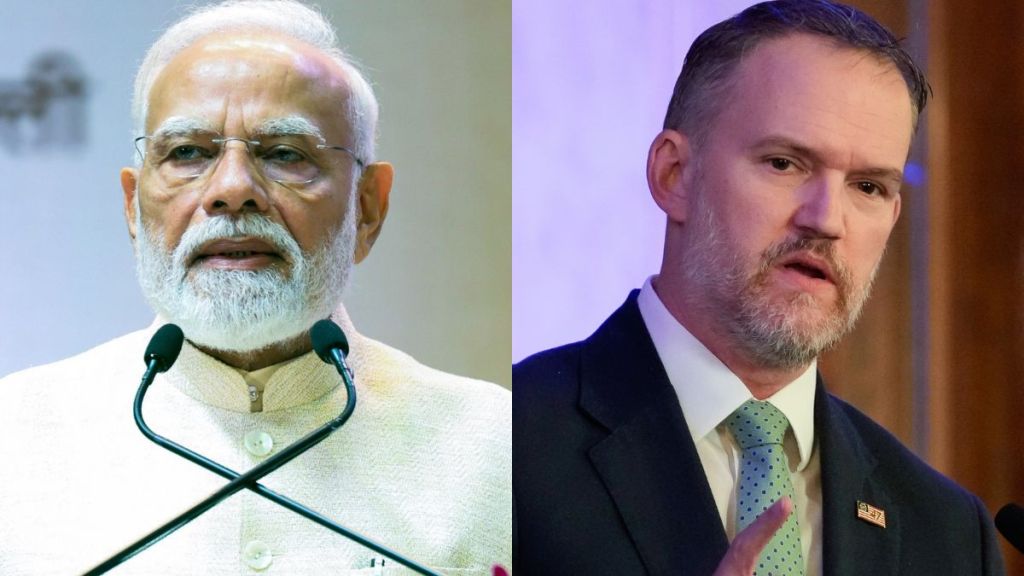

Despite Prime Minister Narendra Modi and US President Donald Trump engaging in “constructive” talks to review their countries’ bilateral ties, US Trade Representative Jamieson Greer has expressed skepticism about an immediate India-US trade deal.
The top leaders’ telephonic conversation on Wednesday coincided with Greer’s own meeting with Commerce and Industry Minister Piyush Goyal on the sidelines of the G20 Trade Ministers’ Meeting in Milwaukee, United States. The Trump administration official has since hinted that the POTUS and PM Modi will speak again soon to assess progress as negotiations between both sides near their final phase.
Amid an ongoing visit to the United States, Goyal is set to meet US counterparts to advance a “balanced and mutually beneficial” India-US Bilateral Trade Agreement, as revealed days ago.
The US-India trade deal has been severely stalled over the past year, especially due to the US tariff landscape further complicating negotiations. Despite previously announcing the finalisation of the framework for the first phase of the bilateral trade agreement in February, India has repeatedly asked for improved terms in the proposed deal. Earlier this month, New Delhi told Washington that renewed US tariffs tied to India’s purchase of Russian oil could impact relations between the countries.
Greer says Trump and Modi could speak again
During the QnA segment at the 2026 G20 Trade Ministers Meeting, Jamieson Greer told ANI that talks between the US and India were in the “short strokes,” suggesting they were in the final stretch and nearing conclusion. “I think we’re toward the end of it.”
Greer said that he believed Trump and Modi “may have another call very soon on this just to assess progress and where we are,” according to ANI.
However, he asserted that a quick announcement wasn’t likely even as both sides had mapped out crucial issues underlining bilateral ties.
“I don’t think there’s something imminent, but we truly have identified the universe of items that are sticking points, and we’re working diligently toward them.”
Recent US-India talks signal hope for potential bilateral trade deal
Back in September, India’s Piyush Goyal said that the deal between the US and India was “done and dusted” and would be implemented as soon as America grants India an appropriate competitive edge over rivals, including China, Bangladesh, and ASEAN member states, in the US market.
Before meeting Greer on Wednesday, Goyal shared insight into how their interaction would proceed, with India focused on engaging bilaterally with the US to “advance a balanced and mutually beneficial India-US Bilateral Trade Agreement (BTA) and finalise an interim deal in line with the Joint Statement of 7 February 2026.”
Having met his US counterpart, the Indian minister has since shared on X that they had a “productive discussion” towards “early conclusion of a mutually beneficial interim agreement” under the BTA.
Greer also called the conversation a “constructive” one, asserting that the US was “continually trying to finish the trade deal with India.”
Meanwhile, Modi and Trump, who spoke over a phone call the same day, reviewed bilateral cooperation in trade, defence, energy and critical technologies, according to a subsequently released statement from the PMO’s office. Both leaders also discussed regional and international developments.
“The leaders reaffirmed their commitment to advancing the India-US Comprehensive Global Strategic Partnership and agreed to maintain close engagement to deepen cooperation,” the statement added.
Before these recent interactions, External Affairs Minister Dr S Jaishankar said that a concluded trade agreement would contribute to “better” ties between the two countries.
Acknowledging that the agreement had been long stalled while speaking at an event organised by the Asia Society in New York, he also pointed out how “much of the world had had a more difficult relationship with the US.”
“I mean that may not be a consolation, but that’s a reality,” Jaishankar added.
At the same time, the foreign minister still noted that changes related to US tariff policies could affect the agreement.
“The 301 process is still in the works; it’s still unfolding. So the issue for us is at what point do you close out an agreement which is very, very far advanced,” he continued. “But the period that it took to reach it, that did create bumps last year for the relationship. So presumably, if that agreement is closed out, that would be one point which would contribute to a better relationship.”
Jaishankar’s remarks allude to the US imposing an additional 10% tariff on Indian goods in July under Section 301 of the Trade Act. This came after a probe into India’s measures tied to goods produced with “forced labor.” This particular framework was adopted by the Trump administration after the US Supreme Court in February struck down the Republican leader’s wide-ranging reciprocal tariffs imposed on all US trading partners, invoking emergency economic powers.