


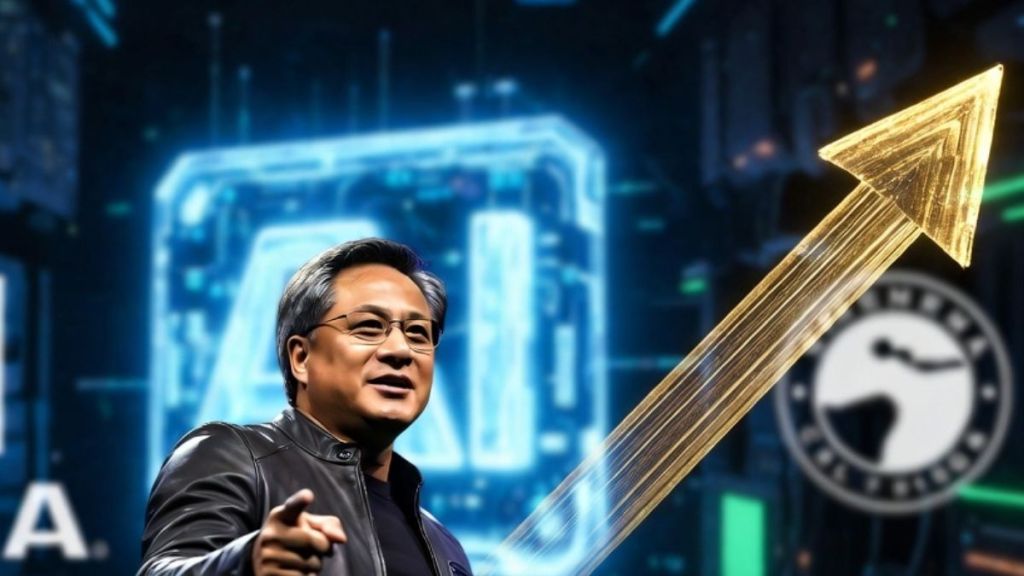

Nvidia’s CEO Jensen Huang has witnessed a major boost in his fortune after the ‘World Leader in AI Computing ‘ confirmed that it was acquiring the New York City-based company, Hugging Face, in a $12.9 billion deal. Huang jumped to the No 8 spot on the Forbes Real-Time Billionaires list on Friday, sitting just behind Oracle co-founder Larry Ellison with an estimated net worth close to the $200-billion mark.
Forbes’ Billionaires list, last updated at 1 a.m. EDT on September 5, still showed the Nvidia chief executive as the eighth-richest person in the world, with an estimated net worth of $198.8 billion. Bloomberg’s Billionaire Index also retains the same ranking for Huang, but records a slightly lower net worth of $191 billion.
In addition to his overall rank across the globe, Forbes’ America’s Richest Immigrants list, released in July, put Huang, who is the son of Taiwanese immigrant parents, at the No 3 spot, just behind South Africa-born Elon Musk and Russian-origin Google co-founder Sergey Brin. Both occupy the first and fifth positions with net worth more than $900 billion and $255 billion, respectively, on the World’s Real-Time Billionaires list.
Jensen Huang’s net worth is linked to his Nvidia stake
The self-made semiconductor titan’s wealth is almost entirely dependent on his approximately 3% stake in Nvidia, the chip-maker he co-founded in 1993 and then took public in 1999.
As a result, the recent 1.1% boost to his net worth was contingent on the company’s shares experiencing a surge after the confirmation of the Hugging Face deal. On Friday, the company’s shares traded up a little over 1.5%, continuing a positive streak secured in the last few days of trading that helped raise its stock 6.3%, according to Forbes.
Overall, the company’s stock has risen 24% since the start of 2026, hitting around $231 per share after settling around $188 per share in January, as per the Forbes report published Friday. Huang’s $5.4 trillion company has earned a spot among the world’s largest corporate backers of tech companies, as it continues to expand its ecosystem. Its equity investments were valued at $99 billion as of July 26, up from about $7 billion the previous year, according to CNBC.
Preceding Huang by a few billion dollars, Oracle’s co-founder Larry Ellison enjoys his spot as the world’s No. 7 richest billionaire with a net worth of $202.4 billion, according to Forbes’ latest update on Saturday. The recent revision of the website’s Real-Time Billionaires list also confirms that he was the second-biggest gainer of the day, enjoying a 2.09% boost to his fortune.
Although no longer a trillionaire, SpaceX and Tesla CEO Elon Musk still remains the richest man in the world with an estimated net worth of $908.2 billion.
How did the Nvidia-Hugging Face deal come about?
Huang announced in a company blog post, dated September 3, that Nvidia had agreed to buy Hugging Face for $12,930,300,000 with a goal to scale the open-source AI platform, strengthen its infrastructure, and expand access to AI for developers and institutions worldwide. It makes for Nvidia’s second-biggest purchase, after the $20 billion acquisition of chipmaker Groq’s assets at the end of 2025.
“As the opportunity for open models accelerates, Hugging Face can serve the global AI community at unprecedented scale. NVIDIA’s infrastructure, engineering and global reach can help improve platform reliability, safety, model evaluation, inference and deployment capabilities, while preserving the open ecosystem that made Hugging Face foundational,” the Nvidia CEO added in his note, highlighting that Hugging Face CEO Clément Delangue came to him as he considered the platform’s next chapter.
Delangue painted a similar narrative in a recent interview with CNBC, noting that Hugging Face first approached Huang over the summer about a deal upon the realisation that both the company and open-source AI in general “needed more resources, more scale, more visibility.” The platform’s CEO affirms that he reached out first, seeing Nvidia as “a perfect home” for Hugging Face.
During the conversation with CNBC, he also brought up the recent cyberattack against his company and attributed it to engineering mistakes. He further disclosed that the open-source AI platform ultimately used an Nvidia version of a Chinese open model to resolve the issue. Delangue asserted that the breach, in turn, consolidated his belief in the importance of open model, pushing his company to “double down” on their proliferation.
Recognising the need to bet on open AI models, Huang maintained in his blog post that Nvidia’s acquisition of Delangue’s company wouldn’t alter its signature identity: “Hugging Face will remain an open platform for the entire AI ecosystem.”
The Nvidia CEO also acknowledged that such models “broaden access to AI and help ensure that AI leadership is distributed across companies, institutions and communities,” and “enable organisations to match the right model to the right job.”
As part of the massive deal, the chip giant will pay about $11.9 billion to Hugging Face investors, in addition to extending an equity-based retention program of up to $1 billion for employees who eventually join Nvidia, Reuters reported.