


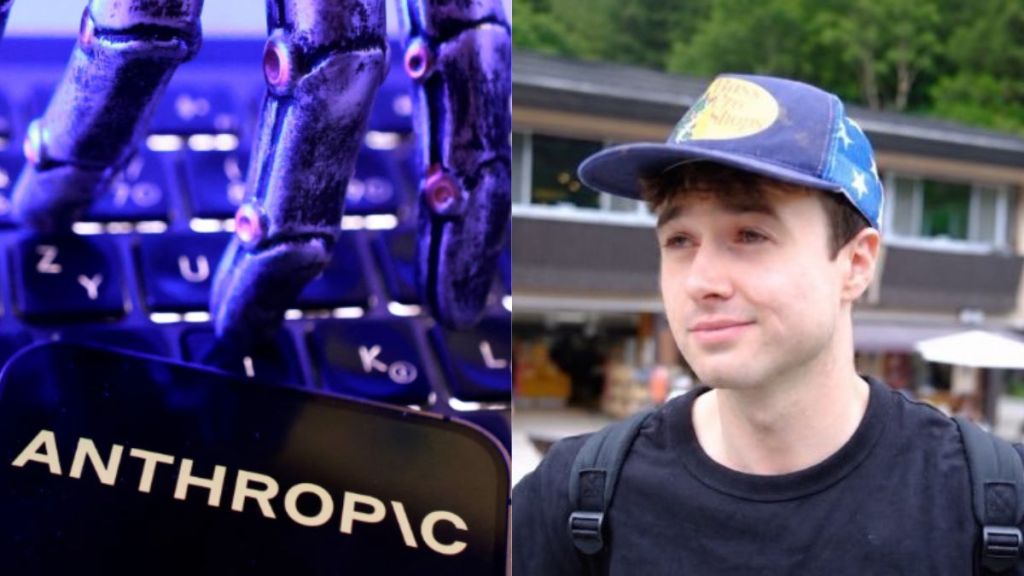

The artificial intelligence industry is witnessing a seemingly endless streak of reshuffling as several rising companies, including Anthropic and OpenAI, prepare for their Nasdaq debut. While many business headlines have largely reduced this series of resignations to how they are happening “ahead of IPO(s),” some researchers are choosing to sound the alarm on the AI boom as a whole.
Jacob Coxon, an Anthropic researcher who has not only decided to leave his post at the Dario Amodei-led startup but has also chosen to quit the AI industry, joined the list on Tuesday (US time). But that’s not all. In his lengthy exit post, Coxon consciously spoke out against serious AI safety concerns that influenced his decision. Jacob, who also previously worked at OpenAI, urged the world not to underestimate the power of AI.
The former Anthropic and OpenAI employee accused both his old companies of acting irresponsibly and “racing straight to self-improving superintelligence and gambling with our lives.”
As AI startups have quickly transformed into leading tech giants and companies continue investing billions of dollars into advancing technology, Jacob’s social media confession has left behind a dire existential warning to ponder, contrary to the media’s focus on “blockbuster” IPO races. His departure and exit message have especially emerged as a hard-hitting shocker since he wasn’t just any other employee at Anthropic, but a reseacher who specialised in training new AI models by having them consume massive amounts of data, according to the Wall Street Journal.
Back in February, Anthropic’s then-AI safety researcher Mrinank Sharma pulled a similar move by quitting the US firm to pursue writing and studying poetry. The “world is in peril,” he wrote behind the cryptic message, while sharing his resignation letter on X.
A common response is “if they truly believe this, why are they still building it?” At OpenAI, many have not deeply internalized the civilizational stakes. At Anthropic, the stakes are well-understood, but they are locked in a race to get there first – they believe no one else…— Jacob Coxon (@hilbertspaess) September 9, 2026
Ex-Anthropic researcher pens existential AI risk warning
“The people building AI earnestly believe that it could kill us all by the end of the decade,” Coxon warned on X.
Evan Hubinger, an ‘Alignment Science Lead’ at Anthropic, also agreed with Jacob’s premonition, stating online, “we really do earnestly believe AI could kill all humans! I personally think it is >10% within the next decade.” Although Coxon decided to walk away from AI, Hubinger asserted that Anthropic is “trying its best,” but it neither has a plan to “solve alignment for superintelligence,” nor are they on track to achieve it.
Coxon then goes on to raise a question many others would be mulling over: “If they truly believe this, why are they still building it?” He answers the question by illuminating the split between both his work places, OpenAI and Anthropic.
To be clear, as we say in our latest Risk Report (https://t.co/9PDj8Uvoty), I think the risk from present models is low. What I am worried about is superintelligence arising from recursive self-improvement, as we have said is happening faster than we thought…— Evan Hubinger (@EvanHub) September 9, 2026
The former AI researcher claimed that many at OpenAI “have not deeply internalised the civilisational stakes.” Meanwhile, the stakes are “well-understood” at Anthropic, but they are “locked in a race to get there first – they believe no one else will act responsibly, so they must do it themselves, despite the risk.”
“Accepting this race and entering the ‘endgame’ is a hubristic gamble that should not be launched from a private company’s Slack. Attempting to speedrun alignment should require extraordinary confidence that there are no better trajectories available,” he added in the lengthy X confession.
Having left OpenAI earlier this year, the 27-year-old Brit ultimately joined Anthropic, believing in its model-safety efforts. However, as documented in his Anthropic resignation post, he doesn’t find either of them can responsibly contribute to the development of AI.
OpenAI’s chief scientist had a similar message
Coxon isn’t the only person in the industry to have spoken out at length on the issue. His dire warning, in turn, surfaced days after OpenAI’s chief scientist Jakub Pachocki called for “extreme caution” over the company’s progress, as he shed light on the need for more intervention to ensure “humans remain in control of the future.”
In a blog post titled ‘An Alien Mind,‘ he wrote, “I am concerned no one is prepared for the consequences of a continued rapid rise in machine intelligence.”
Pachocki’s post made headlines as leading AI labs rally behind AGI, or artificial general intelligence, while debate on how to describe it also grows. Meanwhile, his own company released a more powerful AI model called GPT-6 Astra in early September. Like Coxon, the OpenAI scientist echoed the warning that “no lab has solved alignment and monitoring to a sufficient degree to continue responsibly scaling at maximum speed for much longer.”
“Welcome to the AGI era,” OpenAI President Greg Brockman proclaimed in a press briefing announcing the launch.
OpenAI has defined AGI as systems that can outperform human at most economically useful tasks, according to Bloomberg. On the contrary, Google DeepMind’s 2023 paper downplays the focus on economic value, driving attention towards AI surpassing humans at useful work or learning new skills with little data.
Why leading AI scientists are calling for a slowdown in AI race
The OpenAI chief scientist was also among several top AI figures to sign a statement titled “Pacing the Frontier” in July, which again made a case for slowing down the development of advanced AI. Warning the world of the outcome of AI is “not guaranteed,” the statement said that to “realize AI’s potential, industry, government, and society at large may need the option to buy time to address emerging risks, develop security measures, and strengthen oversight.”
High-profile signatories included Anthropic co-founders Dario Amodei, Jack Clark, Chris Olah, Benjamin Mann and Jared Kaplan, Meta AI chief scientist Shengjia Zhao, Shane Legg, Co-Founder & Chief AGI Scientist at Google DeepMind, and many others. A total of 1,386 employees of frontier AI companies have since signed the open letter.
Pointing out how companies are under intense competitive pressure not to unilaterally slow down, they urged the US government to “support an international effort to develop the technical and governance tools needed to deliberately pace the frontier of automated AI development.”
Speaking at the presentation of Pope Leo’s first encyclical in May, Anthropic’s co-founder Chris Olah even stressed that there was a “real possibility” that AI will displace human workers “at very large scale,” as he noted that AI must be guided from outside Big Tech as well.
All these heart-rending AI-related warnings of the future come as the present also continues to be adversely affected by the booming tech. Countless tech companies, including Meta, PayPal, Microsoft and Amazon, have attributed massive layoff plans introduced as part of cost-cutting measures to going AI-first.
According to the real-time tracker Layoffs. fyi, 129,488 tech employees have so far been laid off across 297 tech companies in 2026.