


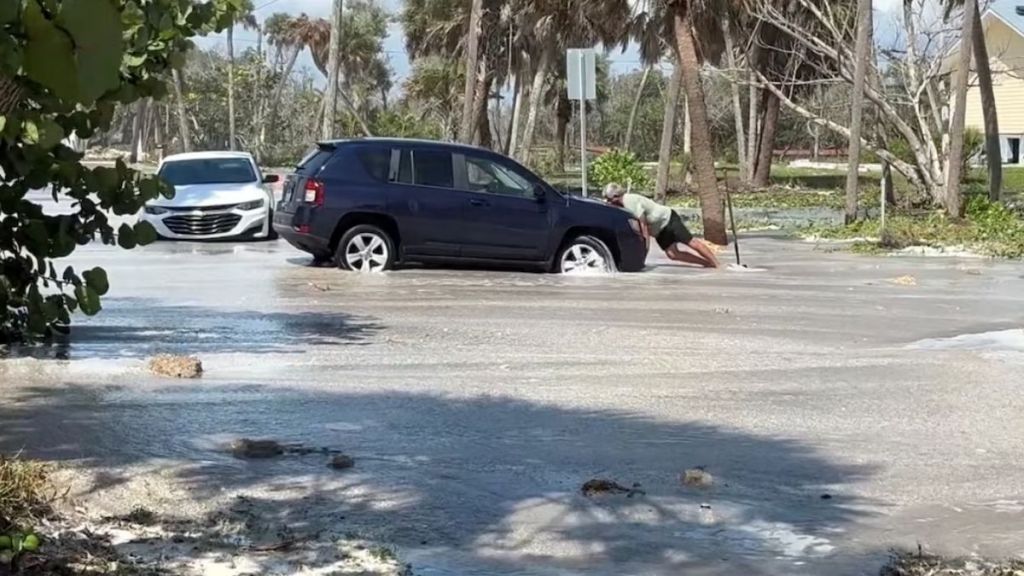

Hurricane Isaias left over 900,000 electricity customers without power across Florida, Alabama and Georgia after making landfall near Destin, Florida, on Saturday. The storm weakened rapidly as it moved inland, but the threat of flash flooding, damaging winds and tornadoes persisted across parts of the southeastern United States, reported AP.
The National Hurricane Center (NHC) said Isaias had weakened into a post-tropical cyclone by early Saturday, with maximum sustained winds falling to 35 mph (55 kmph) as it moved across Alabama.
However, forecasters warned that 4 to 8 inches (10 to 20 centimetres) of rain could fall across southern Alabama, Florida’s Panhandle and the Big Bend region over the weekend.
Isaias was the first hurricane of the 2026 Atlantic season to make landfall on the US coast, reported AP. Its passage flooded roads, damaged buildings and infrastructure, and disrupted electricity supplies.
What damage has Hurricane Isaias caused?
Communities along the Gulf Coast reported flooded roads, fallen trees and damaged power lines after the storm made landfall.
In Pensacola, Mayor D.C. Reeves said the airport had sustained damage, while parts of downtown experienced power outages. A hotel roof was also reportedly torn away by strong winds.
Mobile, Alabama, reported fallen trees and power lines, while roads in Houston County were closed because of dangerous conditions. The Alabama Emergency Management Agency said the closures would remain in place until officials determined that travel was safe.
Some counties in Florida’s Panhandle temporarily suspended emergency response operations on Friday night because conditions had become too dangerous for crews to work safely.
More than 915,000 electricity customers across Florida, Alabama and Georgia were without power early Saturday, AP reported, citing PowerOutage. Over 430,000 outages in Florida and nearly 297,000 in Alabama as the storm hit the coast, reported Reuters.
The outages affected homes and businesses, while debris and blocked roads complicated travel and recovery efforts. The full extent of the damage and the timeline for restoring electricity were not immediately clear.
The storm also disrupted air travel. Most Friday flights at several airports in the Florida Panhandle were grounded, while Destin-Fort Walton Beach Airport suspended all flights into and out of the airport that day, reported AP.
What threats remain after landfall?
Although Isaias had lost hurricane strength, forecasters warned that heavy rainfall and severe weather could continue as the system moved inland.
The NHC said early Saturday that the storm was about 25 miles (40 kilometres) south-southwest of Montgomery, Alabama, and nearly 105 miles (170 kilometres) south of Birmingham. It was expected to move towards the Tennessee Valley later on Saturday and Sunday while continuing to weaken.
The NHC had discontinued tropical-storm and storm-surge warnings by its 4 am Central Daylight Time advisory on Saturday. However, the risk of flash flooding remained, particularly in areas forecast to receive 4 to 8 inches of rain.
Heavy rainfall can overwhelm drainage systems, flood roads and homes, and trigger flash floods. Forecasters also warned that tornadoes could develop across parts of the Florida Panhandle, Georgia and the Carolinas.
Authorities urged residents to avoid flooded roads and fallen power lines, follow local emergency instructions and remain alert to changing conditions.
Homeland Security Secretary Markwayne Mullin said emergency declarations had been approved for Florida and Alabama, making federal resources available to support the response.
President Donald Trump cancelled plans to attend Saturday’s football game between the University of Georgia and the University of Alabama in Tuscaloosa. He said he did not want his visit to disrupt emergency response efforts.