



The race to build the infrastructure required for artificial intelligence is creating a new set of challenges for technology companies, that is finding enough electricity.
Data centers are consuming increasing amounts of power as companies expand their AI capabilities, build massive computing facilities and install thousands of power-hungry servers. The problem is no longer simply about finding land or building data centers quickly. Access to reliable electricity has become one of the biggest bottlenecks in the next phase of the technology boom.
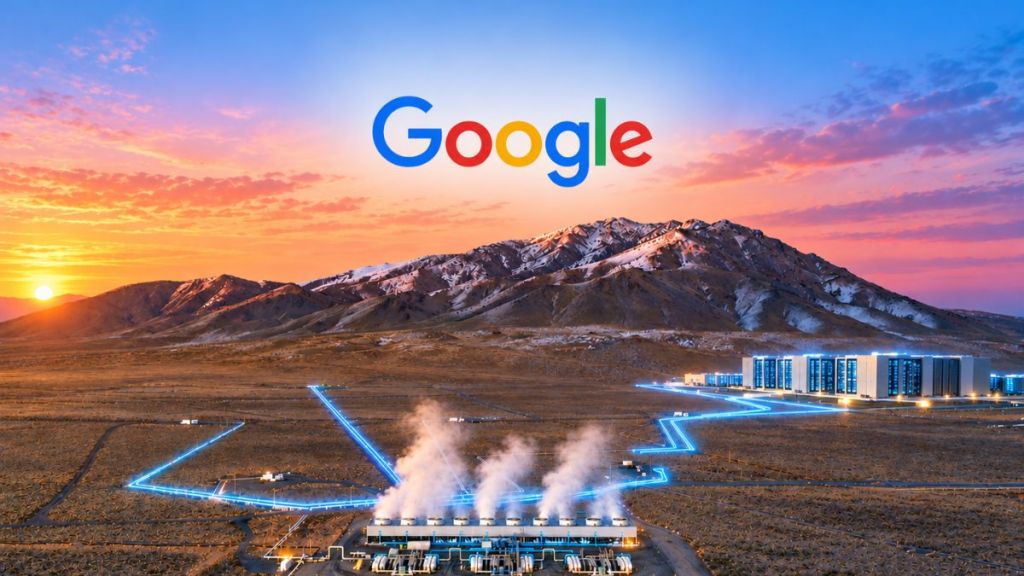
Google’s latest deal with geothermal energy company Fervo Energy gives us a glimpse into how technology companies could try to solve that problem.
Under a new agreement, Fervo will supply Google with 396 megawatts of electricity from its Cape Station geothermal project in southwestern Utah, with power expected to become available in 2028. Google also has the option to purchase another 600 megawatts by June 2030, potentially taking the total capacity close to 1 gigawatt.
The agreement is being described as the largest enhanced geothermal power purchase agreement of its kind. It could also become an important test case for a much bigger question facing the technology industry, Can next-generation geothermal energy help power the rapidly expanding data center economy?
For years, solar and wind have been central to corporate clean energy strategies. Both sources, however, depend on weather conditions. Data centers need electricity around the clock, every day of the year.Enhanced geothermal energy could give something different.
It can potentially provide steady, emissions-free electricity regardless of whether the sun is shining or the wind is blowing. Fervo believes advances in drilling technology could allow geothermal projects to be developed in far more locations than traditional geothermal plants.
For Google, the Utah deal comes at a time when access to power is becoming increasingly valuable. For Fervo, the agreement gives its ambitious geothermal expansion plans and a major commercial endorsement. The deal could have implications far beyond one project in Utah.
AI boom is becoming a power boom
The rapid growth of artificial intelligence has transformed the conversation around electricity demand in the United States. For decades, electricity demand in many parts of the country remained relatively flat. That has changed as hyperscalers, utilities and other large customers look for new sources of electricity.
Fervo CEO Tim Latimer says the change has been dramatic. “It’s a total transformation from 10 years ago, when people were questioning even the need for more new electricity,” Latimer told CNBC. “This is a once-in-a-generation boom moment where hyperscalers, utilities and other customers need [power] now, and it’s our power that will be an important part of the electric grid,” Latimer added, according to CNBC.
The surge in demand is creating a difficult situation for companies planning large data center campuses. Connecting new facilities to the electricity grid can take years. Utilities are dealing with growing demand from data centers, manufacturing projects and other industries. Developers also face delays in securing equipment needed to build new power plants.
The situation has become serious enough that companies are increasingly looking beyond traditional electricity sources. Natural gas plants can provide reliable power, though they produce carbon emissions. New nuclear projects can offer carbon-free electricity, though they often take years to get permission, build and go digital. Renewable energy sources such as wind and solar are expanding rapidly, though their output can vary depending on weather conditions.
Geothermal energy is attracting attention because it can potentially solve several of those problems at once. It can operate around the clock. It has a relatively small land footprint compared with some other renewable energy projects. Enhanced geothermal systems could also be developed in more places than conventional geothermal facilities.
“Potentially expanding to a gigawatt by 2030, that’s really fast,” Logan Mitchell, a climate scientist and energy analyst with Utah Clean Energy, told CNBC. “In the data center world, speed to power is a precious commodity.” This could become one of geothermal energy’s biggest advantages in the AI era.
Why Google is betting on Fervo
Google and Fervo have been working together for several years.The companies first signed an agreement in 2021 to develop next-generation geothermal technology. Fervo later began operating a 3.5-megawatt commercial pilot project in Nevada in 2023.
Google has also previously worked with Fervo and utility NV Energy on a 115-megawatt power purchase agreement connected to geothermal development in Nevada.
The Utah agreement represents a much bigger commitment. Fervo will supply 396 megawatts from its Cape Station project near Milford through the development of an enhanced geothermal systems GeoCluster. Google has the option to increase its purchases by around 600 megawatts by June 2030.
The total capacity could approach 1 gigawatt. It is a significant amount of electricity. According to the Salt Lake Tribune, the combined capacity would be roughly equivalent to one quarter of the power currently consumed across Utah.
Google has not yet finalised the location of the potential Utah data center that could use the electricity. Final plans remain subject to regulatory approvals, engineering and market conditions.
The company has, however, made clear that it sees geothermal energy as an important part of its future power strategy.
“The next chapter of advanced power generation technology is being written in Utah,” Michael Terrell, Head of Advanced Energy at Google. “This project will drive meaningful economic benefit to the local community … by making enhanced geothermal more affordable and accessible.”
The importance of the deal goes beyond the amount of power involved. Google is effectively providing a major commercial validation for a technology that has long been viewed as promising but difficult to scale.
For a young company like Fervo, securing a large customer can also make it easier to raise money and finance future projects. Energy infrastructure projects require billions of dollars in investment, and lenders generally want confidence that someone will buy the electricity before providing large amounts of financing.
“Securing deals with major clients like Google validates Fervo’s model, making it easier to attract future contracts and secure project financing from lenders that require guaranteed revenue before funding drilling.” The relationship between customers, financing and construction could become increasingly important as the AI boom pushes demand for electricity higher.
A different way of producing geothermal power
Geothermal energy is not new. Traditional geothermal power plants have operated for decades by tapping naturally occurring underground reservoirs of hot water and steam. The biggest limitation has always been geography.
Companies need the right geological conditions. Natural reservoirs are not available everywhere.Enhanced geothermal systems are designed to change that. Instead of depending entirely on naturally occurring reservoirs, companies such as Fervo create their own underground systems.
The company drills deep into hot rock and uses water to capture heat from underground. The heated water returns to the surface, where it passes through equipment that generates electricity. The water is then cooled and reinjected into the ground.
At Cape Station, Fervo drills a pair of wells more than two miles deep. One of the wells can extend horizontally for more than a mile.
The company creates fractures in the surrounding rock before sending water through an injection well. Underground temperatures exceed 400 degrees Fahrenheit. The heated water returns through a separate production well and is used to generate electricity.
The geothermal brine is then cooled and reinjected into the ground through what the company describes as a closed-loop system. The process has similarities with drilling and hydraulic fracturing techniques developed by the oil and gas industry.
Fervo was founded by people with experience in that sector. Tim Latimer began his career as a drilling engineer in South Texas before founding Fervo in 2017 with Chief Technology Officer Jack Norbeck.
The company faced skepticism in its early years. Investors questioned why they should invest in a power generation company when electricity demand appeared relatively stagnant. Oil and gas companies were also doubtful about whether drilling through harder and hotter rock would work.
The market has changed considerably since then. The AI boom and the growing demand for electricity have created a new opportunity for companies that can provide reliable power.
Fervo’s earlier decision to acquire geothermal rights across the Western United States may now prove particularly valuable. Latimer began acquiring rights to land during the company’s early years, eventually building a portfolio of nearly 600,000 acres.
The company acquired those rights at an average price of about $4 per acre. Similar land can now cost more than $400 per acre. The company’s Cape Station project sits in Beaver County, Utah, near a Department of Energy research project focused on enhanced geothermal technology. The location could become a major center for the commercial development of next-generation geothermal energy.
The challenge is making geothermal cheap enough
The technology is promising, though geothermal energy still faces a major challenge, cost. Drilling deep wells through hard rock is expensive. The equipment has to operate under extremely high temperatures. Projects also need power plants and other infrastructure at the surface.
Fervo says it has already reduced its costs significantly as it has drilled more wells.Its first wells at a pilot facility in Nevada took 70 days to drill to a measured depth of 11,220 feet.At Cape Station Phase I, the average drilling time dropped to 21 days despite the measured depth increasing to 14,483 feet.
The cost for Phase I is estimated at around $7,000 per kilowatt. Cape Station Phase II is targeting costs of about $5,500 per kilowatt while drilling even deeper wells reaching 19,448 feet.
Fervo’s long-term goal is to reduce costs to around $3,000 per kilowatt. “Because we can drill consistently… we’ve removed a lot of the uncertainty and the exploration risk that has plagued geothermal for years,” Latimer told CNBC. “We put geothermal on the kind of learning curve that has yielded dramatic cost reductions in other industries … We’re expecting dramatic cost reductions in both the drilling side of the business and the power plant side of the business through that modularity and standardization.”
The company believes repetition could be the key. Oil and gas drilling became increasingly efficient because companies repeatedly drilled similar wells, collected large amounts of data and improved their methods over time.
Fervo wants to create a similar learning curve for geothermal energy. Its engineers monitor real-time data from underground sensors while drilling. Teams at the company’s Houston headquarters can track information coming from drilling sites. On-site geologists study the changing properties of the rock to improve drilling conditions.
The company has also developed specialised techniques involving drill motors, drill bits and drilling fluids. Fervo says these improvements have produced what Latimer describes as a “step change in performance for geothermal drilling.” The company is also trying to reduce costs at the power plant level.
The first 33-megawatt power plant at Cape Station involved components being delivered individually. The larger Phase II plants have standardised parts and designs. Those plants are expected to have a capacity of 50 megawatts each and could see construction times fall by more than 30%.
Data centers could become a major market
The biggest long-term opportunity for Fervo could come from data centers.The company wants to develop projects that can connect to the electricity grid as well as facilities that provide power directly to customers.
Latimer has pointed to behind-the-meter projects as an important opportunity. Behind-the-meter power refers to electricity generation and storage located directly on a customer’s property.
For a data center developer struggling to wait years for a grid connection, having access to dedicated power generation could be extremely valuable.
“We are developing a model where we are both going to be pursuing at the right locations transmission and grid-connected projects, as well as customers who want faster delivery. Behind-the-meter is a great opportunity there,” Latimer said. The AI industry could create exactly the kind of customer base needed for such projects.
Hyperscalers are building larger facilities and need increasing amounts of reliable electricity. Many technology companies have also made climate commitments, making carbon-free power particularly attractive. Hyperscalers have shown a willingness to pay above-market rates for clean electricity in some cases.
The speed of deployment could also give geothermal an advantage. Fervo relies heavily on supply chains already established by the oil and gas industry. The company’s power plants use Organic Rankine Cycle turbines, which do not face the same equipment bottlenecks affecting the gas turbine market.
The shortage of gas turbines has become another challenge for companies trying to build new power generation. Fervo’s ability to build projects using existing drilling expertise and supply chains could become increasingly valuable if electricity demand continues to rise.
The Utah project will therefore be closely watched by technology companies, utilities and investors. A successful Cape Station could demonstrate that enhanced geothermal energy is capable of moving beyond small pilot projects and becoming a meaningful source of large-scale power.
Cape Station could become a much bigger project
Fervo’s ambitions for Cape Station extend well beyond the initial Google agreement. The project has the potential to reach a capacity of 4.3 gigawatts, according to the information provided by the company.
Fervo had already been developing hundreds of megawatts at the site before the Google agreement. The first phase is expected to include 100 megawatts of capacity, with a 33-megawatt unit expected to begin generating test power in the fourth quarter.
The Google agreement supports the development of a larger second phase expected to add around 400 megawatts. The company’s broader goal is to repeat its geothermal development model across the Western United States and eventually in other parts of the world.
Fervo currently has project sites throughout the Western United States. “We have project sites throughout the entire Western United States. We now have the capital to pursue it, and we want to repeat these GeoBlocks all over the West and then all over the world until we realize a more reliable, affordable, and sustainable electric grid,” Latimer said.
The company’s commercial position has strengthened considerably. Fervo’s agreement with Google brings its total contracted power to around 1 gigawatt. Southern California Edison, Shell Energy and NV Energy are also among the buyers of its electricity.
Before the latest agreement, the company had already secured binding contracts for hundreds of megawatts of power and built a significant revenue backlog. Fervo went public in May 2026 and raised nearly $2 billion through an oversubscribed initial public offering.
The company plans to use the capital to expand
The journey will not be easy. Fervo remains an early-stage company that is spending heavily to build its projects. The company reported a net loss of $55.9 million in its first full quarter as a public company and spent $226.5 million in capital expenditures while developing Cape Station.
The company had projected capital expenditure of up to $900 million during the second half of 2026. The financial risks remain significant, particularly because enhanced geothermal technology is still moving toward commercial scale.
Utah could offer a preview of the future
The Google-Fervo agreement could become an important moment in the relationship between the technology industry and the energy sector. For years, discussions around AI focused mainly on chips, computing power and software.
Electricity is now becoming an equally important part of that conversation. The companies building the next generation of AI infrastructure need enormous amounts of power. They need it quickly. They increasingly want it to be reliable and carbon-free.
Traditional sources of electricity may not always be able to meet all those requirements at the same speed. Enhanced geothermal energy is still far from becoming the dominant source of electricity in the United States. Geothermal currently accounts for only a small share of the country’s overall power generation.
The technology’s potential could nevertheless be much larger if companies such as Fervo can prove that drilling techniques borrowed and adapted from the oil and gas industry can unlock heat from the Earth in more locations.
The stakes are particularly high in places such as Utah, where data center development is already creating debates over electricity demand and environmental impacts.
Large computing facilities have faced criticism over the enormous amounts of energy they consume. Developers have struggled to secure enough power from utilities and have sometimes looked toward natural gas generators and other self-contained power systems.
Clean, round-the-clock geothermal power could offer a different path. “It seems like that would be doing it in a way that’s much more sustainable and could be more beneficial,” Mitchell said. “I could see a data center that’s relying on clean technologies having a different reception.”
The appeal is clear. Geothermal energy can operate around the clock. It has a smaller land footprint than many other renewable technologies. It does not depend on sunshine or wind.
Mitchell compared the reliability of geothermal power to nuclear energy. “It’s very similar to nuclear energy in that way,” he said. The Google deal will not solve America’s growing power shortage on its own.
Nearly 1 gigawatt of potential capacity is significant, though the scale of future electricity demand from AI, data centers and other industries could be much larger.
The agreement could do something equally important: show that there is a major customer willing to commit to next-generation geothermal energy at scale. The commitment could encourage more investment, more drilling and more technological development.
The ultimate test will be whether Fervo can deliver electricity from Cape Station on schedule and bring costs down enough to compete with other sources of power. Success could make geothermal energy a much more important part of the AI infrastructure story.
Google’s Utah agreement is therefore about more than one data center or one power project. The AI boom is creating a race for computing power. The next race may be for the electricity needed to keep those computers running. Enhanced geothermal energy could be one of the technologies trying to fill that gap.