


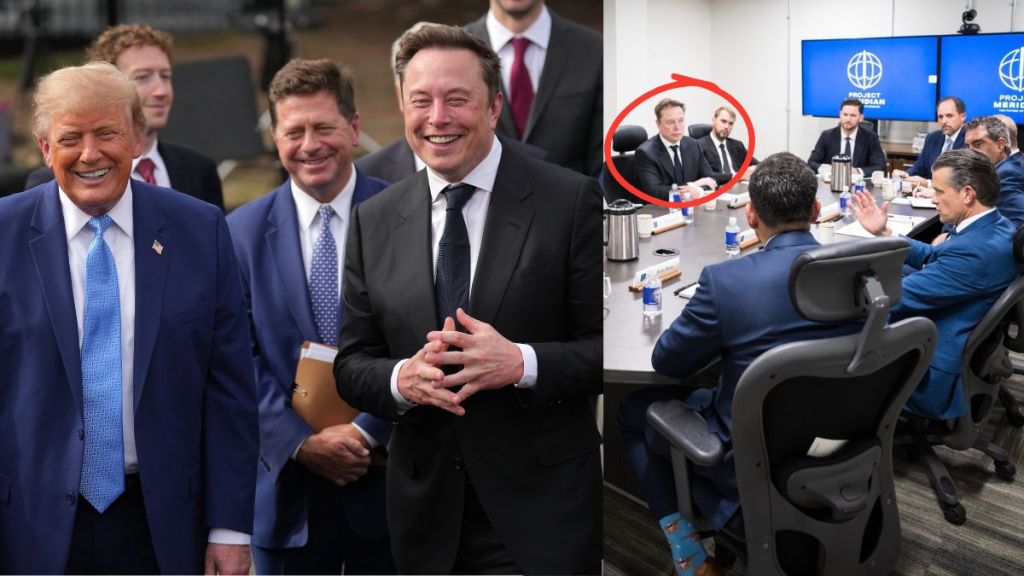

Shortly after announcing the creation of a new US military AI and drone command called Autonomous Warfare Command, aka Autowarcom, US Defence Secretary Pete Hegseth has put the future of the country’s warfare in the hands of the world’s richest man, SpaceX and Tesla CEO Elon Musk. According to the announcement on Wednesday (US time), the tech mogul will co-lead a Pentagon study of the future of warfare dubbed “Project Meridian.”
This marks Musk’s return to the Trump administration, although in a limited capacity, for the first time since his public feud with the US president last year. Both Trump and his ‘First Buddy’ have since reconciled and been spotted together at several White House events.
The development notably comes after the tycoon’s short-lived role in the Trump administration as senior advisor to the president and de facto head of the so-called Department of Government Efficiency (DOGE) last year. After formally renouncing his role as a “special government employee” in May 2025, he committed to stepping away from politics and focusing on his companies as Tesla suffered from tumbling sales and stock prices.
Since his previous government departure, Musk’s other company, SpaceX, has revelled in a blockbuster Nasdaq debut in June 2026. The historic IPO briefly promoted Musk from his billionaire status to the sole holder of the world’s trillionaire.
Elon Musk reclaims role in the Trump admin
Like his unveiling of AutoWarCom in front of hundreds of officers and enlisted personnel on Wednesday, Hegseth also announced the Meridian project at Quantico, Virginia. It was during his second address at the Marine Corps Base that he disclosed Musk’s return to the Trump world.
Given his position as the founder of xAI, Musk’s attachment to the project conspicuously came at a time when the Trump administration is ramping up its focus on artificial intelligence. The tech billionaire was even in attendance at the recent White House state dinner hosting Xi Jinping amid the Chinese leader’s three-day visit in the United States, which also included crucial AI talks with the POTUS. Days later, he was also seen all-smiles alongside the MAGA leader following a White House luncheon with tech leaders to discuss AI concerns.
Musk will head the Meridian Project alongside fellow billionaire and Anduril Industries founder Palmer Luckey, and former House Speaker Newt Gingrich under the direction of War Department Chief Technology Officer Emil Michael. Both Musk’s and Luckey’s companies have big Pentagon contracts.
SpaceX alone has secured at least $7 billion worth of contracts this year with the Trump administration owing to the work related to its Golden Dome missile defense shield, which heavily features Musk’s satellite company, Reuters reported in late July.
The recently announced Pentagon initiative won’t produce any new policy documents; it will instead look into “the domains we must conquer, and capabilities we must master,” according to Hegseth.
“We are leveraging a unique source of American advantage, one our adversaries do not have: our innovators, our senior leaders and our technologists — big thinkers and doers who will forecast the creative solution for tomorrow’s conflict,” the US Defence Secretary said at Quantico. “…”Their work will be focused on discovering, developing and fielding the weapons and systems that our children and our grandchildren will need in their lifetimes.”
Elon Musk barely stepped away from US politics
Despite his last year’s claims of forming a new political party called the ‘America Party’ while feuding with Trump, Elon Musk has largely remained committed to the Republican cause, considering a slew of donations made through his America PAC.
Ahead of Musk’s DOGE exit in 2025, reports started pouring in about how some Tesla investors were even complaining that he was too distracted by his special government role. Subsequently, he said that he’ll step back from DOGE to focus more on Tesla as the company saw a 71% drop in Q1 profits at the time.
In December 2025, Musk again stressed during a podcast conversation that he would never lead the cost-cutting program again, calling it only a “little bit successful.” Merely months before that, he held up a chainsaw at a conservation conference, symbolising the department’s goal to cut billions from the federal budget. DOGE initially promised to save as much as $2 trillion a year by slashing federal jobs and cutting government programmes, among other measures.
Reviewing DOGE’s claims of $110 billion savings across contracts, grants and leases, a report released by the Government Accountability Office (GAO) in August 2026 found that the ‘Wall of Receipts’ was “incorrect or lack(ed) supporting evidence.”
His recent political spending pattern has starkly contrasted with his prior plans to cut back on such campaigns. He emerged as one of the chief financiers of Trump’s presidential victory in 2024, spending over a quarter of a billion dollars in the lead-up to the election.
“In terms of political spending, I’m going to do a lot less in the future,” he said in a video interview at the Qatar Economic Forum last year. “I think I’ve done enough.”
On the contrary, recent campaign records, cited by The Guardian, show that he remains a force to reckon with in the upcoming November midterms. His America PAC has spent $3.4 million in a bid to defeat Democratic candidate Abdul El-Sayed in Michigan’s Senate race. Similarly, the PAC contributed $6.4 million to attack Democrat James Talarico in the Texas Senate race and $1 million to back Trump-endorsed Ken Paxton.