


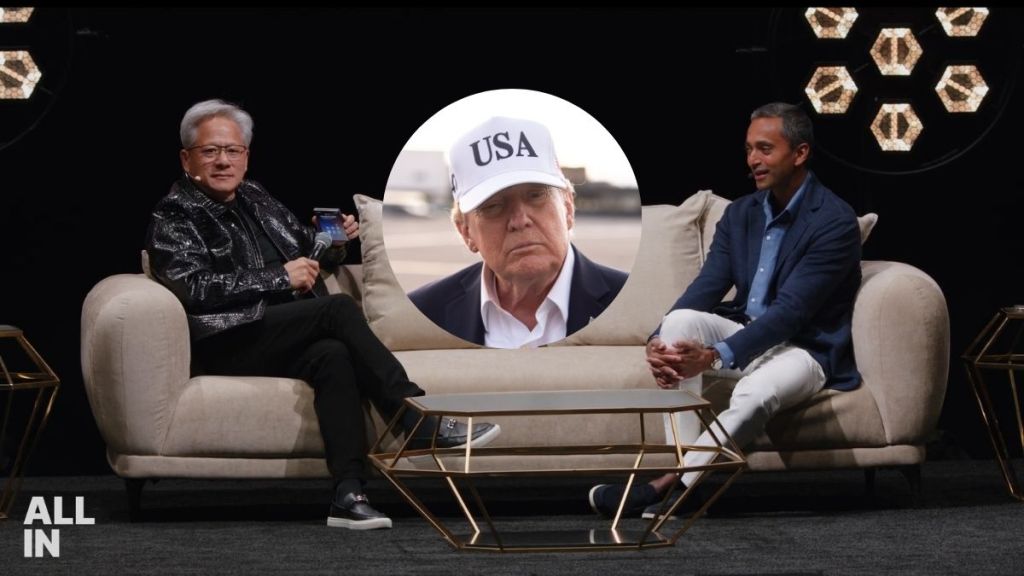

This past week, several tech experts who have directly contributed to the development of artificial intelligence sounded the alarm about the booming technology potentially posing an existential threat to humanity. US President Donald Trump, however, consciously chose to flip the narrative by downplaying these dire warnings and emphasising that the United States continues to lead China in the AI race. His remarks come just ahead of his meeting with Chinese President Xi Jinping, scheduled for next week in Washington.
In yet another development on this front, the MAGA leader went as far assuming the stance of a “hoax-buster,” dismissing safety concerns regarding AI in an unexpected call with Nvidia CEO Jensen Huang. The billionaire semiconductor titan accepted the POTUS’ sudden phone call during the All-in Summit in Los Angeles on Monday and put him on speakerphone.
Contradicting calls from top tech executives to slow the pace of AI acceleration and other concerns tied to the booming surge of data centres, Trump went as far as calling the latter the “oil of the next 20, 25 years.” Videos from the event have since circulated on social media, further illuminating Trump’s two cents on the raging debate about AI. The Trump War Room, which is linked to a pro-Trump PAC, also reposted one such clip posted on X.
The alarming discussions about AI’s potential catastrophic impacts in the near future particularly made for heavy headlines over the week after Anthropic researcher Jacob Coxon announced his resignation last week. Explaining his rationale behind the unprecedented move, he said, “people building AI earnestly believe that it could kill us all by the end of the decade.” Several others in similar roles have agreed with him and even spoken out publicly since then about their respective exits from frontier AI companies.
The likes of Anthropic co-founder Dario Amodei, OpenAI’s Sam Altman and Elon Musk subsequently joined calls for slowing the technology’s development. As a result, AI-related stocks fell worldwide on Monday. Addressing the same issue, thousands from Anthropic, Meta AI, OpenAI and Google DeepMind, among other firms, had already signed an open letter titled “Pacing the Frontier” in July, urging the US government’s involvement in AI regulation.
pic.twitter.com/NcJhVuRmWO— Trump War Room (@TrumpWarRoom) September 14, 2026
Trump calls Jensen Huang to dismiss AI fears as a ‘hoax’
Having already articulated his pro-AI stance on Monday, Trump called Nvidia boss Jensen Huang while he was on stage at an industry summit. Defending artificial intelligence, he called all the recently raised warnings about the advancing technology a “hoax, as he told the US must defeat China.
“The robots will not be taking over. The AI will not be taking over the rest of the world. The whole thing is a hoax,” the POTUS told Huang.
He even insisted that those criticising AI were “just playing right into the hands of a lot of people that don’t want to see it happen. That could be political people, that could also be China.”
Earlier in the day, Trump unloaded that the United States doesn’t need additional guardrails to regulate AI companies, as he thought little of tech leaders’ requests suggesting otherwise.
“The only control or ‘guardrails’ that AI needs is a STRONG AND SMART (High IQ!) PRESIDENT, and the U.S.A. has that, in spades!” he wrote on Truth Social. In the same post, he stressed that China would benefit from such developments.
US House Speaker Mike Johnson told reporters the same day that Trump could sit down with AI executives this week or “early next week” to discuss “the responsibilities of the companies to maintain safety and what role, if any, the government has to play in that.”
Meanwhile, Vice President JD Vance spoke to reporters separately and told them that he feels a “bit weird” about so many frontier AI tech companies “coming to the government and begging the government to regulate them.”
On the other hand, a Reuters report indicated that three US senators are working on a bill that would push AI companies to demonstrate they are taking reasonable precautions to keep their tools from causing harm.
President @realDonaldTrump calls Nvidia CEO @JensenHuang live on stage and makes it clear: America WILL NOT lose the AI race to China. 🇺🇸 pic.twitter.com/Ai0Kd892JV— Trump War Room (@TrumpWarRoom) September 14, 2026
Trump’s view on data centres
Data centres around the world have triggered growing environmental concerns due to massive energy and water consumption, air and noise pollution, and more.
Trump, however, doesn’t agree. While speaking to Huang on the phone, he called data centres “great,” and hailed them for making people and states “wealthy.”
Insisting that people “have to be a little careful” and do things “prudently” when it comes to data centres, he said, “It’s the oil of the next 20, 25 years, it’s bigger than the internet and AI, you know, much more so.”
With Huang, who sits on Trump’s council of science and tech advisors, being on the same page as the POTUS on the AI issue, the Republican leader added, “We’re going to make sure that everybody wins in the AI race in America. Every industry, every company, every state, every people.”
Where do Americans stand on AI and data centres?
On top of the concerns raised by many tech leaders, a survey led by Rutgers researchers (published September 9) found that even though AI use is surging, Americans still prefer humans making consequential decisions. The poll showed that nearly 72% of Americans have used at least one major AI tool, up from 50% in November 2024.
MUST SEE: Amazing moment as President Trump calls Nvidia CEO Jensen Huang while he’s on stage at the All-In Summit.@POTUS on AI Doomerism: “I’m telling you, it’s all a hoax… and we’re not going to let that happen.” pic.twitter.com/ZP8cCaSMqG— The All-In Podcast (@theallinpod) September 14, 2026
It also revealed that more than a quarter of Americans (27%) use AI every day. And yet, fewer than one in 10 would allow it to make the final decision without human supervision on hiring, loans, college admissions, parole or priority for a medical procedure. The Rutgers survey also disclosed that between 45% and 54% say AI shouldn’t be used altogether in such decisions.
“We adopt AI because it is useful, convenient or expected of us,” said Katherine Ognyanova, a professor with the Rutgers School of Communication and Information and a coauthor of the report. “At the same time, people are concerned about AI taking over high-stakes tasks or making important decisions without human supervision. Overall, using a tool and trusting it fully are two different things.”
A separate recent poll conducted by Quinnipiac University showed that 76% of 1,397 surveyed Americans believe they can trust AI either “hardly ever” or “only some of the time,” while 80 percent are either “very concerned” or “somewhat concerned” about it. Only 35% expressed being “very excited” or “somewhat excited” about AI.
Meanwhile, the same poll found that 65% of Americans were against the “the building of an AI data center in their community.” Among them, 72% cited “electricity costs,” 64% “water use,” and 41% “noise” for their opposition.
Gen Z participants were reported to be especially critical about AI’s role in the job market’s future. The March 2026 Quinnipiac University poll revealed that 81% believed AI would deplete job opportunities.