


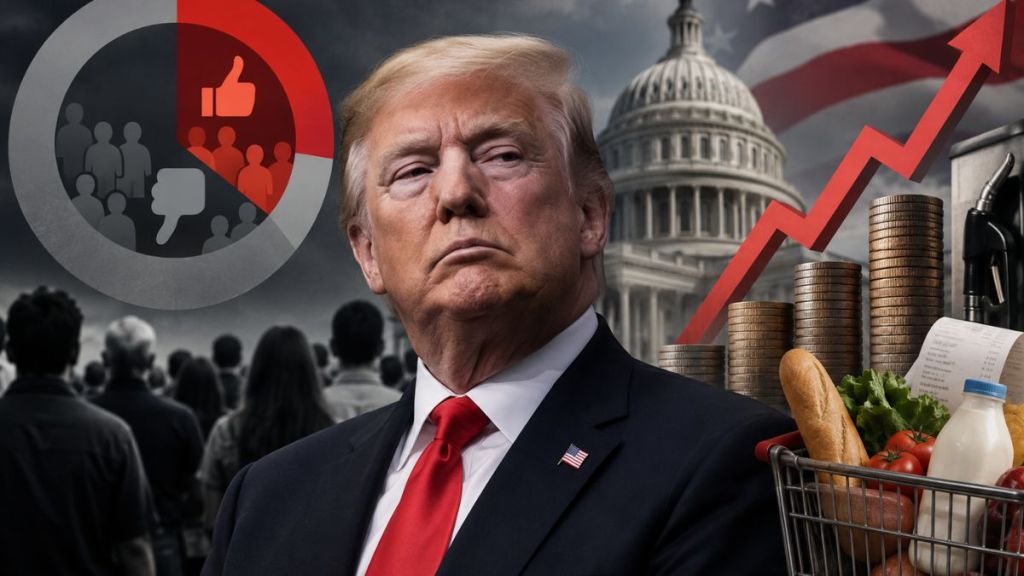

President Donald Trump’s standing with American voters has weakened massively as concerns over inflation, the cost of living and the economy increasingly shape how voters view his second term, according to a new NBC News poll. The survey, released ahead of the November midterm elections, found that just 41% of registered voters approve of Trump’s job performance, and 56% disapprove. His approval rating is the lowest recorded in the NBC News poll during his second term.
More importantly for the White House, 55% of voters said they believe Trump’s policies have hurt the US economy. This is a significant increase from March, when 48% held that view. The economic assessment comes as inflation and the cost of living remain among the biggest concerns for Americans. The NBC survey found that voters continue to place the economy and household costs at the centre of their concerns, and higher gasoline prices have added to pressure on household budgets.
The findings are part of a pattern in recent polling. A September Marquette Law School poll found that only 28% of Americans approved of Trump’s handling of the economy, while approval of his handling of inflation and the cost of living was even lower, at 19%. A Reuters/Ipsos poll released earlier in September put Trump’s overall approval at 35%, with 63% of Americans disapproving of his proposed $5,000 payments to adults if Republicans retain control of Congress.
The Reuters/Ipsos survey also found that Republicans had lost their longstanding advantage over Democrats on economic policy. The surveys point to a central problem for Trump, that is voters are increasingly judging his presidency through their experience of prices and household finances.
The economy is becoming a problem for Trump
The NBC News numbers show how much perceptions of Trump’s economic record have changed during his second term. In March, 48% of voters said Trump’s policies had hurt the economy. By September, that figure had risen to 55%. Only 26% said his policies had helped the economy, while 18% said they had made little difference.
The change is important because economic performance has traditionally been one of the strongest issues for Republicans. In the latest NBC survey, the parties are now essentially tied on which is more trusted to handle the economy, with Democrats holding a narrow 39%-38% advantage. The margin is within the poll’s margin of error. It represents a substantial change from three years ago, when Republicans had a 21-point advantage over Democrats on the economy.
The Marquette poll similarly found that economic issues have become a weak point for Trump. Only 28% approved of his handling of the economy, compared with 69% who disapproved. His ratings were even weaker on inflation and the cost of living, with only 19% approving. The same survey found that inflation and the cost of living were the most important issue for 37% of Americans. The economy came second, at 16%. This means nearly half of respondents identified either inflation and the cost of living or the broader economy as their most important issue.
Inflation remains the biggest pressure point
For voters, the economy is not necessarily an abstract measure of GDP growth or employment. It is increasingly being experienced through everyday expenses. The Marquette survey found that 64% of Americans believe Trump’s policies are increasing inflation, while only 18% believe they are reducing it. This shows a deterioration from the beginning of Trump’s second term. In January, 49% expected Trump’s policies to increase inflation, while 36% thought they would decrease it.
The latest survey also found that 68% of Americans expect inflation and the cost of living to increase over the next 12 months. Only 12% expect prices to decline. Personal financial perceptions have also weakened. Thirty-eight percent of respondents said they were worse off financially than they were a year ago, compared with 19% who said they were better off.
Gasoline prices have added another layer to the problem
Marquette found that 80% of Americans believed gasoline prices had risen over the previous six months. The increase came after the US-Iran conflict disrupted energy markets and pushed fuel prices higher. The pressure has been particularly significant because fuel costs affect more than motorists. Higher transportation and energy costs can feed into the prices of goods and services across the economy.
Reuters reported last week that diesel prices had climbed to record levels, with the increase posing a wider inflation risk because diesel is heavily used in transportation, agriculture and construction. Oil prices have also remained volatile as the Iran conflict disrupts energy flows through the Middle East. Reuters reported on September 20 that Brent crude had fallen to around $101.75 a barrel on hopes for diplomatic progress, but disruptions to regional oil infrastructure and shipping routes remained a concern.
Trump’s policies face a tougher test
The polling comes as Trump continues to defend an economic agenda built around tax cuts, tariffs, domestic production and a reduction in regulation. The administration has argued that these policies will strengthen US manufacturing, encourage investment and create jobs. However, voters are evaluating the policies against their immediate experience with prices.
The NBC poll found that Trump’s signature tax and spending legislation, enacted in 2025, has not generated overwhelming public support. Forty-two percent said they would be less likely to support a congressional candidate who backed the legislation, compared with 36% who said they would be more likely to support such a candidate.
Trump’s proposal to provide $5,000 payments to adults if Republicans retain control of Congress also failed to generate broad enthusiasm. Forty-six percent said they would be less likely to support a candidate backing the proposal, compared with 21% who said they would be more likely. The findings suggest that voters are not necessarily rewarding the administration simply for announcing new economic measures.
The question is increasingly whether those policies are improving household finances. This distinction matters for Trump because his political message has long centred on the argument that his economic approach will deliver better outcomes for American workers and consumers.
Tariffs add another economic uncertainty
Trump’s tariff policy is another part of the economic debate. The administration has presented tariffs as a way to protect American industries and pressure trading partners to make concessions. But tariffs can also raise the cost of imported goods and components, creating pressure on companies and consumers.
Marquette found that only 30% of Americans approved of Trump’s handling of tariffs in September. That was down from 33% in July and 37% in May. The issue has also become intertwined with broader concerns about inflation. The White House has maintained that Trump’s economic programme will eventually produce stronger growth and greater domestic production. However, the polling indicates that voters are judging the administration on current costs rather than on potential longer-term benefits. This creates a difficult political environment when inflation remains the country’s most important issue.
Iran conflict adds pressure through energy prices
The economic debate has also been affected by Trump’s decision-making on Iran. The NBC poll found that more than six in 10 voters believe the Iran war has not been worth it. Fifty-seven percent said they would be less likely to support a candidate who backs the war, compared with 24% who said they would be more likely. Trump has defended the decision and argued that the economic costs are justified by the security objectives of the conflict.
In May, when asked whether economic concerns would influence his decisions on Iran, Trump said: “I don’t think about Americans’ financial situation. I don’t think about anybody. I think about one thing. We cannot let Iran have a nuclear weapon, that’s all. The conflict has nevertheless had a direct economic consequence through energy prices.
At a rally in North Carolina, Trump acknowledged that Americans were paying more for gasoline because of the war but argued that the cost was justified. This could be difficult to sell to voters who are already reporting higher household expenses.
Other polls show the same direction
The NBC findings do not stand alone.The Marquette survey puts Trump’s overall approval at 37%, with 63% disapproving. His approval on inflation and the cost of living is just 19%, while his rating on gasoline prices is 20%. The poll also found that Trump’s strongest ratings remain concentrated on immigration and border security. His approval on border security stood at 49%, compared with 28% on the economy. This illustrates the difference between the issues where Trump retains stronger support and those where voters are increasingly dissatisfied.
The Reuters/Ipsos survey released earlier this month found Trump’s overall approval at 35%, up slightly from a record-low 33% in the previous survey. At the same time, the poll found Democrats leading Republicans 44% to 37% on the generic congressional ballot and reported that Republicans had lost their previous advantage on economic management. The Reuters/Ipsos findings also showed the importance of the Iran conflict and fuel prices in shaping the political environment.
The surveys differ in methodology, sample and question wording, so their numbers should not be treated as directly interchangeable. But the direction across the polls is similar: Trump’s overall approval is below 50%, economic approval is weaker still, and inflation and household costs remain major concerns.
The economic question heading into the midterms
The NBC poll also shows how Trump’s economic standing could become part of the broader congressional campaign. Democrats lead Republicans 50% to 45% among registered voters when asked which party they want to control Congress. This figure is not an election forecast, but it shows the political environment in which Republicans are defending their congressional majorities.
More significantly for the economic debate, the NBC survey found that Democrats have erased the Republican advantage on inflation and the economy. Democrats lead Republicans 38% to 31% on which party voters trust more to handle inflation. On the economy, Democrats hold a narrower 39%-38% advantage.
Republicans continue to have significant advantages on issues including crime, immigration and border security. This contrast leaves the economy as a central area where voters are testing Trump’s record. Republican pollster Bill McInturff of Public Opinion Strategies, whose firm conducted the NBC survey with Democratic pollster Hart Research Associates, acknowledged the challenge. “The issue environment is tilting substantially towards the Democrats,” McInturff told NBC.
Voters are looking at what they pay
For Trump, the economic challenge is ultimately about whether voters believe their financial situation is improving. The latest polling suggests many voters do not believe their financial situation is improving.
The NBC survey shows that more than half of voters believe Trump’s policies have hurt the economy. Marquette finds that only 19% approve of his handling of inflation and the cost of living, while 64% believe his policies are increasing inflation. The Reuters/Ipsos poll provides another indication that the administration’s economic advantage over Democrats has weakened.
At the same time, global energy markets, the Iran conflict, interest rates, and international trade are influencing the economic picture, factors that extend beyond the White House. For the administration, however, the political challenge remains the same: convincing Americans that its policies will improve their economic position.
With inflation and the cost of living continuing to dominate voter concerns, the latest NBC News poll suggests that this argument is facing increasing scrutiny. The next phase of the campaign will show whether that dissatisfaction remains primarily an assessment of Trump’s economic record or becomes a broader judgment on his presidency and the Republican Party.