


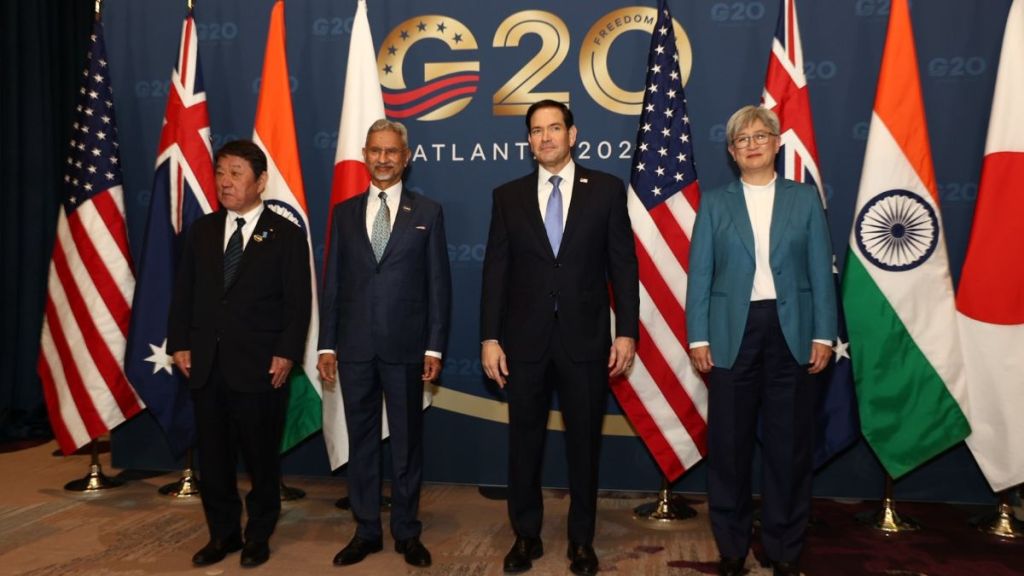

Foreign ministers for the Quad bloc of India, the United States, Japan and Australia formally unveiled wide-ranging plans pertaining to artificial intelligence, minerals and maritime decisions after a high-level meeting at the G20 Foreign Ministers’ Summit in Atlanta, Georgia, this week.
The major development saw America committing $10 million to support critical minerals recycling initiatives in India and ASEAN (Association of Southeast Asian Nations) member states. The allocation of funds was not exclusive to India. Notably, the Quad bloc also set aside more than $85 million to assist expanded access to trusted AI across the Indo-Pacific.
India’s External Affairs Minister Dr S Jaishankar was in attendance at the Atlanta event alongside his US, Japanese and Australian counterparts, Marco Rubio, Toshimitsu Motegi and Penny Wong.
The Quad’s commitment to minerals recycling in India and ASEAN countries comes over a year after the Union Cabinet chaired by Prime Minister Narendra Modi approved a Rs.1,500 crore Incentive Scheme to develop recycling capacity in the country for the separation and production of critical minerals from secondary sources. This was part of the National Critical Mineral Mission (NCMM), already aimed at building domestic capacity and supply chain resilience in critical minerals.
Quad unveils $10 million plan for India, ASEAN minerals recycling
In addition to welcoming several key initiatives bolstering the Indo-Pacific region’s prosperity, the Quad leaders reiterated that the Quad Critical Minerals Initiative Framework announced in May 2026 strengthened cooperation on critical mineral supply chains.
The bloc members continue to work together to recover critical minerals from electronics waste and scrap materials to reduce reliance on any single supplier. Expanding collaboration on this front, they welcomed private sector-led investment in waste collection networks, processing plants, and refineries and work with Quad countries to establish trusted critical minerals recycling value chains. As a result, they’ve established a plan to provide $10 million to assist infrastructure and facilities in India and ASEAN countries that recover critical minerals from waste.
Turning attention to maritime and transnational security amid several ongoing global conflicts, the Quad leaders reasserted their commitment to making the seas safer.
According to a joint press statement, the second Quad-at-Sea Ship Observer mission successfully took off from Chennai, India, to Perth, Australia, from September 25 to October 7, with representatives from all four member nations aboard the Indian Coast Guard Offshore Patrol Vessel in a bid to strengthen Quad maritime interoperability to address unlawful maritime activities.
The Quad countries are now looking forward to holding their first exercise under the Indo-Pacific Maritime Surveillance Collaboration initiative at Sea Dragon 2027, announced in May by foreign ministers in New Delhi. The measure aims to strengthen maritime collaboration and enhance information sharing between the Quad members.
According to the joint press release, the Quad ministers also highlighted the importance of economic security in maintaining global stability and prosperity. Reaffirming their commitment to a free and open Indo-Pacific, they again emphasised the need to build reliable and open global supply chains and trusted and resilient infrastructure.
“The Quad ministers highlighted the importance of Super Intelligence (SI)* and initiatives like Pax Silica to the future of economic growth and expressed their intent to provide over $85 million of technical and financial assistance to support access to trusted SI across the Indo-Pacific, including through the Quad SI Accelerator,” the statement read.
Jaishankar shares official statement after Quad meeting
EAM S Jaishankar has since outlined the crucial priorities he and the other Quad leaders discussed during this year’s third QUAD Foreign Ministers’ meeting. Stressing the need to safeguard freedom of choice and secure supply chains, he began listing the issues on X: “Maintaining stability, driving prosperity and ensuring freedom of choice as our continuing commitments in the Indo-Pacific.”
“Deepening cooperation to promote supply chain resilience and ensure technology, critical minerals & energy security,” he continued.
Next, he came to “Countering non-market practices and increased economic stresses in the Indo-Pacific,” and then “Taking forward agreements on counter-terrorism, maritime security, and capacity building to enhance resilience & contribute to peace and stability.” Finally, he laid emphasis on “Developing a more contemporary QUAD agenda with a practical approach.”