


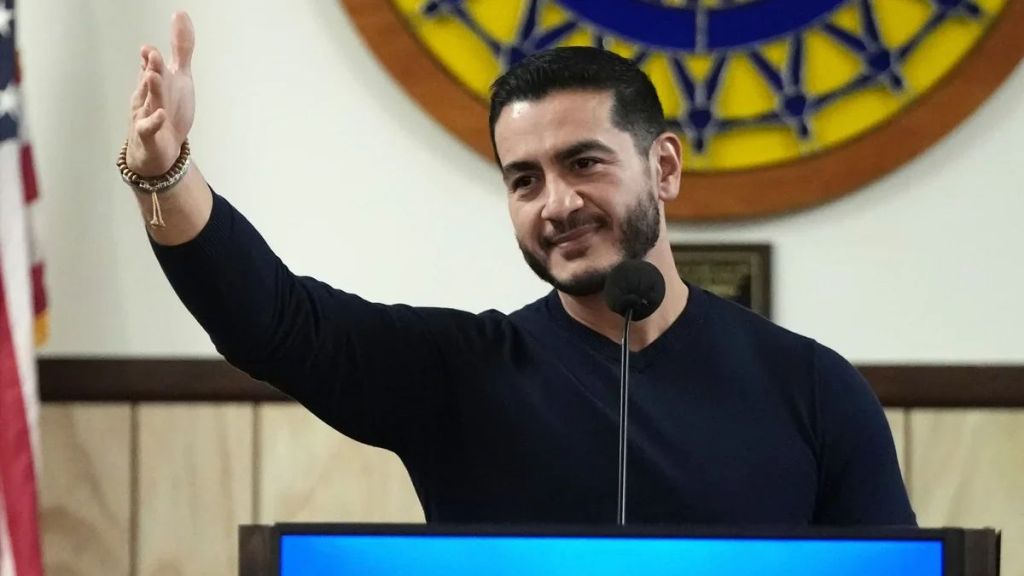

Abdul El-Sayed, a 42-year-old doctor, epidemiologist and progressive Democrat, has made history by becoming the first Muslim to be elected to the US Senate. El-Sayed defeated Republican candidate and former congressman Mike Rogers in Michigan’s closely watched Senate race, retaining the seat for Democrats and overcoming a campaign marked by political divisions, attacks on his faith and questions over his progressive politics.
A former public health official in Michigan, El-Sayed entered the race with a platform centred on universal healthcare, economic equality and reducing the influence of money in politics. His victory is also significant because Michigan is a politically competitive state that voted for Donald Trump twice, making the election a test of whether a progressive candidate could win over voters beyond the Democratic Party’s traditional base, as reported by CBS.
From public health to politics
El-Sayed previously served as the director of the Wayne County Department of Health, Human and Veterans Services in Michigan. As an epidemiologist, he built his public profile around public health, healthcare access and policies aimed at addressing economic and social inequalities. His healthcare background became central to his political identity. During the Senate campaign, he advocated Medicare for All, a proposal to establish a universal healthcare system in the US. He also called for greater public investment in education, healthcare and infrastructure, according to The Guardian.
His campaign was built around the slogan: “Money out of politics, money in your pockets and Medicare for All.” The message placed him firmly on the progressive side of the Democratic Party, aligning him with prominent left-wing figures such as Senator Bernie Sanders and Representative Alexandria Ocasio-Cortez.
El-Sayed’s political rise gained momentum when he defeated Democratic Representative Haley Stevens in the party’s primary. Stevens had been considered a more moderate candidate and had received substantial backing from pro-Israel groups. Her defeat marked a setback for the Democratic establishment and focused on the growing influence of progressive candidates within the party. The seat became vacant after Democratic Senator Gary Peters decided not to seek re-election. Peters had represented Michigan in the Senate since 2015.
A campaign shaped by Israel and his Muslim identity
El-Sayed’s positions on Israel and US foreign policy became major points of contention during the campaign. He called for an end to American military aid to Israel and accused the Israeli government of genocide, positions that drew criticism from political opponents and pro-Israel groups. The American Israel Public Affairs Committee (AIPAC), through its affiliated Super PAC, United Democracy Project, spent approximately $30 million in an unsuccessful effort to prevent his victory in the Democratic primary, according to The Guardian. The organisation also re-engaged in Michigan during the closing weeks of the general election campaign.
His views on Israel also created tensions within the Democratic Party. Stevens, who had lost the primary to El-Sayed, eventually endorsed Republican candidate Mike Rogers in the final days of the campaign. Stevens demanded that El-Sayed condemn an advertisement by an outside group linking US military aid to Israel with rising grocery prices, which she described as antisemitic. El-Sayed said the advertisement “was not made by me” and added that he disagreed with its contents. The disagreement escalated when Stevens appeared alongside Rogers at a church service in Detroit on Sunday and announced her endorsement of the Republican candidate.
“It is this one vote,” she said. “And I will tell you why: Because when you see hate, when you see us standing with Hasan Piker, and repeated hate, it’s not acceptable.” El-Sayed maintained his position and continued to campaign on healthcare, economic concerns and the influence of money in American politics.
Facing attacks from Trump and Republicans
His Muslim identity became another major issue during the campaign, with President Donald Trump and several Republican leaders repeatedly attacking him. Trump described El-Sayed as a “jihadist” and falsely claimed that he was associated with the Muslim Brotherhood, an Islamist organisation founded in Egypt in 1928. Texas Senator Ted Cruz also questioned his alleged connections to the group and warned that his election could have serious consequences for Americans.
“If I am correct that he is a passionate supporter of the Muslim Brotherhood, there is a very real risk that Americans will die as a result,” Cruz said days before Election Day. Trump also invoked the September 11 terror attacks and Flight 93 while urging Michigan voters to reject El-Sayed. El-Sayed repeatedly denied the allegations and rejected claims that he had any association with the Muslim Brotherhood.
“I have never been a member of the Muslim Brotherhood, I never will be a member of the Muslim Brotherhood,” he told Fox News. The attacks continued throughout the campaign, with Trump frequently referring to El-Sayed by his middle name, Mohamed. El-Sayed responded to the criticism at an October 25 campaign event alongside Sanders. “That’ll be Sen. Mohamed to you, bro,” he said.
Defeating Mike Rogers and making history
El-Sayed faced Republican Mike Rogers, a former US representative, Army veteran and former FBI agent. Rogers sought to present himself as a practical, moderate-minded leader while questioning El-Sayed’s positions on Israel, Iran, and other foreign policy issues.
He also criticized El-Sayed’s association with controversial political streamer Hasan Piker. However, Rogers struggled to distance himself from Trump and the Republican administration’s unpopular policies, including tariffs and the war in Iran.
Republicans have not won a Senate election in Michigan since 1994. Republicans have not won a Senate election in Michigan since 1994. “You took a chance on the unlikeliest of candidates,” he told the crowd. “They want an America that is too small for some of us,” El-Sayed said. El-Sayed’s victory marks a historic moment in American politics, making him the first Muslim elected to the US Senate. His win also demonstrates that a progressive candidate can secure a victory in a politically competitive state despite opposition from sections of the party establishment and sustained attacks from Republican leaders.