



An American tech giant’s annual proxy filing shed light on a staggering gap between the earnings of its top boss and the company’s median employee. An official US Securities and Exchange Commission document has lifted the lid on the jaw-dropping figure as the company remains shrouded in backlash related to layoffs.
Co-founded by billionaire Larry Ellison, Oracle has been at the centre of numerous saddening headlines this year amid a seemingly endless string of AI-driven job cuts. A separate company filing recently revealed that the workforce at the tech giant dropped by 21,000, or 13%, in the fiscal year that ended May 31. Before the massive cuts, Oracle had around 141,000 employees.
Now, as the firm faces a debt of tens of billions of dollars amid increasing demand for AI investments, an SEC filing (dated September 25, 2026) has again revealed a shocking divide between those occupying seats at the top of the company’s hierarchy and those somewhere in the middle.
Oracle’s massive CEO-to-employee pay ratio revealed
The annual proxy filing submitted Friday documented a whopping jump in the CEO-to-employee pay ratio. These stats stood at 11-to-1 in FY25 when ex-chief executive Safra Catz got $1.1 million in total compensation. In comparison, the median employee earned $98,899.
The Israeli-American titan, who has been an executive at Oracle since 1999 and has an estimated net worth of $2.9 billion (according to Forbes), served as CEO from 2014 until she stepped down last year. While she remains the executive vice chair, Clayton “Clay” Magouyrk and Michael “Mike” Sicilia replaced her as co-chief executive officers in September 2025.
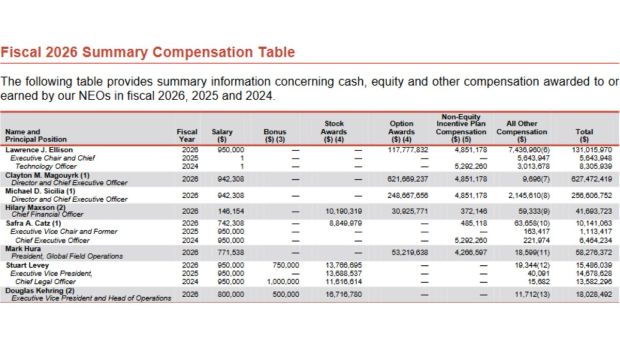
According to Oracle’s new filing, Magouyrk’s pay saw a sudden boost, especially owing to the company’s AI-fuelled surge. The proxy document pointed towards a 6,623-to-1 CEO pay ratio, which means that for every US dollar Oracle’s median employee earned, Clay secured $6,623, Forbes reported.
It further showed that not only had the co-CEO’s compensation risen significantly from what the former CEO received, but the median employee’s pay had also dropped. Magouyrk, who joined the company over a decade ago, got a stock-option award worth $621.7 million, while Sicilia’s share was $248.6 million. Consequently, Oracle reported Clay’s total compensation for FY26 as $627.5 million and Mike’s as $256.6 million.
On the contrary, the Texas-based tech company’s median employee pay was $94,740, according to the September proxy filing.
Deeper look at CEO vs worker pay comparison
As Oracle emerged as a company with one of the widest gaps between CEO compensation and median employee pay, even CEOs at the USA’s 100 lowest-paying corporations earned 614 times more than workers, according to an analysis by the Institute for Policy Studies (IPS).
The report, released in August, showed that CEO compensation at the 100 S&P 500 corporations with the lowest median worker pay had surged 41.4% between 2019 and 2025. This increase was twice as much as the surge in median worker pay during the same period (20.7%). As a result, the CEO-to-worker pay ratio at the “Low-Wage” firms jumped 8.4% during this window, with the average CEO compensation at $17.5 million in 2025, while median worker pay was $36,571.
On a more similar path to Oracle’s Clay Magouyrk, Starbucks’ CEO Brian Niccol made 6,666 times more than his average worker in 2024, according to a 2025 AFL-CIO report comparing the compensation gap between leading executives and their employees. The figures showed that Niccol, who joined the largest coffeehouse giant in 2024, got more than $97.8 million in total compensation that year, while a typical company worker’s pay was less than $15,000.
Who are Oracle’s CEOs?
Clay Magouyrk, an Oracle veteran, has been serving as the company’s co-CEO alongside Mike Sicilia since last year after succeeding Safra Catz. Beyond his association with the chief executive post, he is best known for heading Oracle Cloud Infrastructure and as a founding member of the company’s cloud engineering development centre. Moreover, he is credited with the significant expansion of Oracle’s global data-centre operations.
Before starting his long Oracle journey in 2014, he spent six years at Amazon and AWS. Currently in his early 40s, he holds a Bachelor of Science degree in electrical engineering from the University of Memphis.
Meanwhile, Mike Sicilia, who is in his 50s, joined Oracle through its 2008 acquisition of project management software provider Primavera Systems. At the time, he held the role of chief technology officer. Having begun his career as a software engineer in 1993, he holds a Bachelor of Science degree in Computer Science from Saint Joseph’s University in Pennsylvania.
According to his official Oracle profile, he is behind some of the company’s most strategic acquisitions and delivered critical new offerings to customers. Before the promotion, he was president of Oracle Industries and oversaw businesses, including retail, financial services, healthcare, communications, engineering and construction.