


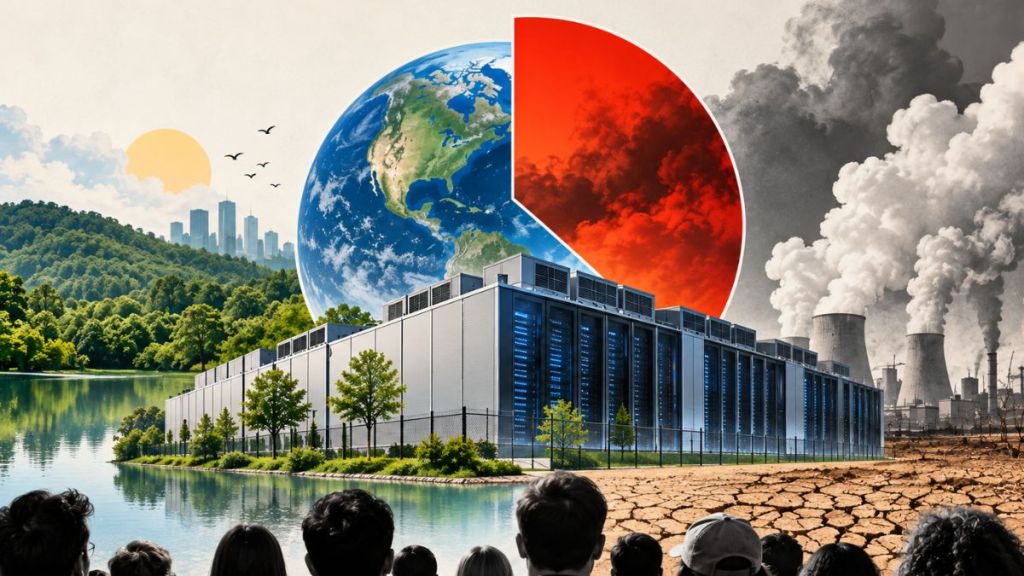

Data centers are facing a more skeptical public in the United States, with Americans increasingly concerned about their impact on the environment, household energy costs and the quality of life of communities living nearby.
A new Pew Research Center survey shows a change in public opinion since the beginning of 2026. The change comes as protests against new data center construction have spread and some state and local politicians have raised concerns about their impact. President Donald Trump, meanwhile, has remained a vocal supporter of data centers.
The survey, conducted among 10,548 US adults found that 54% of Americans now believe data centers are mostly bad for the environment. This is up sharply from 39% in January.
The concerns extend beyond the environment. Half of Americans, or 50%, say data centers are mostly bad for home energy costs, compared with 38% in January. Nearly half, 49%, also say they are mostly bad for the quality of life of people living nearby. In January, the figure was 30%.
Only 4% of Americans say data centers have a mostly good impact on the environment, home energy costs or the quality of life of people nearby.
Rural communities show a major change
The concern is particularly notable in rural America, where many data center projects are currently planned or under development.
In January, 32% of rural Americans said data centers were mostly bad for the environment. By August, that share had risen to 50%.
The change or transition is also visible when it comes to household energy costs. The share of rural Americans who view data centers as mostly bad for home energy costs rose from 32% in January to 46% in August.
Views on the quality of life of people living near data centers have changed in a similar way. The share of rural Americans holding a negative view increased from 28% to 45%.
Urban and suburban Americans have also become more negative about the environmental, energy cost and quality of life effects of data centers.
The change across rural communities is significant because the survey notes that most data centers currently being planned or developed will be located in rural areas.
Jobs and tax revenue remain more complicated
Americans are less certain about the economic benefits of data centers. Views on local jobs and tax revenue remain divided. The share saying data centers are mostly bad for local jobs rose from 15% in January to 24% in August. The share saying they are mostly bad for local tax revenue increased from 12% to 21%.
At the same time, 22% say data centers are mostly good for local jobs, while 22% hold the same view about local tax revenue.
A large section of the public remains unsure about the economic impact. In August, 23% were unsure about the effect on local jobs and 32% were unsure about the effect on local tax revenue.
The political divide on these questions has also begun to change. Democrats and Democratic-leaning independents remain more likely than Republicans and Republican-leaning independents to view data centers negatively. Liberal Democrats have been a major driver of the change.
Among liberal Democrats, 34% now say data centers are mostly bad for local tax revenue, up from 19% in January. Republicans continue to be more likely to view data centers positively when it comes to local jobs and tax revenue. Their views, however, have also changed a lot.
Republicans are now seven percentage points more likely than they were in January to say data centers are mostly bad for local jobs and local tax revenue.
Political support is no longer uniform
The growing public concern is being reflected in a more varied political response. Trump has continued to support data center construction during his second term. Texas Gov. Greg Abbott, who had previously supported expansion, issued a statewide moratorium on new data centers in August.
Some Democratic governors have also moved towards tighter oversight. Pennsylvania Gov. Josh Shapiro and Illinois Gov. JB Pritzker have recently shifted their positions to support additional rules and oversight covering data center construction and operation.
The survey claims that the debate is no longer limited to one political group or one type of community. Republicans have also become more concerned about the local impact of these facilities. In the latest survey, 42% of Republicans said data centers were mostly bad for the quality of life of people living nearby. This was up from 24% in January.
6 in 10 Americans uncomfortable with a new data center nearby
The public unease becomes even clearer when Americans are asked about a new data center operating in their own area.
Six in 10 Americans, or 60%, say they would be not too or not at all comfortable with a new data center operating in their area. Only 19% say they would be somewhat comfortable, while 7% say they would be extremely or very comfortable.
The discomfort is visible across urban, suburban and rural communities. Among rural Americans, 60% say they would be not too or not at all comfortable with a new data center. The figure is 63% among suburban Americans and 57% among urban Americans.
There is also a clear partisan difference. About two-thirds of Democrats, or 68%, say they would be uncomfortable with a new local data center, compared with 54% of Republicans. Liberal Democrats stand out most strongly, with 81% saying they would be uncomfortable.
Awareness is rising as concerns grow
The shift in public opinion has happened alongside greater awareness of data centers. In January, 25% of Americans said they had heard or read a lot about data centers. By August, that share had increased to 35%.
Overall, 88% of Americans now say they have heard at least a little about data centers. Only 12% say they have not heard of them.
The survey found that awareness is higher among men than women and among people with at least a bachelor’s degree than among those with less education.
Still, a sizeable share of Americans remain unsure about the impact of data centers. Depending on the issue, between 18% and 32% say they are not sure how data centers affect the environment, home energy costs, quality of life, local jobs or local tax revenue.
The numbers point to a public debate that is becoming more informed but also more divided. Data centers may bring jobs and tax revenue to communities, but growing numbers of Americans are questioning their environmental and local costs.