


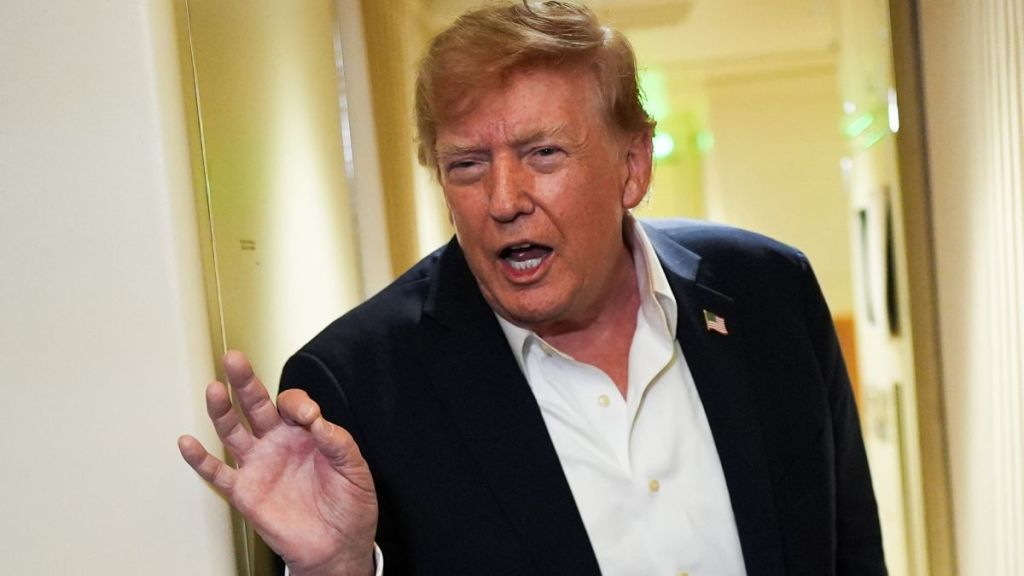

US President Donald Trump‘s approval rating ticked up after hitting record lows for weeks, according to a new four-day Reuters/Ipsos poll released on Monday (US time). However, the sudden two-point surge in his overall popularity didn’t necessarily mean a reprieve for the Republican Party, as Americans doubled down on their support for Democrats in the US Congress ahead of the upcoming November mid-term elections.
The survey was conducted hot on the heels of the Republican Party‘s first-ever mid-term convention, where Trump controversially vowed to pay every American adult a $5,000 dividend if his party regains control of Congress in the forthcoming election cycle. The POTUS’ proposal aimed at persuading voters to align with the Right has since sparked heavy backlash and questions of “bribery” in US politics.
The latest Reuters/Ipsos poll fanned the fire, with a significant majority of Americans viewing his offer critically. Trump’s convoluted promise complicates things even further, as it would cost around $1.35 trillion with approximately 270 million US adults in the queue.
According to the US Treasury Fiscal data, the government had $37.64 trillion in federal debt at the end of 2025. The total debt for the US through September 10, 2026, has since surged to $40.05 trillion.
Where does Trump’s approval rating stand?
Trump’s ratings showed some 35% of 1,143 respondent Americans siding with him for his performance in the White House, up from 33% in an August 28 to 31 Reuters/Ipsos poll.
The previous cycle particularly shed light on how the ratings remained stuck at 33%, the lowest figure of the MAGA leader’s political career due to his handling of the war in Iran, among other things. Americans have especially expressed heightened discontent with the rising levels of inflation, given how gas and oil prices have seen drastic hikes since the war in Iran started on February 28.
The Trump brand weighs heavily on the Republican Party
The POTUS’ approval ratings have been declining ever since the United States launched a war on Iran in late February. Consequently, West Asia has been at the centre of chaotic turmoil centred around disrupted global oil supplies because of the uncertainty surrounding the Strait of Hormuz. The waterway is responsible for the passage of a fifth of the world’s oil and LNG.
Support for Republicans has similarly been rattled as a consequence of the developments, resulting in Americans somewhat losing faith in the party regarding economic policy. According to the Reuters poll released in the first week of September, about 71% of 924 registered voters, including 4 in 10 Republicans, disapproved of Trump’s take on the cost of living.
The last month witnessed a dramatic shift in American adults’ acceptance of the Democratic vs Republican divide on economic policy. Although the Republican Party had led the front for about a decade, registered voters have now been siding with the Democrats, owing to the newfound belief that they have better ways of handling the economy.
Even though direct negotiations between the US and Iran hadn’t been on the table, the ongoing conflict had still calmed down to an extent recently. Recent weeks have seen that quiet dissipate yet again due to renewed attacks from both sides.
When markets opened on Sunday, the price of the global benchmark for oil, Brent crude, surged about 3.2% to about a whopping $108 a barrel. Meanwhile, West Texas Intermediate crude, the US benchmark, was up about 2.9%, to a little under $103 a barrel.
Gasoline prices, on the other hand, were steady over the weekend, recording a national average of $4.31 a gallon, according to the AAA motor club. Rates for regular gas per gallon have jumped nearly 45% from where they stood during the pre-war time.
Support for Democrats on the rie
Results of the Reuters/Ipsos poll released on Monday showed 63% of American adults, including 4 in 10 Republicans and 9 in 10 Democrats disapproving of Trump’s $5,000 payout promise made during his convention speech.
When asked which party they would vote for if the congressional elections were held today in what is called a “generic ballot” poll, 44% of surveyed Americans chose Democrats and 37% preferred Republicans. This 7-point difference has emerged as the widest gap since Trump’s return to the White House last year.
Trump’s $5,000 dividend claim backfires
Beyond the convention speech adversely impacting his popularity, including among Republicans, his remarks also prompted immediate backlash from Americans. Even Trump’s own party members raised big questions about how the US government would be able to afford to pay that much money to Americans.
Texas Republican Rep. Chip Roy openly lambasted Trump’s claims, writing in an X post, “Maybe some of us think dependency is evil & soul-sucking in all its forms.”
Bob Good, also a Republican and former representative who chaired the House Freedom Caucus, called the ‘Trump Dividend’ a “socialist vote-buying scheme.”
Vice President JD Vance was pressed to answer questions related to Trump’s offer on Fox News last week.
“I can hear the critics’ heads exploding,” Fox News anchor Bret Baier told Vance. “They’re saying out loud, I guarantee you: ‘The president is bribing voters to vote for Republicans to take over the House, and then he’s bankrupting the country because the deficit and debt is huge and inflation would come back if this comes into play.'”
Vance chose to defend the proposal, labelling it a “dividend for American workers,” as he spoke highly of the “extraordinary amount of revenue” generated by Trump’s tariffs.
“If you keep us in power and allow us to continue to do these things, then you’re going to share in some of the benefit of this incredible wealth that we’re creating in the United States of America,” the vice president added. “I don’t think it’s a controversial idea.”