



While the entire artificial intelligence industry weighs fears of a potential doomsday scenario in the near future, Meta’s latest consumer AI product is reeling in personal profits for the company’s chief executive, Mark Zuckerberg.
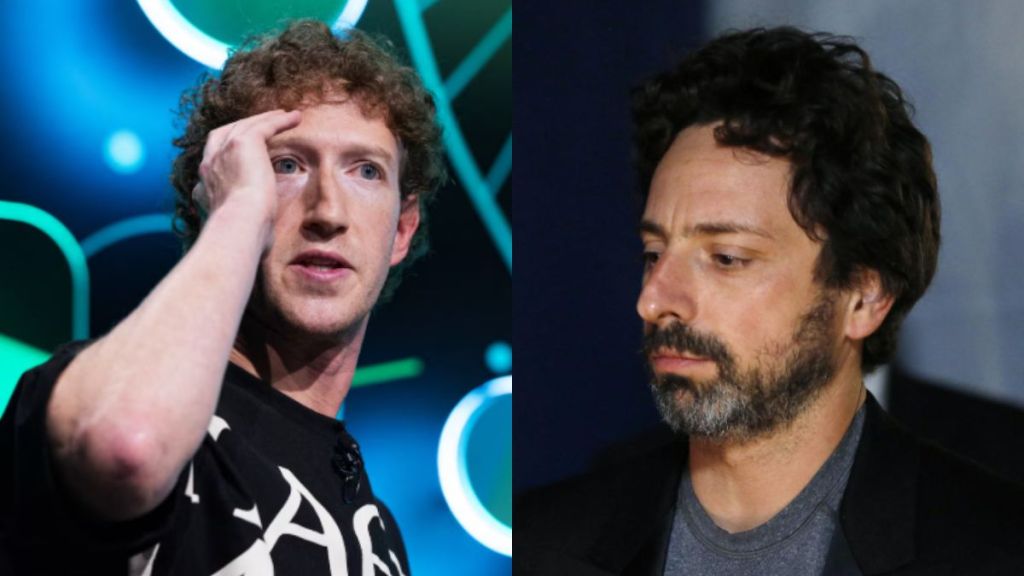
On Wednesday, the tech giant’s new Muse AI agent boosted the Facebook founder’s net worth by more than $4 billion alone as Meta’s stock price surged, according to Forbes. The sudden multi-billion-dollar rise in his fortune pushed Zuckerberg’s net worth close to $257 billion, putting him at the No. 5 spot on Forbes’ Real-Time Billionaires List. In light of the shuffling of positions on the world’s richest rankings, the Meta CEO ended up ahead of Google co-founder Sergey Brin, whose estimated net worth at the time was $255.4 billion.
Mark Zuckerberg is back at No. 6 on the Billionaires List
Contrary to the previous fortune surge on Wednesday afternoon, Mark Zuckerberg’s estimated net worth slipped to $255.1 billion, according to the latest update on ‘The World’s Real-Time Billionaires’ list on the Forbes website as of September 24, 12:45 am EDT. Despite the slump, the Meta boss topped the list of ‘Biggest Gainers,’ reflecting a “+$2.5 billion” or 1.01% daily net worth change.
Given the latest update, Zuckerberg only briefly claimed the title of the world’s fifth-richest person, as by early Thursday he was back to the No. 6 spot behind Sergey Brin. The Google co-founder’s net worth, however, settled at $255.4 billion, even as Forbes counted him among the ‘Biggest Losers’ of the day owing to a loss of $9.2 billion or 3.49% in his estimated fortune.
Elon Musk, Amazon founder Jeff Bezos, Google co-founder Larry Page and Dell Technologies’ boss Michael Dell claimed the spots No 1 through 4 on Forbes’ Real-Time Billionaires list as of Thursday. Their estimated net worths were $930.5 billion, $369.2 billion, $277.5 billion and $270.2 billion, respectively.
What fuelled Meta CEO’s net worth surge?
Zuckerberg, whose fortune is mostly linked to Meta, witnessed a dramatic surge in wealth on Wednesday after his company’s stock rose 2.1% to more than $750 a share as of 2 pm EDT. Meanwhile, a decline of more than $9 billion in Brin’s recorded net worth on September 23 was attributed to Google parent Alphabet’s stock slipping 3.5%. Earlier on Monday, Meta’s stock price jumped about 11%, causing Zuckerberg’s net worth to shoot up about $25 billion in a single day.
Having originally co-founded Facebook in 2004, which eventually grew into the parent company Meta, Zuckerberg still owns a roughly 13% stake in the company, according to Forbes. The firm’s recent stock rise has been tied to the growing hype around the recently released AI agent, Muse, which JPMorgan analysts predicted could “become the most widely used consumer AI application since ChatGPT,” Reuters reported earlier this week.
In the last month alone, Meta’s stock has risen over 34%, and the figures have continued to climb higher since Muse was launched about two weeks ago.
According to recent estimates from market intelligence provider Apptopia, Muse’s app has been downloaded on mobile devices more times during its first 12 days on the market than OpenAI’s ChatGPT was in the 12 days after its debut (only the US and Canada markets included in the data comparison). The firm also found that Meta’s consumer-facing AI personal agent has more daily active users than ChatGPT had at the time.
Muse unveiled amid growing AI safety concerns
Earlier this month, Meta formally introduced Muse as “The World’s First Personal AI Agent Built for Everyone” in a news release dated September 8, 2026. The company’s official statement touted it as a “safe, secure, private, and widely available personal AI agent” designed in a way that communicating with it just feels like messaging another person.
“Each person stays in control of their Muse and decides how much access it gets,” the news release added.
The new Meta AI agent has emerged as the first such major consumer product to be released under Alexandr Wang, who was hired to head the company’s artificial intelligence efforts last year. Its unveiling almost coincided with Anthropic researcher Jacob Coxon’s resignation from the company over fears that frontier AI companies are irresponsibly doubling down to build self-improving systems that could soon slip out of their control and lead to catastrophic consequences for humanity.
Coxon, who was previously attached to both Anthropic and OpenAI for three years, said in his resignation post earlier this month that such companies are “gambling with our lives.” He warned that AI development could pose a threat to human life by the end of the decade.
“Do not underestimate the power of this technology,” he continued. “These will soon be superhuman systems that can hack anything, revolutionise any field overnight, and acquire real power and resources. We have all witnessed the progress in each of these domains, and progress is not slowing.”
Several other former AI workers have since echoed the sentiment by issuing their own dire warnings. Tech leaders, including Anthropic co-founder Dario Amodei, SpaceX boss Elon Musk and OpenAI’s Sam Altman, have also joined calls for government regulation to “pace the frontier.”
Coincidentally, this particular series of events has led up to the much-anticipated summit between US President Donald Trump and Chinese leader Xi Jinping. AI especially looms large over their second meeting of the year this week, as the US commander-in-chief has repeatedly asserted that the United States “is leading China in AI,” and that he wants “to keep it that way, because whoever wins AI, wins.”