


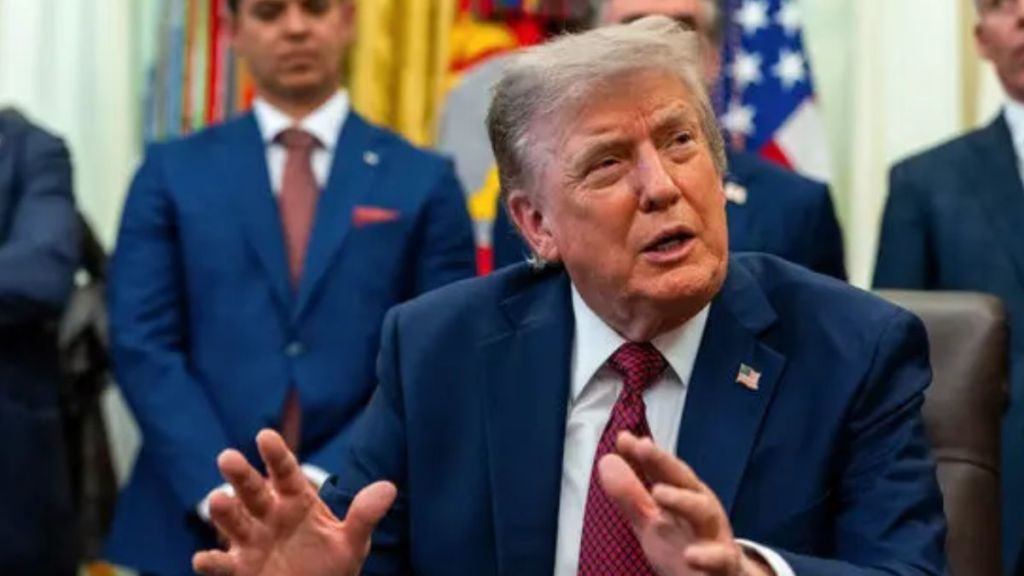

US President Donald Trump has said Washington is not negotiating with Iran but added that a decision on the conflict could come soon. His remarks came as reports said the US and Israel were preparing for possible fresh strikes on Iran, while Washington ordered some of its diplomats and their families to leave Saudi Arabia.
Speaking to NewsNation on Wednesday, Trump said, “we are going to have something, one way or the other.” He did not explain what he meant or give a timeline for any possible action.
According to ANI, Trump also acknowledged some contact with Tehran, saying talks were happening “a little bit.” He said sanctions and military pressure were working against Iran. The latest developments come as the war, which began in February, has repeatedly shifted between threats of further attacks and attempts to reach a ceasefire.
Trump signals action after US midterm elections
Trump said many people expected developments after the US midterm elections on November 3. His remarks come amid reports of differences between Washington and Israel over when to resume military action against Iran.
The Financial Times reported that Israeli Prime Minister Benjamin Netanyahu had ordered the military to prepare for a major offensive in early October. However, Trump reportedly opposed restarting the war before the midterm elections. The Israeli military, also known as the IDF, reportedly called off an operation planned for the weekend of October 10.
The White House has said the US will not attack Iran before the elections.
However, the Jerusalem Post, citing several sources, reported that the Trump administration had come “very close” to approving a strike on at least one recent occasion.
Axios also reported that Trump and Netanyahu had discussed a joint operation targeting Iran’s military and nuclear facilities. The White House denied that account, calling it false.
Hegseth meets Netanyahu as US and Israel prepare strike plans
US Defence Secretary Pete Hegseth made an unannounced visit to Israel on Monday and met Netanyahu at Ovda Air Base, according to Axios and Reuters. The visit came a day after Trump publicly backed Netanyahu, who faces voters on October 27.
Axios reported that Hegseth and senior leaders of the US Central Command are among the strongest supporters within the administration of resuming strikes against Iran. However, no decision to restart the attacks has been announced.
The New York Times reported that US and Israeli forces had drawn up plans for a short but intense military operation targeting Iran’s energy infrastructure, nuclear facilities, and missile and drone stockpiles.
A large US military force, including three aircraft carriers, is expected to be in place by early November, the report said.
Some officials believe the threat of fresh attacks could also be used to put pressure on Tehran during negotiations over its nuclear programme and control of the Strait of Hormuz, a key shipping route for global oil supplies.
Netanyahu has also used the issue in his campaign. He has told voters that Trump wants him to remain in office to “finish the job once and for all.”
US orders diplomats and families to leave Saudi Arabia
The US State Department on Wednesday ordered non-emergency government employees and their families to leave Saudi Arabia. The department cited attacks by Iran-backed Houthi forces on the kingdom, including attacks affecting its airports.
State Department spokesman Tommy Pigott said the order applied only to Saudi Arabia.
However, an AFP diplomatic source said all American staff and their families had been ordered to leave the country. According to the source, families of US embassy staff in the United Arab Emirates, Jordan, Qatar and Bahrain had also been told to leave.
The State Department has not confirmed the wider departure orders. It also described an earlier Reuters report about a withdrawal across the Gulf as inaccurate.
When asked about the reports, Trump said he did not know about them.
A State Department spokesperson warned that the security situation could deteriorate quickly, with hostilities potentially spreading beyond the immediate conflict zone.
The reported departures come as concerns grow that the US and Israel could resume military action against Iran, raising the risk of further attacks across the region.
How the US-Iran war has shifted between attacks and ceasefires
The US and Israel launched strikes against Iran on February 28, setting off a conflict that has since seen several attempts to pause the fighting.
A two-week ceasefire was announced on April 7 and later extended. However, the pause in fighting did not last.
On June 17, the two sides signed a 14-point memorandum of understanding that formalised a longer ceasefire. But attacks resumed within weeks, and Trump declared the agreement over in early July.
The US then reinstated its naval blockade of Iranian ports on July 14.
In late September, The Wall Street Journal reported that Trump had rejected Iran’s proposal for a seven-day plan to reopen the Strait of Hormuz. The report said Trump had told aides that he expected bombing to resume after the US midterm elections, while also suggesting that a deal could be reached soon after the vote.
Iran warns of response to any fresh attack
Iran has warned that it will respond if the US or Israel launches another attack.
A spokesman for Iran’s Islamic Revolutionary Guard Corps threatened to unveil a new weapon, comparing it to a counterpart of the US MOAB, or Massive Ordnance Air Blast, bomb. He did not provide further details about the weapon.
Iranian President Masoud Pezeshkian also told parliament that the country was facing a severe crisis but would stand firm.
With Washington saying it is not negotiating, reports of military preparations continuing, and American diplomatic staff leaving parts of the Gulf, the possibility of renewed fighting remains a major concern.