


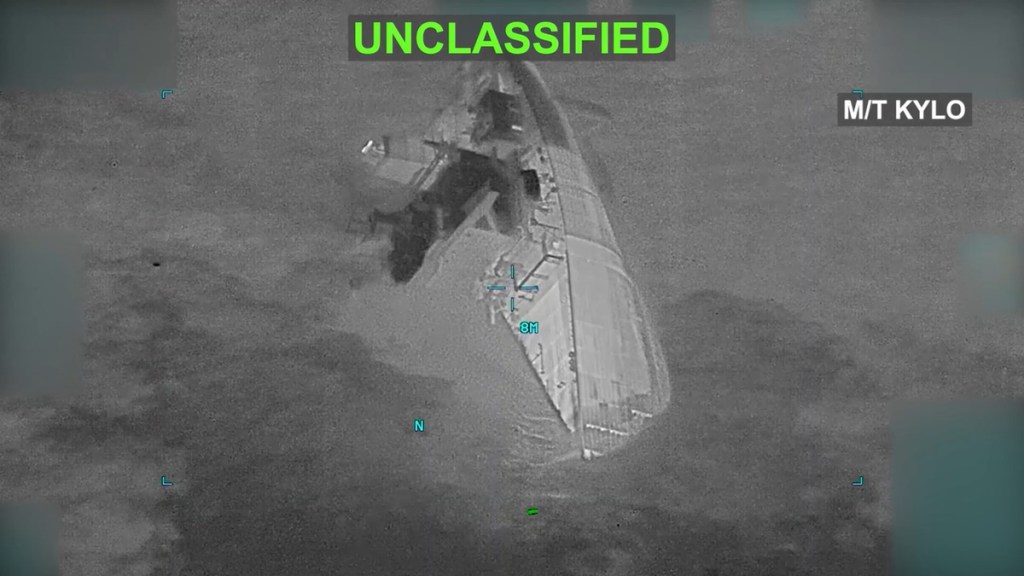

US and Iranian forces attacked vehicles passing through the Persian Gulf on Saturday — prompting “war crime” allegations from Tehran. American authorities had vowed “even higher economic cost” after the Islamic Revolutionary Guard Corps launched ballistic missiles at two US Navy ships. The fresh escalation came even as oil prices soared and diesel hit a record high in the United States.
“Thanks to the precision and professionalism of American service members, the MT Kylo sank in the Gulf of Oman today and joined Iran’s navy at the bottom of the sea,” the US Central Command posted on X alongside video footage.
CENTCOM also claimed it had “permanently disabled” IRGC crude oil carriers MT Downy off the coast of Kharg Island and MT Stark 1 near Jask. The three crude oil tankers were allegedly part of a shadow network that funds the IRGC and its regional proxies. The attack came soon after Tehran said it had targeted three tankers that were on unauthorized routes in the Strait of Hormuz.
Oil prices surge again, diesel sets record
Brent crude futures closed at $96.28 a barrel on Friday — their highest level since July 24 — as escalating tensions in West Asia drove global supply concerns. According to reports, Brent crude rose 7.6% while US crude gained nearly 10% during the week. The rally in oil prices has combined with a much steeper increase in fuel prices to push inflation and government borrowing costs higher around the world.
Meanwhile diesel prices set a retail record in the United States — with a gallon now costing $5.85 on average as per AAA data cited by Reuters. Economists cited by the publication warned that the price could rise even higher due to the sharp drawdown in inventories and as agricultural states in various parts of the country head into harvesting and planting seasons.
Iran, US exchange ‘escalation’ threats
US President Donald Trump posted an AI-generated video of Iran’s Kharg Island being “blown to smithereens” last week as tensions escalated sharply. The military has also vowed strong retaliation in case of an attack from Tehran — drawing a similar warning from Iranian authorities.
CENTCOM said its forces had struck three Iranian crude oil carriers on September 5 after the IRGC launched ballistic missiles towards two US Navy warships patrolling regional waters. The military said an aircraft carrier and a guided-missile destroyer successfully evaded multiple “unprovoked Iranian attacks” with no harm to the American personnel.
“Let the message to the IRGC be clear: If you shoot at two of our ships, we will impose an even higher economic cost —taking out three of yours. We will not hesitate to defend American forces, and if necessary, destroy Iran’s limited and exposed oil fleet,” CENTCOM quoted its head, Admiral Brad Cooper, as saying.
“These illegal and irresponsible actions, which constitute a continuation of the US military aggression against Iran and are part of the naval blockade and economic warfare imposed on the Islamic Republic of Iran, represent a clear violation of Article 2(4) of the United Nations Charter, constitute a war crime, and pose a threat to international peace and security as well as maritime trade,” the Iranian Foreign Ministry countered.
The IRGC Navy claimed America had attacked and damaged three of its oil tankers “out of desperation to close the Strait of Hormuz”. The group claimed it had subsequently targeted three oil tankers using an “unauthorised route” through the crucial waterway and “three vessels affiliated with the US in other areas”. It also urged vessels operating in and around the Strait of Hormuz to avoid what it called unauthorised waterways.
“The US terrorist army is warned that if the evil, insecurity, and harassment of Iranian ships and the naval blockade of Iran continue, the strikes by the armed forces of the Islamic Republic of Iran against US military vessels in the region will be more severe than before, and there is a possibility of its expansion,” IRIB had earlier quoted a spokesperson for Khatam al-Anbiya Central Headquarters as saying.