


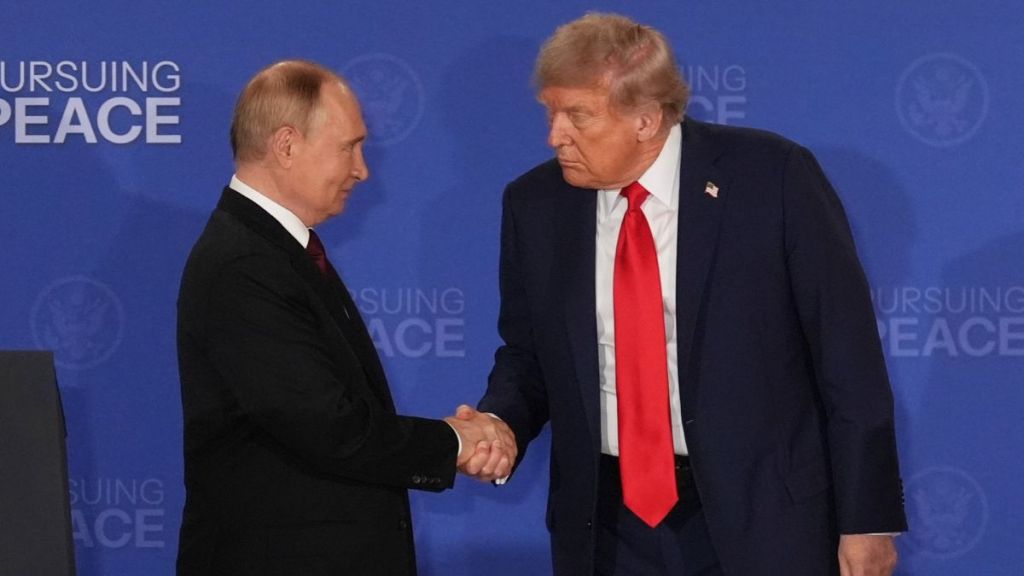

US President Donald Trump has issued a public statement defending his recent decisions against the backdrop of the ongoing Ukraine-Russia conflict. His statements took centre stage as vehement criticism continues to rise within the United States and globally (especially Ukraine) over the agreed-upon US-Russia diesel deal and the subsequent suspension of Moscow-related sanctions.
Justifying the move, the US president said on his Truth Social platform that his reversal on almost five years of sanctions targeting Russia and its trade partners meant to keep Vladimir Putin’s country on the table for further negotiations.
Conversely, Russian President Vladimir Putin is also believed to be pushing for a joint summit with Trump and Chinese leader Xi Jinping next month in a bid to negotiate an end to the Ukrainian conflict, which has now stretched beyond four years, according to a Wall Street Journal report citing sources familiar with the plan.
Putin aiming for a favourable outcome with potential US-Russia-China summit
Notably, Russia is aiming for the supposed meeting’s outcome to swing in its favour. Kremlin spokesperson Dmitry Peskov has since confirmed that discussions were taking place behind the scenes about a potential meeting between the leaders, the report noted. The WSJ article further cited a former Russian intelligence officer briefed on the matter suggesting that Putin himself had brought up the idea during the October 9 phone call with the POTUS.
The unexpected diesel deal was struck following this interaction. At the time, Trump declared that Russia would promptly supply over 300,000 tonnes of diesel, followed by an additional 500,000 tonnes in November and 1 million tons immediately thereafter.”
Moscow is also expected to deliver an extra 3 million tonnes “within a short period of time” after that, according to the US leader’s October 9 social media post.
Ukrainian President Volodymyr Zelenskyy has already hit out against the confirmed developments from the US favouring Russia, telling US outlets that siding with Putin would be a “historic mistake.” He denounced Trump’s Friday decision to waive sanctions and tariffs against Russia just days before they were set to go into effect under the law known as the Lindsey O. Graham Sanctioning Russia and Iran Act of 2026, or simply the Graham Act.
Named after the late Republican Senator Lindsey Graham, the sweeping legislative package would have targeted tariffs of up to 100% on goods imported to the US from the five largest buyers of Russian fuel. Signed into law last month, the act would have affected India as well.
“At a time when the Russians have carried out such a massive attack on our energy sector, a decision was unfortunately made in America to completely disregard the Lindsey Graham Act, which was supposed to impose truly effective pressure on Russia to bring this war to an end,” the Ukrainian leader wrote in a Saturday statement on X. “This Act could have helped enormously – and still can! But it needs to actually work, and every voice in support of it matters.”
Trump issues defence of Russian sanctions waiver
Although the late Senator Lindsey Graham, after whom the now-called-off law was named, had strongly pushed for US assistance to Ukraine, Trump has entirely flipped the conversation.
While the sanctions initially meant to exert intense pressure on Russia and push the country towards resolving the Ukrainian conflict, the US president is now repeatedly taking aim at Zelenskyy instead due to his country’s retaliatory attacks on critical Russian energy infrastructure. On top of America’s renewed support for Russia, the MAGA leader at one point even called for the Ukrainian president’s replacement, deepening his row with Zelenskyy.
“I am in the process of negotiating Peace in the war between Russia and Ukraine,” Trump said on Truth Social, adding that he didn’t want to “do anything that will drive, foolishly, Russia away from the bargaining table”.
In his social media post, Trump also said that his Ukrainian counterpart “doesn’t want to end this war, and probably never did.” Apparently turning his back on Zelenskyy, the POTUS added, “he could have made a better deal two years ago than he can now.”
US Secretary of State Marco Rubio has similarly issued reiterating statements, addressing America’s U-turn on the issue. On Saturday, he told US reporters that the president wants to take 60 days “to sort of analyse what imposing both sanctions and tariffs will mean to the global economy and even to the US economy.”
During his official trip to Uzbekistan on Monday, he again echoed the sentiment, acknowledging that it’s “very difficult” for some countries to “acquire energy from alternative sources.” In a bid to maintain a “balancing” act on the foreign policy front, the US diplomat admitted that the now-waived sanctions wouldn’t have just impacted Russia, but also a number of countries, including India, with which the US is currently attempting to finalise a much-delayed trade deal.
“You’ve got countries like India, for example, that have voluntarily diversified their energy portfolio, but are still getting a substantial amount of energy from Russia because it’s hard to pivot from one day to the next. But they’re also an important ally and partner of the United States. So we need that period of time to sort of study all this and figure out what the right combination is,” Rubio told reporters in Samarkand.
Putin-Trump-Xi summit confirmed?
As of now, nothing has been set in stone.
“There is no clear understanding yet regarding the meeting itself or its potential agenda, although all three parties acknowledge the hypothetical possibility of such a meeting taking place,” Kremlin spokesman Dmitry Peskov told the Wall Street Journal.
The US news outlet further reported that a senior US official said that Trump hasn’t agreed to such a trilateral summit, but he could be receptive to the idea, given his self-proclaimed alias as the global “peacemaker.”
Where do oil prices stand in the meantime?
Global analysts had already projected that a diesel deal with Russia wouldn’t imemdiately bring down oil prices. However, the subsequent sanctions waiver announcement has prompted rates to slip from a five-month high on Monday, as hopes of increased Russian fuel exports resurfaced.
The international benchmark, Brent crude futures, dropped $2.29, or 2.08%, to $107.57 a barrel by 0619 GMT after rising to its highest ($110/barrel) since May 19 on Friday. US West Texas Intermediate crude fell $1.95, or 1.92%, to $99.46 a barrel, after settling at its highest level since September 17 on Friday.