


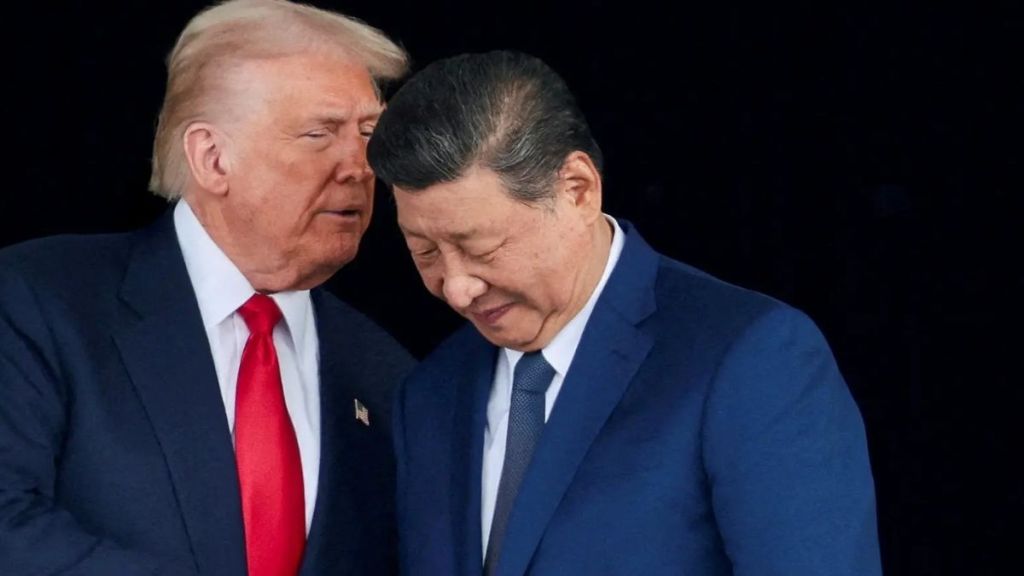

As President Donald Trump meets Chinese President Xi Jinping in Washington on Thursday, Taiwan is watching closely. The summit is expected to focus on trade, technology and efforts to manage tensions between Washington and Beijing. However, for Taipei, the biggest question is whether Taiwan’s defence relationship with the US will become part of Trump’s talks with Xi.
The reason behing the concern is a proposed $14 billion US arms package for Taiwan that has been on hold since Trump’s meeting with Xi in Beijing in May. Trump has described the weapons deal as a possible “negotiating chip”, raising concern in Taiwan that its security could become part of a wider US-China bargain.
What Trump and Xi are discussing
US officials and analysts have lowered expectations for a major breakthrough from today’s meeting. Craig Singleton of the Foundation for Defense of Democracies said the White House does not see every Trump-Xi meeting as needing to produce a major agreement, since the two leaders are expected to meet several more times this year. “The White House argument is that Trump and Xi expect to see each other repeatedly this year. So, every one of these meetings doesn’t have to result in a large splashy package,” he told reporters, according to US News.
James Lewis of the Centre for European Policy Analysis said the summit would largely revolve around three issues: Taiwan, technology and trade. “No one is expecting any big breakthroughs,” he told The National. Jon Huntsman, the former US ambassador to China and Russia, said the meetings are partly symbolic but still important because they keep communication between the two leaders open.
Taiwan waits for a decision
While Trump and Xi sit down in Washington today, Taipei is waiting to see what happens to the arms package.Taiwan’s Defense Ministry has publicly maintained that US support remains in place.Maj. Gen. Chiao Fu-chun said Taiwan would continue working with Washington to move the deal forward. “We will continue to maintain close contact with the US Department of War and continue to push forward the arms procurement deal between Taiwan and the US, ensuring it proceeds as planned,” he told reporters in Tainan, according to WTOP. There is uncertainty over when Trump will make a decision.
Reports cited by Semafor suggest the US president could wait until after the Asia-Pacific Economic Cooperation summit in November before deciding on the package.Bonnie Glaser of the German Marshall Fund said Taiwan is unlikely to dominate today’s summit in the way it did during the Trump-Xi meeting in May. However, Beijing is still expected to raise the issue.
Xi is likely to argue that continued US arms sales to Taiwan would undermine efforts to build a more stable US-China relationship, Glaser told Semafor. China has already made its position clear. Chinese Ambassador to the US Xie Feng wrote in the People’s Daily that Taiwan remains one of Beijing’s “red lines” in its dealings with Washington, alongside human rights, according to NBC News.
Zhao Hai of the Chinese Institute of Hong Kong said Beijing would prefer the current pause in US military exports to Taiwan to continue. “So far, the outcome has been quite good for China, which is the pause on US export of military equipment,” he told NBC News.A senior US official told NBC News that Trump will decide on a new arms package “in a fairly short time”. Trump approved $11.1 billion in arms sales to Taiwan in December, the largest such package Taiwan has received.
US leverage is also under scrutiny
Today’s summit comes as Washington and Beijing are entering the talks with different sources of leverage. The US has faced pressure on its military resources after months of war with Iran. China, meanwhile, has significant control over rare earths and other critical minerals that are important to US defence production.
Orville Schell of the Asia Society’s Center on US-China Relations said Washington no longer holds all the leverage in the relationship.”The United States doesn’t hold all the cards, in fact, maybe not even the preponderance of the cards,” he told NBC News.Allen Carlson of Cornell University similarly argued that China’s position has strengthened relative to the US. He said Trump’s focus at the summit would be on securing an outcome he can present as a success.
Taiwan sends its own message
As Trump and Xi meet in Washington today, Taiwan is also focusing on its own defence capabilities.On Wednesday, Taiwan’s military held live-fire drills involving the domestically developed Cheetah armoured vehicle.
The vehicle can carry a 105mm cannon and reach speeds of about 100 kph. Taiwan’s military said it was designed for different terrains and could be used in urban combat, according to WTOP. The timing puts Taiwan’s own defence efforts in focus as Taipei waits for Washington to decide on the next arms package.
Trump has also pushed Taiwan to increase defence spending. Taiwan’s defence spending is expected to exceed 3% of GDP in 2027, while President Lai Ching-te has pledged to raise it to 5% by 2030.
Trade deal already in place
For all the attention on Taiwan, the most concrete result of the Trump-Xi engagement may already have been agreed before today’s meeting. US Treasury Secretary Scott Bessent said Wednesday that Washington and Beijing had agreed to extend their trade truce through January 10. The agreement had originally been due to expire in November.
The extension followed talks between Bessent and Chinese Vice Premier He Lifeng, according to NBC News. Trump and Xi are also expected to discuss AI safety, rare earth exports and the war in Iran. This leaves Taiwan as a key issue hanging over today’s summit, even if it is not the main item on the agenda.
The focus today is therefore not only on what Trump and Xi say publicly about Taiwan. It is also on what happens behind the scenes, particularly whether the US arms package remains separate from the negotiations between Washington and Beijing.