


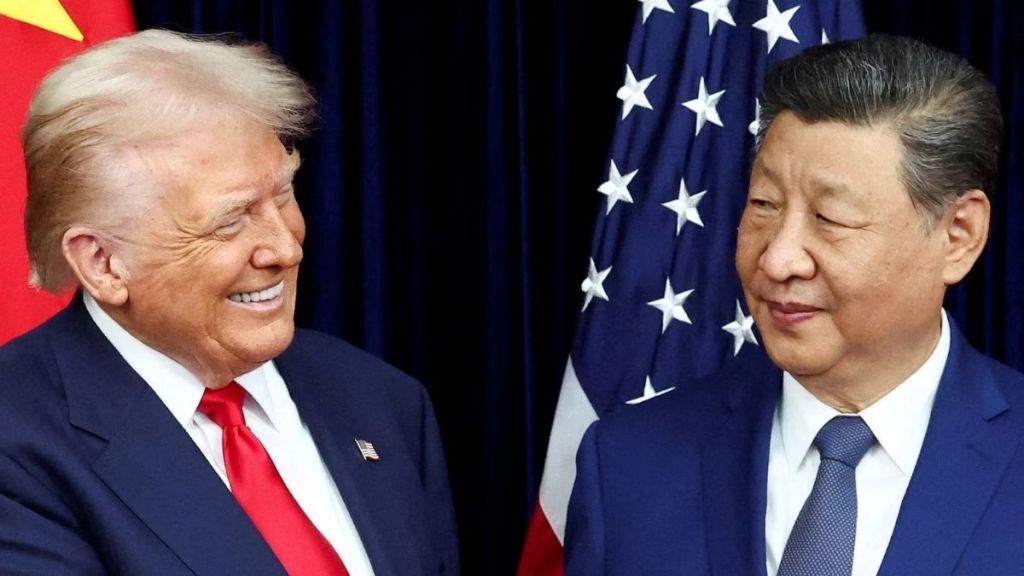

Washington is preparing for a high-stakes meeting between Donald Trump and Xi Jinping, with artificial intelligence, rare earths and trade at the centre of talks that could determine whether the US-China truce survives
For much of the past year, the United States and China have been trying to keep a fragile pause in their economic and technology rivalry from turning into another full-scale confrontation. This will face a major test on Thursday, when US President Donald Trump hosts Chinese President Xi Jinping at the White House.
Xi’s state visit to the United States, which began on September 23 and runs through September 25, is his first visit to Washington in a decade. The meeting comes as Washington and Beijing continue to compete over trade, technology and national security, even as both sides try to prevent tensions from spiralling again. Leaders are expected to discuss trade, tariffs, rare earths, AI and other major areas of disagreement.
According to Reuters, there is unlikely to be a reset in relations. Instead, the immediate focus is on keeping the existing economic truce alive while finding limited areas where the two countries can work together.Two issues stand out that is who controls the materials needed to build the technologies of the future, and who gets ahead in artificial intelligence.
AI moves to the centre
Artificial intelligence has become one of the most important new fronts in the US-China rivalry. Both countries see AI as a technology that can influence economic growth, advanced manufacturing, cybersecurity and military capabilities. Neither Washington nor Beijing appears willing to slow its push for technological leadership.
Trump has repeatedly stressed the importance of US leadership in AI. He has said, “Whoever wins AI wins.” At the same time, both countries are increasingly worried about what happens if advanced AI systems are misused.
The United States has raised concerns about cyberattacks, biological risks and the possibility that increasingly capable AI systems could be used against critical infrastructure. China has its own concerns, including the possibility that AI could be used to undermine domestic political stability.
The result is an unusual situation. Washington and Beijing are competing intensely over AI while also discussing whether they can create basic safety channels between them. This limited cooperation is already taking shape.
US Treasury Secretary Scott Bessent said Washington has proposed a notification system that would allow the two countries to alert each other about AI incidents that could have national security consequences. The proposal was discussed during Bessent’s talks with Chinese Vice Premier He Lifeng in New York ahead of the Trump-Xi meeting. The Associated Press reported that the proposed system is intended to create a communication channel for incidents involving AI that could threaten national security.
Bessent told Reuters, “We think that just like any cross-border activity, that moving from opaque to more transparency between the No. 1 and the No. 2 AI powers in the world is very important.”
Reuters reported that the two sides are also discussing AI safety, the use of open-weight models and possible guardrails against misuse. The discussions are expected to remain limited because disagreements over technology controls and access to advanced computing remain unresolved. The proposed notification mechanism therefore matters less as a major AI agreement and more as a possible first step toward communication during a crisis.
AI race is also a technology fight
The two countries’ AI rivalry goes far beyond safety. Washington has imposed restrictions on China’s access to advanced semiconductor technology used to develop and operate leading AI systems. China, meanwhile, has invested heavily in domestic AI companies and is trying to reduce its dependence on US technology.
US officials have also accused Chinese companies of using a technique known as distillation to extract capabilities from American AI models.
The allegation has become another point of friction between the two governments. China has rejected the accusations and criticised US technology restrictions as attempts to limit its development.
Reuters reported that the dispute over AI also includes advanced chips, technology transfers, regulation and the potential military use of autonomous systems.
The technology rivalry is becoming harder to separate from national security. China’s Minister of State Security Chen Yixin has warned that AI could be used by hostile forces to spread political misinformation and threaten China’s political and ideological security.
Chen wrote that hostile actors could use AI-generated audio, video, text and images to “fabricate political rumors, spread harmful information, and incite confrontational sentiments at low cost and in large quantities.”
The United States, meanwhile, is concerned about the possibility that AI systems developed in China could be used by malicious actors for cyberattacks or other dangerous activities.
There is some common ground. Both countries have an interest in preventing AI from being used for attacks that could cause widespread damage. The difficulty is that each side also views the other’s technology as a potential security threat. This makes the AI discussion at the White House particularly sensitive.
Rare earths give Beijing leverage
If AI represents the future of the technology rivalry, rare earths represent one of China’s strongest sources of leverage today.
Rare earth elements are a group of 17 metals used in products ranging from smartphones and electric vehicles to advanced electronics, defence systems and AI-related hardware.
China has a dominant position in the global supply chain, particularly in refining and processing. The World Economic Forum said access to critical minerals remains a major point of tension because China dominates much of the world’s refining capacity.
This dependence has become increasingly important for Washington. The United States wants a more secure supply of critical minerals and rare earths. China wants assurances that US export controls and other restrictions will not be used against Chinese companies without consequences.
The issue became especially important after China restricted rare earth exports during the previous escalation in the trade war. The restrictions exposed how dependent manufacturers outside China remain on Chinese processing and supply chains.
Reuters reported that China controls up to 70% of global rare earth mining, 85% of refining capacity and about 90% of rare earth metal alloy and magnet production, according to consultancy AlixPartners.
Those numbers explain why rare earths are such a powerful bargaining tool. The United States can impose tariffs or restrict Chinese access to technology. China, in turn, can use its position in critical mineral supply chains to create pressure on American industries. The result is a relationship in which both sides have tools to hurt the other, but both also have reasons to avoid using those tools too aggressively.
Busan truce faces a new test
The rare earth dispute is closely linked to the trade agreement reached by Trump and Xi in Busan last year. This agreement helped reduce the immediate pressure from the trade war and paused some Chinese export controls on rare earths and other critical minerals.
The truce is due to expire in November, leaving the two sides with a relatively short window to decide what comes next. Washington and Beijing are now trying to work out whether the arrangement can be extended.
Reuters reported that the US and China are also discussing tariff reductions involving about $30 billion of goods on each side. Potential areas include agriculture, energy, medical devices and other non-sensitive products.
The World Economic Forum said the two countries are still working to define the roughly $30 billion basket of goods that could be covered by the proposed Board of Trade mechanism. Rare earths, however, remain a major obstacle.
US Trade Representative Jamieson Greer has accused China of creating uncertainty over the continuation of the trade truce by restricting strategic mineral exports.
“They have limited rare earth exports. They’ve controlled them,” Greer said in an interview with Bloomberg News, according to reporting provided ahead of the summit. Securing reliable access to rare earths is not simply a trade issue for Washington. It is also a supply-chain and national security issue.
Why the two issues are connected
AI and critical minerals may appear to belong to different worlds. One involves software, computing power and algorithms. The other involves mines, processing plants and industrial supply chains. For the US-China relationship, they are increasingly connected.
Advanced AI requires enormous amounts of computing power, electricity, semiconductors and sophisticated hardware. Many of the technologies used in modern manufacturing also depend on critical minerals. This means control over physical supply chains can affect the development of digital technologies.
China’s position in rare earth processing gives Beijing leverage over industries that Washington sees as important for its future technological and military strength.
The United States is therefore trying to do two things at the same time. It wants to maintain its lead in advanced AI while reducing its dependence on Chinese supply chains.
This will not happen quickly. Building mines, refining facilities and alternative supply chains takes years. Until those alternatives are developed, the US remains exposed to China’s position in critical minerals.
Reuters reported that the Trump administration has taken a less aggressive approach toward Beijing ahead of the summit, with experts pointing to China’s dominance of rare earth supply chains as an important reason.
Trade still holds the relationship together
AI and rare earths may dominate the strategic discussion, but trade remains the immediate economic concern. The two countries want to prevent another tariff escalation that could affect companies and consumers around the world.
Both sides are also discussing purchases of US agricultural products and Boeing aircraft, along with possible tariff reductions on non-sensitive goods. The World Economic Forum said the leaders could also discuss extending the Busan truce and setting purchase targets for agriculture, energy and aircraft.
The Trump administration wants China to provide greater access to its market and maintain supplies of critical minerals. Beijing wants relief from tariffs and technology restrictions. Neither side has abandoned its strategic goals.
Taiwan and Iran remain in the background
The economic discussions will take place alongside major geopolitical disagreements. Taiwan remains one of the most sensitive issues in the relationship. China considers Taiwan part of its territory, while the United States maintains longstanding security commitments toward the island. The issue has already complicated US arms sales to Taiwan.
Iran is another potential source of tension. The Trump administration has increased pressure on Iran and its economic partners. China remains an important buyer of Iranian oil and maintains significant economic ties with Tehran.
Reuters reported that the US and Chinese officials have also discussed Iran in the broader negotiations surrounding the summit. Those issues could complicate an agreement on trade or technology if either side links them directly to economic concessions.
A summit about managing rivalry
When Trump and Xi sit down at the White House, the central question will not be whether the US and China can end their rivalry. Neither side appears to be seeking that. The more immediate question is whether they can keep that rivalry within limits.
AI provides one possible test. A notification mechanism for serious AI incidents would not resolve the technology race, but it could give Washington and Beijing a way to communicate during a crisis.
Rare earths provide another test. A stable supply arrangement could reduce pressure on US manufacturers while giving China continued leverage in negotiations.
Trade provides the third. Extending the existing truce could prevent another round of tariffs while leaving the deeper disagreements unresolved.
The World Economic Forum has described the summit as an effort to stabilise a fragile trade détente rather than deliver a broad reset in US-China relations. This may be the clearest way to understand what is at stake in Washington. Trump and Xi are meeting at a moment when the two countries are deeply connected economically but increasingly separated by technology and security concerns.
AI is becoming a contest over who will shape the next generation of technology. Rare earths are a reminder that control over physical resources can still determine how quickly that technology can be built. The meeting on Thursday will show how far Washington and Beijing can separate cooperation from competition.