


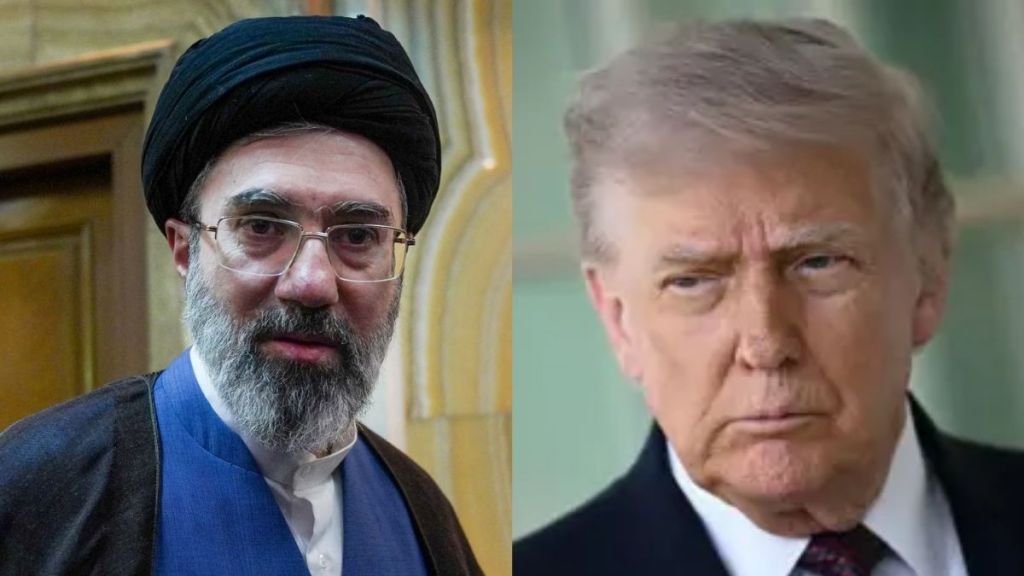

A new attempt to end the seven-month-old US-Iran war has hit a roadblock after US President Donald Trump rejected Iran’s proposal to reopen the Strait of Hormuz within seven days.
Iran had offered to reopen the key shipping route and begin talks on a nuclear deal if the US first lifted its naval blockade of Iranian ports, eased sanctions on Iranian oil and released frozen Iranian assets.
Trump rejected the proposal and later posted a map of the Strait of Hormuz on Truth Social with a new name: “Trump Strait.”
The rejection has led to an exchange of sharp statements from Iran’s president, military and foreign minister. At the same time, both sides have continued to leave some room for diplomacy.
Iran’s seven-day proposal
Iranian Foreign Minister Abbas Araghchi presented the latest proposal during the United Nations General Assembly in New York.
The proposal was sent to Washington through Qatari mediators. Under the plan, normal commercial shipping through the Strait of Hormuz could resume within seven days, but Iran wanted the US to take the first steps.
According to the proposal, the US would have to lift its naval blockade of Iranian ports, ease sanctions on Iranian oil exports, release around $12 billion in frozen Iranian assets and agree to a ceasefire covering the wider region, including Lebanon and Yemen.
In return, Iran would reopen the Strait of Hormuz to commercial ships. Talks on a final nuclear agreement would then begin on the seventh day.
Araghchi said the first steps would take four to five days and that the waterway could reopen on the sixth day.
“The choice now rests with the United States,” Araghchi said, adding that the seven-day countdown would start only “as soon as the United States accepts this plan.”
The proposal came after the US and Iran held their first indirect talks in months through mediators. US Secretary of State Marco Rubio had described those discussions as good, with the US open to further talks.
Trump rejects the deal
Trump’s response was quick.The Wall Street Journal reported that Trump had rejected the Iranian proposal. Trump then posted a map of the Strait of Hormuz labelled “Trump Strait.”
Trump has said Iran will not be allowed to get a nuclear weapon. He has also questioned whether Tehran would follow through on any agreement.
Speaking to reporters over the weekend, Trump said Iran wanted a deal because it was “losing so badly.”
“They want to make a deal, and I think that’s fine,” Trump said. “I’d like to make a deal, too. But that deal would not be acceptable.” Trump had also warned that renewed US military action remained possible.
At the same time, the picture behind the scenes has been less clear. The Wall Street Journal reported that Trump had privately told staff that he believed renewed bombing was likely, but that it could happen after the November US midterm elections.
The report suggested that political timing could be a factor, although Trump has publicly said the midterms have “nothing to do” with his thinking on Iran.
A separate US official told reporters that the mediated talks with Iran had been “positive and constructive”, showing a difference between the private diplomatic discussions and Trump’s public rejection.
This is not the first time Trump has talked about changing the status of the Strait of Hormuz.
In August, he shared an earlier map suggesting that the waterway could become “new US territory.” He also told reporters that Washington already “controls it with the blockade” and called the idea of making it US territory “a great idea.”
The latest “Trump Strait” post came as Iran’s president and foreign minister were returning from the UN meetings in New York.
Pezeshkian: ‘We will stand until our last breath’
Iranian President Masoud Pezeshkian responded to Trump’s rejection with a strong message. After returning from the UN General Assembly, Pezeshkian spoke to a crowd at Tehran’s airport.
“We will stand until our last breath,” he told the crowd.
The statement followed his message at the UN General Assembly earlier in the week, where he said Iran would continue defending itself and would not surrender. He also said Iran remained ready for dialogue and negotiations without accepting the use of force.
Pezeshkian later told Al Jazeera that Iran had lost trust in the US negotiating process.
“We have no trust in the American side,” he said, questioning how an understanding could be reached with Washington.
He said earlier rounds of negotiations had been followed by attacks and new sanctions instead of a reduction in tensions. Pezeshkian also rejected the US position on the Strait of Hormuz. He said the US had “closed the routes before us” and described Iran’s own closure of the waterway as a reaction to that move.
He also said Iran “has not attacked any country in 200 years” and accused the US and Israel of starting the war while believing Iran’s government would collapse within days.
At the same time, Pezeshkian confirmed that Qatar and Pakistan were still passing messages between Iran and the US.
He said the current diplomatic effort was based on the Islamabad Memorandum of Understanding agreed between the two sides in June. According to Pezeshkian, that agreement had since lapsed, and Washington now needed to clarify its position.
Iran’s military issues warning
Brigadier General Abolfazl Shekarchi, a senior spokesperson for Iran’s armed forces, told Iranian state television that Iran would not retreat.
He described Iran as highly experienced in asymmetric warfare and warned the US against trying to take control of the Strait of Hormuz. “They will receive a slap from the Iranian Armed Forces,” Shekarchi said, according to ANI.
He also called on American forces to “leave our region.” Shekarchi warned that ships using Hormuz outside routes designated by Iran “will not have security.”
That warning could affect commercial shipping companies, insurers and oil traders that are already watching the situation around the strait closely.
He also sent a message to Gulf countries that are considering closer ties with Washington, telling them to “get your act together.” According to Shekarchi, they would not be getting “any warm water from America.”
Araghchi says only negotiations can end the crisis
Iran’s foreign minister also continued to defend Tehran’s position. Araghchi said Iran’s conditions for reopening Hormuz remained unchanged and that the waterway could be reopened only after those conditions were met.
“Only a negotiated solution can get them out of this deadlock,” he wrote on social media.
Reuters also reported that Iran had separately contacted regional rival Saudi Arabia over the Strait of Hormuz.