


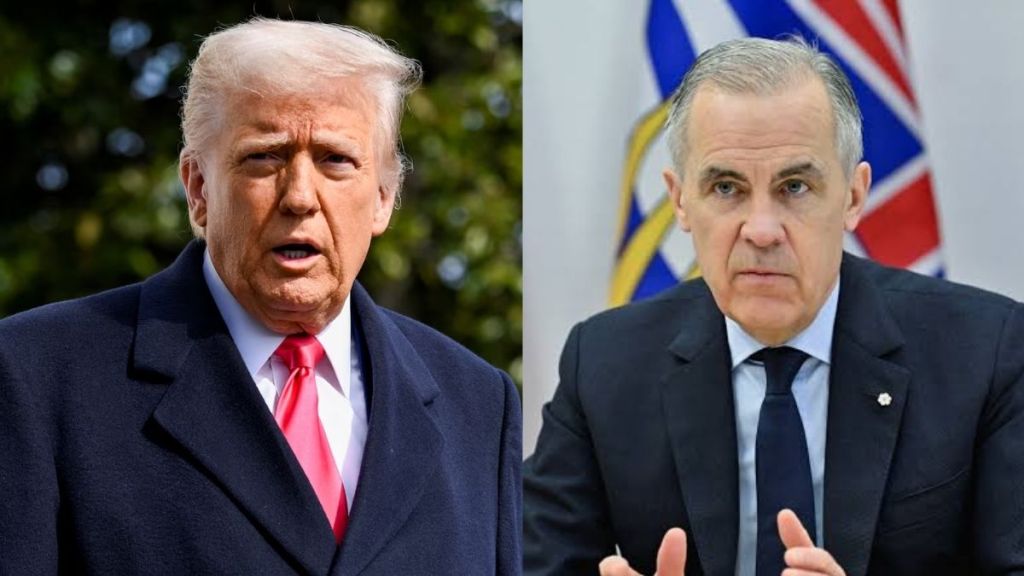

US President Donald Trump signed an order on Friday, ending 50% tariffs on some Canadian agricultural and forestry products. The 50% duties were imposed on $20 billion of Canadian goods after trade talks between Washington and Ottawa collapsed in August. However, now, tariffs on products including “plywood sheets, some paper products, certain machinery and refrigeration equipment” will be eased on October 30, the White House said on October 23 (US time).
The move comes as the MAGA leader’s duties on Canada have soured relations between the two sides while also leading to problems for US businesses in several US states that rely on Canadian goods. Earlier this week, Canadian Prime Minister Mark Carney accused the Republican leader’s levies of driving up costs for US families, putting Ontario workers and businesses at a disadvantage, and tarnishing decades-old trade ties.
Trump’s tariff relief announcement tied to the US midterm elections?
The decision came to the forefront as an incumbent Maine US Senator for Trump’s own Republican Party is currently contesting a re-election battle in the forthcoming November midterm elections. Republican Senator Susan Collins first announced the abrupt development, noting it would help the agriculture industry in Maine, a state that borders Canada. The tariff relief is set to take effect four days before the elections.
Taking note of how the relief would help the state’s producers of blueberries, potatoes, apples, and seaweed, Collins said, “These producers are a vital part of our state’s economy and support our rural and coastal communities.”
“Many of our farmers and growers rely on specialized equipment, packaging materials and other products from Canada that are either unavailable from American suppliers or cannot be replaced without incurring significant expense.”
Just days ago, a new lawsuit filed by Gellert Global Group, a New Jersey-based food importer, challenged Trump’s original decision to invoke a Depression-era law to impose these 50% tariffs on Canadian goods. Back in July, Trump used Section 338 of the Tariff Act of 1930 over alleged trade discrimination by Ottawa. It marked the first time the nearly 100-year-old law was used to impose a tariff.
Meanwhile, Collin’s Democratic opponent Troy Jackson, who clashed with her over the tariff issue at a debate event earlier this month, has since responded to Trump’s action on Friday. “Trump’s trade wars have made life harder and more expensive for Mainers,” he said. “Susan Collins enabled this chaos, voted to confirm the people behind it and now wants credit for bringing a cup of water to put out the fire.”
The midterms are a crucial race for power in the US because they will determine which party controls the US Congress, significantly impacting how Trump’s final two years in the office take shape. Currently, Republicans control both US chambers. However, Trump’s tumbling popularity across US polls—due to reasons including the consistently rising cost of living and price spikes—could pave the way for Democrats to reclaim their stance and aggressively scrutinise the MAGA leader’s presidential power.
Where does the US-Canada trade deal stand?
After Trump imposed the hefty 50% duties on billions-worth of Canadian imports in August, Canada pulled a tit-for-tat move, retaliating with tariffs ranging from 15% to 50% on $20 billion in US goods the following month.
Subsequently, the POTUS even threatened to ban Canadian jet maker Bombardier from the American market, prompting local backlash from Kansas, where the company has 1,500 workers in Wichita. Trump ultimately let go of the potential ban this week as Kansas lawmakers, including Republican Senator Roger Marshall, who is also running in the re-election race, persuaded him.
On Friday (US time), Trump told reporters that Canada is working on a deal.
“We’re very close to a deal with Mexico. It’ll be a very good deal for…hopefully them, but it’s going to be a good deal for us. So we will make it,” the POTUS said. “The same thing with Canada.”
He continued, “Canada is working very hard to make a deal with us. And I hate to say this, but we have all the cards in both of them…We have all the cards.”
In the meantime, Canadian PM Mark Carney has also dismissed US accusations that Canada is planning to interfere in the midterm elections.
“There is no merit to these claims. So I’ll call it out that way,” Carney said to reporters during an official visit to Istanbul, Turkey. The response referred to US Ambassador Pete Hoekstra’s remarks made in a podcast, as he told Canadians to “keep your nose out of American politics.”
Carney went on, “I’m disappointed that their envoy sees that as his role to make these suggestions. We have a very deep diplomatic presence in the United States. We have lots of interaction with American companies, citizens, individuals, stakeholders, more broadly.”
He further asserted, “We’re very, very careful to not be seen, to not be seen to interfere. We have no intention to interfere with their democratic processes.”