



Diesel has suddenly become a major political issue in Washington.
US President Donald Trump said on Tuesday that he supports stopping American diesel exports as fuel prices continue to rise. Treasury Secretary Scott Bessent, who was standing with Trump, said the administration was studying whether a full or partial export ban could actually be implemented.
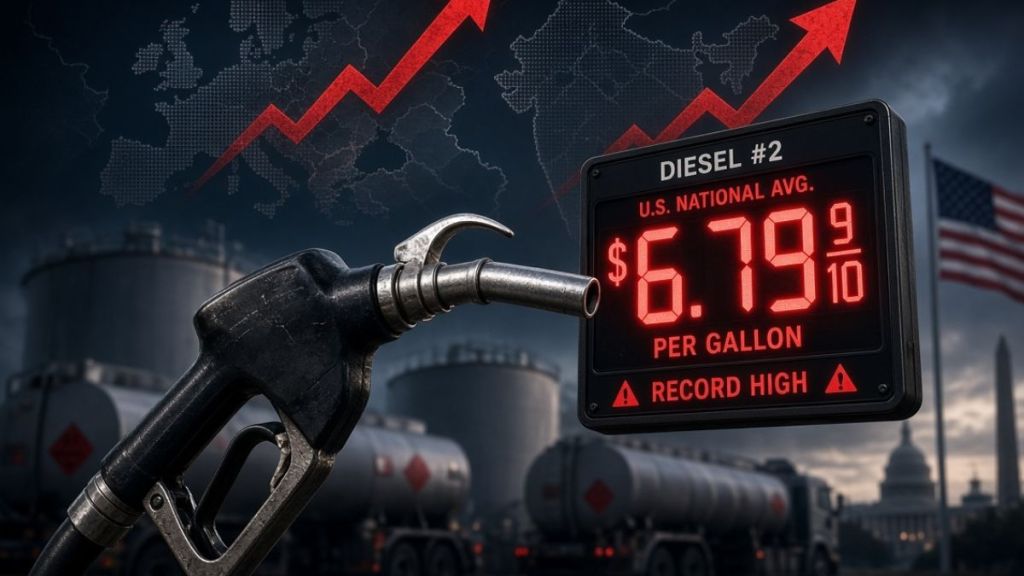
The proposal comes as US diesel prices have reached record levels and just weeks before the November midterm elections. Diesel is especially important for trucks, farming, construction and other parts of the economy, so a sharp rise in its price can push up costs well beyond the fuel pump.
But the problem is not limited to the US. The country has become a key diesel supplier as Europe and other markets seek alternatives to Russian fuel. A US export ban could keep more diesel at home and offer some short-term price relief, but it could also reduce global supplies. Analysts warn this could worsen pressure on Europe, which is already facing record diesel prices and lower supplies from Russia and the Middle East.
Why diesel prices are rising
The current diesel shortage is being driven by several problems at once.
One of them is the war involving Iran. Fighting and disruptions around the Strait of Hormuz have affected oil and fuel shipments from the Middle East.
S&P Global said Middle Eastern diesel exports to Europe were heading towards a six-year low in September. Exports were averaging about 110,000 barrels a day so far this month, compared with 191,000 barrels a day in August.
The International Energy Agency has also reported that net diesel and gasoil exports from Gulf countries in August were only a little more than a quarter of their level before the war began.
At the same time, the Russia-Ukraine war has created another problem for the global diesel market.
Ukraine has been attacking Russian oil refineries with drones. The strikes have reduced some refining capacity and added pressure to Russia’s domestic fuel market.
Trump has openly asked Ukrainian President Volodymyr Zelenskyy to stop attacking Russian diesel facilities.
“Mr. Zelenskyy has to do one thing. He has to stop knocking out diesel fuel in Russia,” Trump said on September 13.
“We spoke to Mr. Zelenskyy about it. There are plenty of other targets. Don’t hit diesel fuel, because that’s hurting, that’s hurting the world,” he said.
Russia has also restricted diesel exports, further reducing the amount of fuel available to the global market. S&P Global reported that Moscow had extended its diesel export restrictions into October.
Europe is feeling the pressure
Europe is largely exposed because it has reduced its dependence on Russian fuel and now needs more supplies from other countries. European diesel prices reached a record on September 15, according to S&P Global. The Northwest Europe benchmark reached $1,642.25 per metric tonne, the highest level since the price assessment began. It eased the next day but remained at the second-highest level on record.
The pressure has become so strong that diesel prices in Europe have also moved above jet fuel prices, according to market data cited by S&P Global.
With Middle Eastern and Russian supplies under pressure, Europe has increasingly turned to the US and other suppliers for diesel.
India has become an important part of Europe’s diesel supply
Indian refiners supplied about 60% of the diesel and gasoil that moved through the Bab-el-Mandeb route towards Europe in August, according to data from energy analytics firm Vortexa cited by Business Standard. Around 200,000 barrels a day of diesel and gasoil moved through the route on ships headed for Europe that month.
Indian refiners have also been major buyers of Russian crude. Russia remained India’s biggest crude supplier in August, although Indian purchases had fallen from the record levels seen earlier in the summer. Reuters reported that India’s Russian crude imports fell to about 2.1 million barrels a day in August and were expected to fall further in September.
On the other hand, Washington is putting pressure on countries that continue buying Russian oil. A US sanctions law signed last week gives Trump the power to impose tariffs on countries buying Russian crude.
Indian refiners have therefore started looking for alternative supplies for future cargoes, according to Reuters.
If Indian refiners reduce Russian crude purchases, that could also affect how much diesel they can supply to Europe.
However, a proposed US ban on diesel exports is unlikely to directly affect India, as the two countries follow very different trade routes for refined fuels. India does not depend on the US for diesel supplies. Instead, it has a large refining industry that processes crude oil, including cheaper Russian crude, into diesel for both domestic consumption and exports.
The bigger impact of a US export ban would likely be felt in Latin America and parts of Europe, which depend heavily on US diesel shipments.
Bessent says US studying the ban
US Treasury Secretary Scott Bessent, who was with Trump at the meeting, said the administration was looking at whether a diesel export ban was possible.
He said officials were also examining whether a full ban or a partial ban would work.
Several Republican candidates in closely watched races have also called for limits on diesel exports.
US Senator Dan Sullivan of Alaska said American fuel should remain in the country until domestic reserves improve.
“American fuel should stay home with Americans,” Sullivan said in a statement on Tuesday. “The cost of diesel is just too damn high. I’m calling for a temporary pause of American diesel exports so that we can rebuild our reserves ahead of winter and put American and Alaskan families first.”
Republican candidates Ashley Hinson in Iowa and Mike Rogers in Michigan have also called for a pause in diesel exports. Both have separately called for a quick end to the war in Iran, putting them at odds with Trump on that issue.
Energy officials warn of a supply problem
Trump’s support for a diesel export ban has raised questions within his own administration.
Energy Secretary Chris Wright warned that stopping exports could leave the US Gulf Coast with more diesel than the market needs. That could then force refiners to cut production, which could also reduce gasoline supplies.
“If you start putting barriers on flows, pretty quickly you will reduce the production, and you’ll have less supply. We need more supply, not less supply,” Wright said at a Daily Caller event last week.
Interior Secretary Doug Burgum has also questioned whether an export ban would actually bring down fuel prices.
Burgum said the move could lead to retaliation from other countries that export energy to the US. He also warned that some states, including California, depend on energy supplies from overseas.