


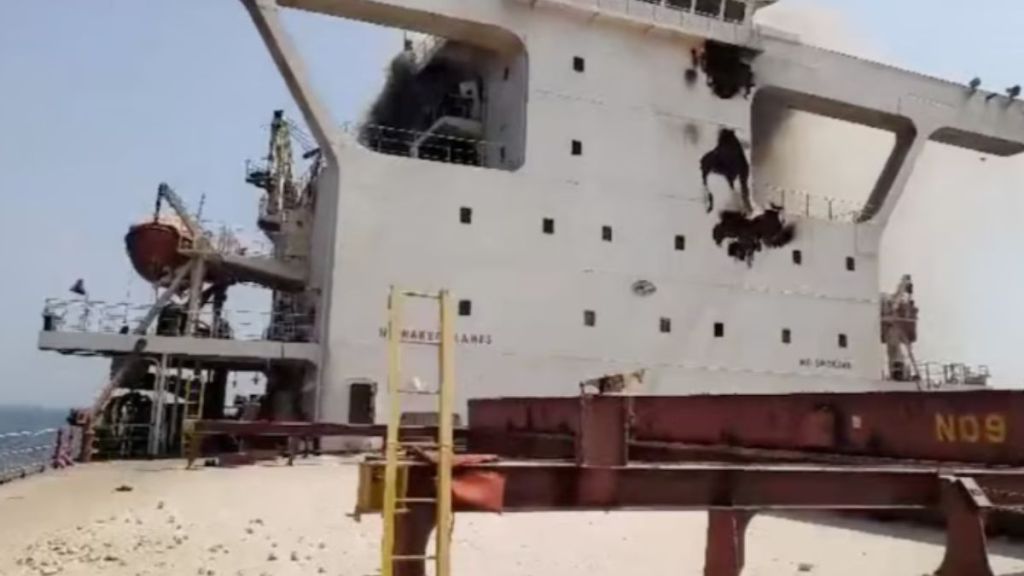

A container ship flying the Singapore flag sank in the Strait of Hormuz this week after being hit by a projectile, adding to a growing number of attacks on commercial vessels in the region. The sinking of the GFS Pride comes as the United States moves another aircraft carrier group towards the Gulf, Iran warns that it could launch a preemptive strike, and Israeli Prime Minister Benjamin Netanyahu says he does not favour attacking Iran before Israel’s October 27 election.
No one was injured when the GFS Pride sank. However, more than 20 vessels, most of them oil tankers, have come under attack in the region this month, raising new concerns about the safety of shipping through one of the world’s most important routes for oil trade.
The war began on February 28, when the US and Israel launched strikes on Iran. A ceasefire agreed in April later collapsed after attacks on commercial shipping resumed. The US has since imposed a blockade on Iranian ports, while Tehran has restricted passage through the Strait of Hormuz.
Open-source flight-tracking data has also shown a sharp recent increase in US military cargo flights, particularly C-17 aircraft, which are used to transport troops, equipment and supplies. However, the scale and purpose of the reported increase have not been independently confirmed.
GFS Pride sinks after being hit by projectile
The GFS Pride, a small container ship that can carry 2,824 twenty-foot containers, was struck on Tuesday, October 13, while passing through the Strait of Hormuz, Singapore’s Maritime and Port Authority said.
The vessel caught fire before sinking. All 21 crew members were evacuated safely, and no injuries were reported.
The authority said it was deeply concerned about the continued attacks on commercial shipping in the strait. Reuters reported that the ship’s manager, UAE-based GFS Ship Management FZE, could not be reached for comment.
Another Singapore-registered vessel, the GFS Giselle, was also hit by an unidentified projectile around the same time, on October 14 Singapore time. The ship suffered damage to its hull but managed to reach a safe anchorage under its own power. All 22 crew members were safe.
The UK Maritime Trade Operations agency separately reported that two container ships, whose names were not disclosed, were hit by unidentified projectiles on Tuesday evening between 16:40 and 17:00 GMT.
US sends more troops and another aircraft carrier towards Gulf
Meanwhile, the US military is increasing its presence in the region as tensions rise. The USS Theodore Roosevelt carrier strike group left San Diego on September 27. The Makin Island Amphibious Ready Group followed the next day, with the USS Anchorage, USS John P. Murtha and the 13th Marine Expeditionary Unit, according to Maritime Executive and the US Naval Institute.
Citing US officials, the Associated Press reported that the additional deployment involves between 9,000 and 10,000 troops, with personnel expected to arrive by the end of November. The Roosevelt carrier group brings more than 7,000 sailors, while the Marine expeditionary unit has about 2,000 to 2,200 personnel.
The US already has more than 50,000 military personnel in the region, officials told AP and The Wall Street Journal. AP described the deployment as the biggest US military buildup in the region since the 2003 invasion of Iraq.
In the Arabian Sea, the USS George H.W. Bush and USS George Washington are enforcing the blockade of Iranian ports and helping protect commercial vessels passing through the Strait of Hormuz, the Jerusalem Post reported.
However, it is not yet certain that three US aircraft carrier groups will be operating in the region at the same time. The Wall Street Journal reported that the Roosevelt is expected to replace the Washington, which arrived in the region in mid-August to take over from the USS Abraham Lincoln. The Lincoln’s crew had spent more than 260 consecutive days at sea.
US weighs military options ahead of midterm elections
The growing military presence comes as the Trump administration considers its next steps against Iran. The Atlantic reported on October 7 that the White House had asked the Pentagon to prepare military options that could be used before the November 3 US midterm elections.
A US official told the publication that US Central Command was preparing the options. No decision had been made on the scale of a possible operation, its targets or whether it would go ahead.
The New York Times reported that the Pentagon had prepared options for a military campaign lasting about three days. Possible targets include Iran’s missile and drone arsenal, energy facilities and command posts belonging to the Revolutionary Guards.
However, Trump said on October 8 that the US would not attack Iran before the midterm elections.
“We will not be attacking Iran at any time prior to the Midterm Elections,” Trump wrote on Truth Social. He said talks with Tehran were productive but added that the US blockade would remain in full force.
Netanyahu does not favour attacking Iran before Israel election
Israeli Prime Minister Benjamin Netanyahu said on Wednesday that he did not favour a preemptive strike on Iran before Israel votes on October 27.
Speaking to Army Radio, Netanyahu was asked about claims by his political rivals that he wanted a military confrontation with Iran before the election.
“Even if Iran fires missiles at us they will blame me,” he said.
Netanyahu repeated that Israel would respond forcefully if attacked. He also said Iran-backed groups were looking to strike Israel before the election.
However, he declined to discuss whether Israel could take military action after the vote. He also refused to share details of his recent talks with Washington about Iran. Israel and Iran have not exchanged fire since June, Reuters reported. Israel has also fought Hezbollah in Lebanon during the war.
Iran says its military is ready to strike first
Iran’s military has also warned that it could attack before facing a new strike from the US or Israel. Army spokesman Brigadier General Mohammad Akrami-Nia told Iran’s state news agency IRNA on October 7 that the armed forces would carry out preemptive operations “should circumstances require it.”
He said Iran had changed its military approach from defence to offence. He pointed to a missile strike on a US base in Jordan in July as an example.
Speaking to Press TV, Akrami-Nia warned that any new Iranian operation would be “more crushing, broader, more decisive, and faster.”
A week earlier, he told the Mehr news agency: “After the 12-day war, we advanced our strategy toward preemptive war.”
Reports earlier surfaced that Iran’s leaders were working on the assumption that the US would attack. According to the report, officials in Tehran were debating whether Iran should strike first.
Iran International reported in early September that calls for a preemptive strike were growing in Iran. However, it noted that no formal change in the country’s military doctrine had been announced.
Iranian Parliament Speaker Mohammad Baqer Qalibaf also warned Washington against launching an attack.
“Try it, and you will receive our response,” he said.
Brigadier General Mohammad Reza Naqdi, an adviser to Iran’s Revolutionary Guards, said the Strait of Hormuz would remain closed and under the full control of the armed forces until Iran’s demands were met.
Iran says ship hit a naval mine
In a statement carried by the Tasnim news agency, the Guards said a container ship carrying more than 2,500 containers had hit a naval mine and sunk after using a route that had not been authorised.
However, Singapore’s maritime authority and maritime security sources described the incident as an attack involving an unidentified projectile.
Security firm Marisks said it had found no independent evidence to support the claim that a mine had caused the sinking. It described the Iranian account as consistent with a “psychological operations campaign” aimed at discouraging commercial shipping from using the strait.
Another ship sinks as attacks take a growing toll
The GFS Pride was not the only vessel reported to have sunk near the Strait of Hormuz during the war.
Reuters reported that the dry bulk carrier Cape Dao also sank after an earlier attack. The ship, which flew the flag of Antigua and Barbuda, was struck on September 23, about 2.5 nautical miles off Oman’s Musandam peninsula. It was travelling from Mina Saqr in the United Arab Emirates to India.
An Indian seafarer was killed in the incident, while 19 others were rescued, according to Indian media reports.
By September 23, the IMO’s tracker had recorded 83 confirmed incidents and 23 seafarer deaths in and around the strait since the war began.
Iran has said it is increasing attacks in response to the US blockade of its ports and tougher sanctions introduced last month.
Shipping traffic remains far below pre-war levels
Brigadier General Amirahmadi, an adviser to Iran’s Revolutionary Guards, said international organisations recorded an average of about 10 ships passing through the Strait of Hormuz each day, compared with nearly 125 before the war.
US officials have offered different figures for oil shipments through the waterway.
US President Donald Trump said 22 million barrels of oil passed through the strait in a single night last week. US Central Command also said it had helped Gulf partners move more than 19 million barrels of crude oil through the waterway on a recent day.