


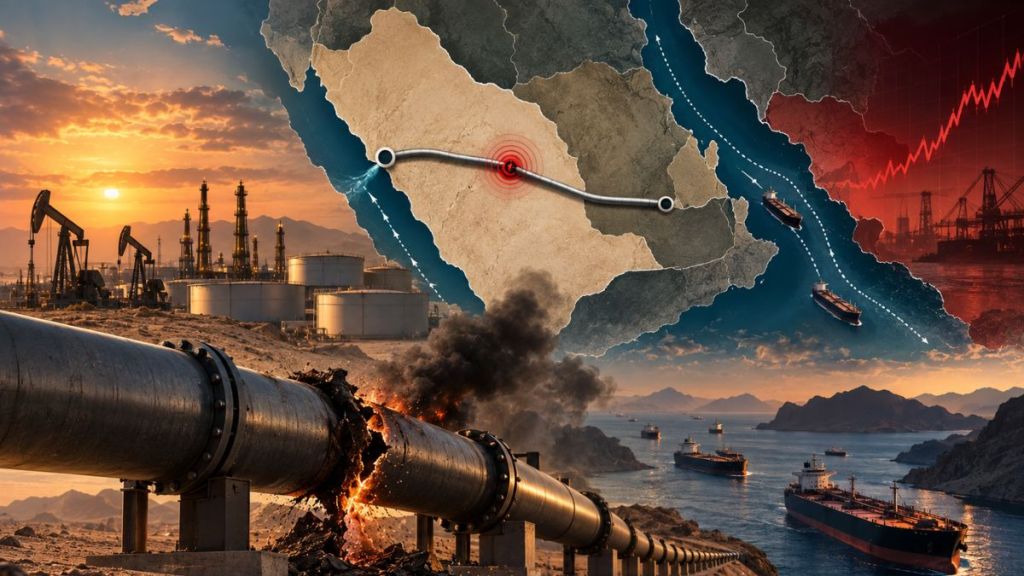

Saudi Arabia shut down its East-West oil pipeline after a drone attack, putting another major strain on an already disrupted global oil market. The pipeline has been one of the kingdom’s most important alternatives to shipping crude through the Strait of Hormuz, where oil flows have been sharply reduced since the war with Iran began.
The 1,200km pipeline, also known as the Petroline, carries crude from Saudi Arabia’s eastern oil fields across the Arabian Peninsula to the Red Sea port of Yanbu. Its key advantage is that it allows Saudi Arabia to move oil to the Red Sea without sending tankers through the Strait of Hormuz.
This alternative has become particularly important during the conflict. Before the war, more than 20 million barrels of oil a day, or more than a fifth of global oil supply, moved through the Strait of Hormuz. Reuters now estimates that flows have fallen to about 6 million to 9 million barrels per day.
What happened to the pipeline
Saudi Arabia closed the pipeline after drones struck it in two areas around Riyadh and Medina, according to Saudi officials. The country’s Ministry of Energy described the shutdown as a precautionary measure after the attack caused damage and injuries. Saudi authorities said the drones were launched from Maysan province in southeastern Iraq, close to the Iranian border and an area where Iran-aligned armed groups have a longstanding presence.
The exact extent of the damage remains unclear. Sources familiar with the incident told Reuters that repairs could take five to six weeks, while another source said the pipeline could resume operations sooner and potentially pump partially while repairs continue. AP, meanwhile, cited two regional officials who estimated that repairs could take three to five weeks.
The attack follows a strike in March near the Saudi-Aramco-ExxonMobil refinery in Yanbu, which temporarily disrupted crude loadings from the Red Sea port. Shipments recovered within days, but the incident showed that Saudi Arabia’s western oil infrastructure could also be exposed to attacks.
Why the East-West pipeline is so important
The pipeline was built in 1981 and stretches about 1,200km from Saudi Arabia’s eastern oil fields near Abqaiq to Yanbu on the Red Sea. It was designed in part to provide an alternative route for Saudi crude if shipping through Hormuz was disrupted.
The pipeline has a maximum capacity of seven million barrels per day. Actual flows, however, have varied considerably. Kpler data cited by Al Jazeera showed flows of about two million barrels per day in August, the lowest monthly level since January, as Houthi attacks made the Red Sea route increasingly difficult to use.
During the first five months of the conflict, Saudi Arabia increased the amount of crude sent west through the pipeline to roughly 4 million to 5 million barrels per day, according to Al Jazeera. This was equivalent to around 4% to 5% of global oil supply and allowed Saudi Arabia, the world’s second-largest oil exporter, to bypass Hormuz when shipping conditions deteriorated.
Rystad Energy told Al Jazeera the pipeline carried an average of 2.6 million to 4 million barrels of oil per day to Yanbu from late August. That entire volume is now at risk of “disappearing from the market.”
Saudi Arabia has little room for disruption
The immediate problem is that Saudi Arabia cannot keep exporting through Yanbu indefinitely without the pipeline.
Reuters said Yanbu has enough stocks to maintain exports for only five to seven days. Saudi oil can also be supplied for several additional days from Egypt’s Ain Sukhna and Sidi Kerir facilities, which store Saudi crude. But those stocks are not unlimited and will eventually run out if the East-West pipeline does not resume operations.
Yanbu has an estimated storage capacity of about 35 million barrels, while Ain Sukhna and Sidi Kerir can store around 18 million and 20 million barrels respectively, according to industry estimates cited by Reuters.
This makes the duration of the shutdown critical. A short interruption could be absorbed through existing inventories and alternative routes. A prolonged outage, particularly if attacks continue to threaten Saudi infrastructure and shipping, could remove millions of barrels per day from an already tight market.
Hormuz and the Red Sea are both under pressure
The pipeline does not operate in isolation. Its closure comes as Saudi Arabia faces disruptions on both sides of its oil-export network.
Flows through the Strait of Hormuz have fallen sharply from the roughly 20 million barrels per day that passed through before the war. Lloyd’s List Intelligence counted 90 tanker transits through the strait in the first week of September, compared with about 130 ships a day before the conflict.
At the southern end of the Red Sea, the situation has also deteriorated. Melius Research estimated that around 3 million barrels of oil a day were moving through the Bab el-Mandeb Strait in early September, but said Monday that “it’s likely zero now.”
Because of Houthi attacks, much of the Saudi crude moving from Yanbu had been travelling north towards the Mediterranean, either through the Suez Canal or Egypt’s SUMED pipeline. But the Houthis have also begun targeting Saudi shipping in the north, according to AP. This leaves Saudi Arabia with fewer reliable options for moving its crude.
How much oil could be lost
The potential scale of the disruption is significant. Reuters reported that Saudi Arabia had been using the East-West pipeline to reroute around 4 million barrels per day, equivalent to roughly 4% of global oil supply. Saudi oil buyers and traders told Reuters that the kingdom could run out of export stocks if the pipeline is not restarted within days.
AP, citing Rystad Energy, put the amount of oil that moved through the pipeline and out of Yanbu since late August at between 2.6 million and 4 million barrels per day. Rystad said that volume is now at risk of disappearing from the market.
The disruption comes at a time when Saudi production has already fallen sharply. The International Energy Agency said Saudi oil supply reached a more than three-decade low in August because of disruptions affecting Hormuz and the Red Sea. The IEA expects global oil supply to decline by about 5.7 million barrels per day this year, equivalent to roughly 6% of global supply.
What it means for oil prices
The global oil market had already been under pressure before the pipeline shutdown. Stockpiles and releases from strategic reserves have helped cushion the impact, with Brent crude trading around $70-$90 a barrel in recent months. On September 14, it even crossed $108. But the longer regional disruptions continue, the more those reserves could be depleted.
The latest disruption is already being reflected in prices. AP reported that Brent crude, the international benchmark, traded above $105 a barrel on Monday. Rystad’s Janiv Shah said the recent jump in Brent prices showed that the market was already responding to “a significant loss of supply.”
The consequences extend beyond petrol and diesel. AP said countries in Asia and Africa that depend heavily on Middle Eastern oil have seen some of the sharpest increases in fuel prices. In the US, regular gasoline averaged nearly $4.32 a gallon on Monday, up almost 45% from $2.98 before the war, while diesel reached $6.23 a gallon, nearly 66% higher than at the start of the conflict, according to AAA data cited by AP.
Higher diesel prices can also feed into the cost of other goods because diesel is widely used by long-haul trucks, delivery networks and farm equipment. Melius Research analysts warned that “An inflationary spillover is likely,” pointing to pressure on essentials including fertilizer and energy.
For Saudi Arabia, the East-West pipeline was built precisely for a scenario in which Hormuz becomes difficult or impossible to use. But the current crisis is showing the limits of that insurance policy.
Saudi Arabia can still move some oil through Hormuz. Salvatore Mercogliano, a professor of maritime history at Campbell University, told AP, “If this (East-West pipeline) was the only method for Saudi Arabia to get their oil out it would be absolutely cataclysmic,” but added, “But since the Hormuz route has opened back up — not completely but opened up some it’s not the death knell for Saudi Arabia. They’re getting oil out.”
The bigger concern is what happens if the pipeline remains offline while threats to Hormuz, Yanbu and Red Sea shipping continue. Al Jazeera cited Gavekal Research as warning that if Yanbu, which processes more than one million barrels per day, also goes offline because of Houthi drone threats, “this would be a disaster for the world at a time when global refining capacity is already critically tight.”
In that scenario, Saudi Arabia’s ability to compensate for lost Gulf exports would itself become constrained turning a regional shipping disruption into a much broader global oil-supply problem.