


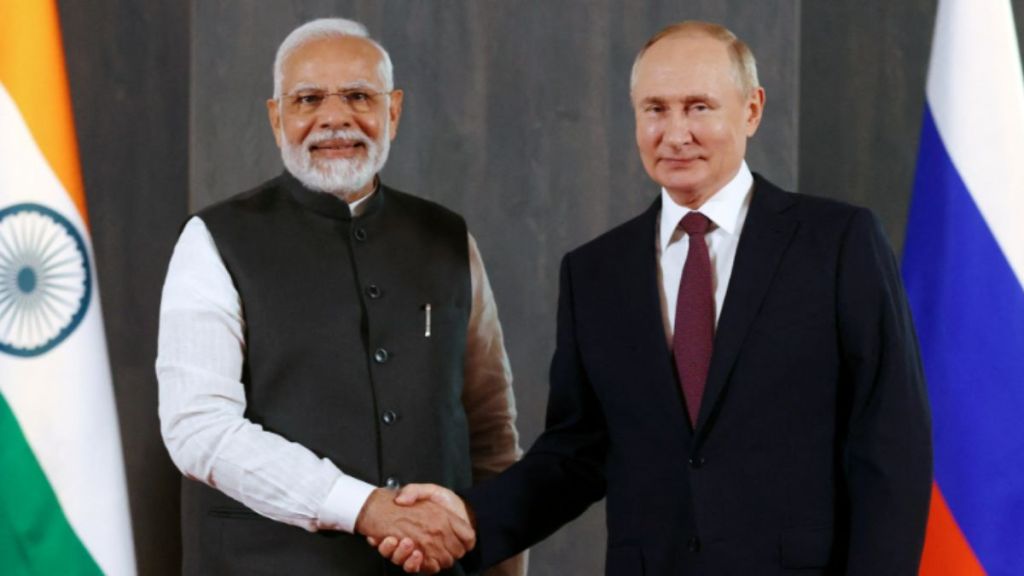

Russia has backed India’s longstanding bid for a permanent seat on the United Nations Security Council, with Foreign Minister Sergey Lavrov calling for greater representation of Asia, Africa and Latin America in the UN’s top decision-making body.
Addressing the 81st session of the UN General Assembly in New York on Saturday, Lavrov said Moscow supports the candidatures of India and Brazil for permanent seats on the Security Council.
“We are in favour of broadening the representation of Asia, Africa, and Latin America. We support Brazil’s and India’s candidatures for a permanent seat,” Lavrov said.
Lavrov also made clear that Russia’s support for Security Council expansion does not extend to adding more Western countries as permanent members. He specifically referred to Germany and Japan, which, along with India and Brazil, form the G4 grouping campaigning for permanent membership.
Russia has also maintained that any reform of the Security Council should preserve the authority of its existing permanent members.
India gets fresh backing at UN
Lavrov’s comments come amid a renewed push by India for reform of the UN Security Council and greater representation for developing countries in global decision-making.
The Security Council currently has 15 members, five permanent members and 10 non-permanent members elected for two-year terms. The permanent members are China, France, Russia, the United Kingdom and the United States, all of which have veto power.
India has been seeking permanent membership for decades and has been part of the G4 campaign, along with Brazil, Germany and Japan, for expanding the Council in both the permanent and non-permanent categories.
The issue has gained fresh diplomatic attention during the current UN General Assembly session.
Four European countries – Poland, Hungary, Slovakia and the Czech Republic – backed India’s candidature for permanent membership during a meeting with External Affairs Minister S Jaishankar in New York earlier this week. Slovak Foreign Minister Juraj Blanar said India, as a leading country of the Global South and an emerging power in the Indo-Pacific, should have a place at the UN’s top decision-making body.
The support followed a similar endorsement in the New Delhi Declaration adopted at the 18th BRICS Summit earlier this month.
The declaration said China and Russia, as permanent members of the UN Security Council, “reiterate their support to the aspirations of Brazil and India to play a greater role in the UN, including its Security Council”.
Mauritius backs India’s candidature
Mauritius has also reiterated its support for India’s permanent membership of the Security Council. Mauritian Foreign Minister Dhananjay Ramful said his country supports the positions taken by the G4 and L69 groupings on Security Council reform.
“We support the positions of the G4 and of L69 on Council reform, and we reiterate our support for India’s candidature for a permanent seat, commensurate with its constructive role in global affairs,” Ramful said.
The L69 grouping consists of developing countries from Asia, Africa, Latin America and the Caribbean that have been pushing for reforms to the Security Council.
India has been particularly active in the G4 and L69 efforts, arguing that the current composition of the Council does not adequately reflect present-day geopolitical and economic realities.
Why India wants a permanent seat
India has argued that the UN’s decision-making structures need to show the changing global order and give greater representation to developing countries.
New Delhi has also pointed to its contribution to UN peacekeeping and its role in international affairs as part of its case for permanent membership.
India has served multiple terms as an elected member of the Security Council and has been at the forefront of calls for comprehensive reform of the Council.
External Affairs Minister S Jaishankar has repeatedly described reform of multilateral institutions as necessary to make global decision-making more representative and effective.
Speaking at a multilateralism summit in New York during the current UNGA session, Jaishankar said “reformed multilateralism” was essential and argued that more participative deliberations and transparent decision-making were overdue.
What is stopping Security Council reform?
While India has received support from several countries, changing the composition of the Security Council remains a complicated diplomatic process.
Any amendment to the UN Charter requires a two-thirds majority in the General Assembly and ratification by two-thirds of UN member states, including all five permanent members of the Security Council.
That gives China, France, Russia, the UK and the US a decisive role in any eventual reform of the Council. The question of veto power is another major point of contention.
Russia has backed the creation of additional permanent seats but has also argued that reform should not undermine the powers of the existing permanent members.
There are also differences among UN members over how many new permanent seats should be created and how they should be distributed among different regions.
China remains key to India’s bid
Russia’s support is significant for India, but Moscow’s endorsement alone cannot bring about a change in the Council’s composition.
China, which is also a permanent member with veto power, has not backed India’s candidature in the same manner as Russia.
At the same time, China and Russia jointly supported India and Brazil playing a greater role in the UN, including the Security Council, in the latest BRICS declaration.