


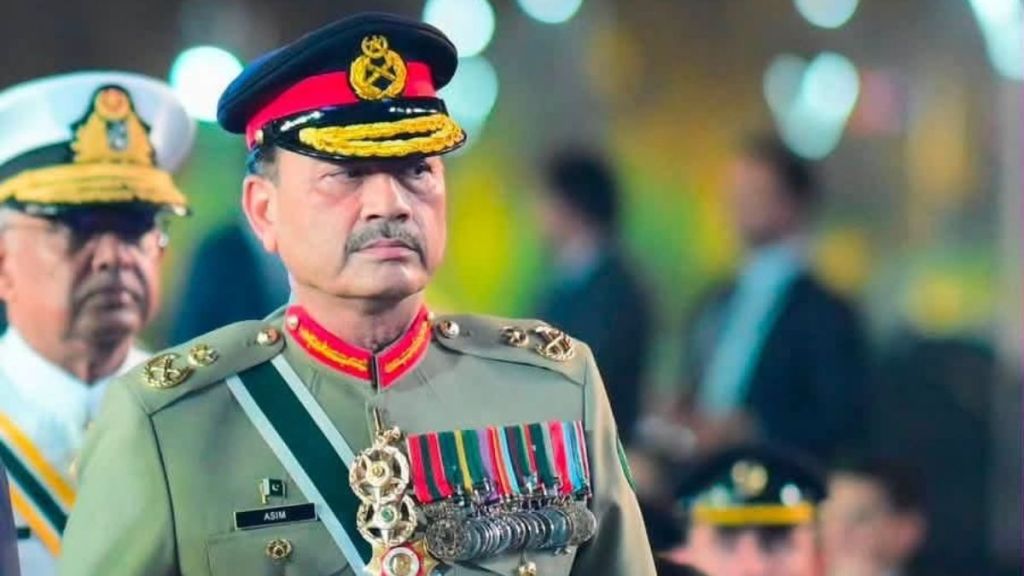

Pakistan has, for the first time in the country’s history, fundamentally changed the legal structure governing the command of its armed forces.
The Defence Forces of Pakistan Act, 2026, cleared by Pakistan’s Parliament created the post of Chief of Defence Forces (CDF). The development makes Field Marshal Asim Munir Pakistan’s first CDF, a post he will hold alongside his existing position as army chief. The National Assembly recorded his appointment as the country’s first Chief of Defence Forces in December 2025.
The most significant change is that the Act gives the CDF “operational command and control of the Armed Forces” and makes the CDF responsible to the Federal Government for that command and control.
The law also makes the CDF the principal military adviser to the prime minister on national security, defence and matters relating to the Armed Forces.
The development in a country where the military has repeatedly intervened in politics raises an obvious question: Is Munir becoming another Zia-ul-Haq or Pervez Musharraf?
The answer is more complicated.
What exactly has changed?
The CDF position was created through Pakistan’s 27th Constitutional Amendment in November 2025. The 2026 legislation provides the detailed statutory framework for the office.
The Defence Forces Act establishes the DFHQ as the headquarters of the Armed Forces and places it under the CDF.
It further states that the CDF has operational command and control of the Armed Forces and is responsible to the Federal Government for that command and control.
In other words, the legislation does more than create a coordinating position. It gives one officer statutory operational authority across Pakistan’s Army, Navy and Air Force.
The Act also provides the CDF with powers relating to the service of military personnel, including provisions concerning retirement, release, resignation, discharge and retention.
Pakistan has done this before? What about India?
Pakistan’s new structure is different from India, where the Chief of Defence Staff (CDS) post was set up in 2019.
Before the CDS was created, India had separate chiefs for the Army, Navy and Air Force. Those three service chiefs continued after the CDS post was established.
The Indian government created the CDS to promote greater synergy among the three services and to administer tri-service organisations.
Pakistan’s legal framework is different in one important respect: the Pakistani CDF is expressly given operational command and control of the Armed Forces by law.
So while both countries have moved towards a single senior military figure, the two command structures should not be treated as identical.
Who had this kind of power in Pakistan before?
Pakistan’s history makes the concentration of military authority particularly significant.
The country has experienced repeated periods of direct military rule. General Ayub Khan seized power in 1958, General Zia-ul-Haq overthrew the government in 1977 and General Pervez Musharraf took power in the 1999 coup.
Zia ruled Pakistan until 1988, while Musharraf remained the country’s dominant political and military figure for almost a decade following his coup.
The important distinction, however, is between command over the military and direct control of the civilian government.
Zia and Musharraf did not merely hold senior military posts. Both came to power through military intervention in Pakistan’s political system.
Munir’s expanded authority has so far come through constitutional and legislative changes.
Is Asim Munir the next Zia-ul-Haq?
There are obvious reasons for the comparison.
Munir is simultaneously Army chief and CDF, giving him statutory operational command over Pakistan’s three armed services. Pakistan’s National Assembly has itself referred to him as both Chief of Army Staff and Chief of Defence Forces.
But that does not make Munir another Zia.
Zia seized power from an elected government in 1977 and subsequently ruled Pakistan.
The current legislation does not abolish the civilian offices of prime minister, parliament or the federal government.
In fact, the Defence Forces Act states that the CDF is responsible to the Federal Government for operational command and control of the Armed Forces.
That distinction matters.
The new law clearly concentrates military command. Whether that concentration translates into direct political rule is a separate question.
Is Munir the next Musharraf?
The Musharraf comparison faces the same problem.
Musharraf’s rise to power followed the October 1999 military coup that removed Prime Minister Nawaz Sharif.
Munir has not taken power through such a coup. Instead, his position has been strengthened through Pakistan’s constitutional and legislative framework.
The Act gives the CDF operational command and control of the Armed Forces and establishes the DFHQ under that office.
Does the new system weaken civilian oversight?
The legislation does not remove formal civilian oversight.
The CDF is responsible to the Federal Government for operational command and control, while the office is also designated as the prime minister’s principal military adviser on national security and defence matters.
At the same time, the law gives the CDF substantially greater formal authority within the military hierarchy.
That creates an important distinction between civilian authority under the legal framework and the concentration of military command within the armed forces.
The legislation does not establish that the CDF can override the federal government. But it does create a clearly defined single military command structure centred on an officer who simultaneously heads the Army.
Pakistan’s external financing is under pressure
The economic picture is more complicated than simply saying Pakistan relies heavily on foreign borrowing.
The World Bank’s International Debt Report 2025 shows that Pakistan’s net foreign debt inflows fell by more than tenfold in 2024 to $354.4 million (about ₹3,367 crore).
The composition of that financing is particularly important.
Net debt flows from bilateral creditors to Pakistan fell sharply, with bilateral financing dropping by more than 75%.
Multilateral creditors were the only major creditor group to record positive net flows to Pakistan in 2024.
The $354.4 million figure is therefore significant not because it shows a steady source of foreign financing, but because it demonstrates how sharply new external debt inflows to Pakistan had contracted.
For a country dependent on external financing, that makes access to fresh funding more difficult even as existing debt obligations continue to be serviced.
How much does Pakistan get from the IMF?
The IMF remains one of Pakistan’s most important sources of external financing.
In September 2024, the IMF approved a 37-month Extended Fund Facility worth about $7 billion (around ₹66,500 crore) for Pakistan.
The initial disbursement was about $1 billion (around ₹9,500 crore), with the remainder to be released in tranches subject to programme reviews.
The IMF says the programme is intended to address Pakistan’s external financing needs, strengthen its balance-of-payments position and rebuild reserves.
So the IMF relationship is not simply “aid”. It is conditional financing tied to economic reforms and periodic reviews.
Pakistan’s defence budget has also risen
The financing squeeze is taking place alongside a larger defence allocation.
Pakistan’s Federal Budget 2026-27 provides PKR 3 trillion for Defence Services, compared with PKR 2.55 trillion in the 2025-26 budget.
That is an increase of about 17.6%.
At an approximate exchange rate of PKR 1 = ₹0.34, PKR 3 trillion is about ₹1.02 lakh crore.
The same budget provides for PKR 8.054 trillion in mark-up payments, including PKR 6.983 trillion on domestic debt and PKR 1.071 trillion on foreign debt.
That means debt-servicing costs are more than twice the Defence Services allocation.
This does not establish that the new CDF structure itself will increase military spending.
But it puts the concentration of military authority alongside a substantially larger defence allocation and high debt-servicing costs.
So how much US aid does Pakistan actually receive?
This is where the scale becomes clearer.
US foreign assistance to Pakistan is now much smaller than the financing Pakistan receives through its broader external-financing system.
The US government’s ForeignAssistance.gov, the official US foreign-assistance database, shows that current US assistance to Pakistan is overwhelmingly economic rather than military.
For comparison, the scale of US support during earlier periods of Pakistan’s military rule was far greater.
During General Zia-ul-Haq’s rule, the Reagan administration negotiated a $3.2 billion six-year military and economic assistance package after the Soviet invasion of Afghanistan.
During the Musharraf period, US assistance again expanded following the September 11 attacks.
The scale and strategic circumstances of those relationships were therefore very different from the present one.
What happens to US aid under Munir?
The key point is that US aid is no longer Pakistan’s main financial lifeline.
The more important financial relationships today run through the IMF, multilateral lenders, bilateral creditors and international capital markets.
That does not make Washington irrelevant.
US foreign assistance remains one part of the relationship, while defence cooperation, investment and access to US-linked financial institutions can provide other channels of engagement.
Pakistan has also sought a closer financial relationship with the United States, including a proposed $10 billion exchange-stabilisation facility aimed at strengthening its reserves and providing confidence to investors.
That is different from US aid: a swap facility or investment-financing arrangement should not automatically be described as foreign assistance.
This distinction is important when assessing what the new CDF structure means for Washington.
China, Saudi Arabia and Türkiye: Pakistan has other partners
Pakistan’s financial and strategic relationships are not limited to the United States.
China remains a major bilateral creditor and a key economic and defence partner.
Saudi Arabia has also been an important source of financial support, including deposits and other forms of assistance, while Türkiye has deepened defence cooperation with Islamabad.
Pakistan has simultaneously strengthened its strategic relationship with Saudi Arabia and Türkiye.
This broader network matters because Pakistan’s external relationships cannot be reduced to a simple Washington-Islamabad aid equation.
Why Munir is not yet another Zia or Musharraf
The Zia and Musharraf comparisons are useful for understanding why the concentration of military power attracts attention. But the historical analogy has limits.
Zia and Musharraf seized civilian political power through military coups.
Munir has so far gained greater authority through constitutional and legislative changes.
His new office gives him statutory operational command and control of Pakistan’s Armed Forces, while the Defence Forces Headquarters operates under his command and authority. At the same time, the Act makes him responsible to the Federal Government for that command.
That makes Munir the most powerful officer in Pakistan’s current military command structure under the new legal framework.
But it does not, by itself, make him Pakistan’s civilian ruler.
The bigger question is what happens next: whether this newly formalised military authority remains within the military chain of command or begins to reshape Pakistan’s civilian, economic and foreign-policy decision-making.