


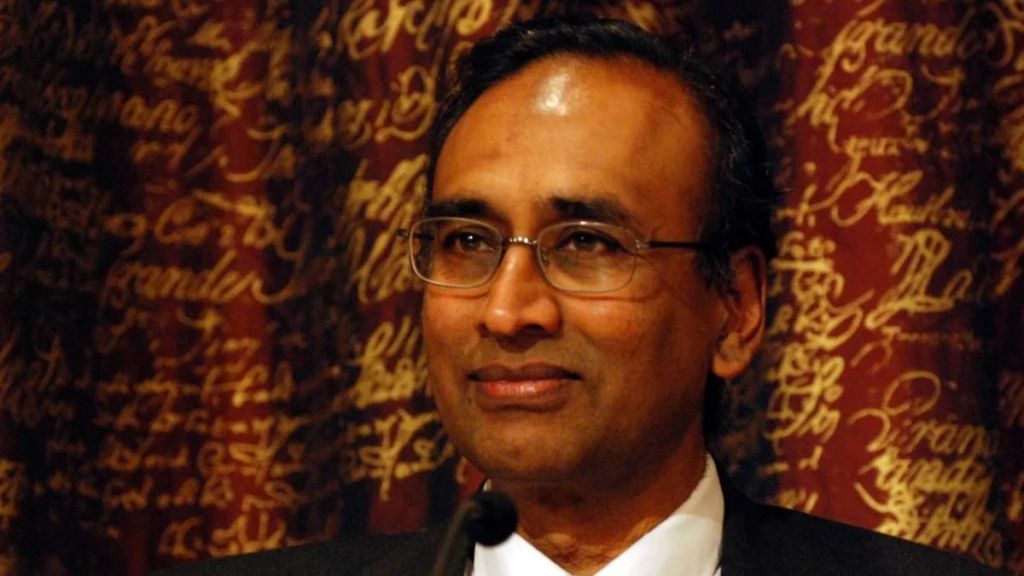

The first time Venkatraman Ramakrishnan saw his father, he was about six months old. His father, C.V. Ramakrishnan, was away in Madison, Wisconsin, on a postdoctoral fellowship. He came from a poor family and did not believe he could support a wife and baby on a postdoc’s income. So he went alone.
Born in 1952 in the Tamil Nadu temple town of Chidambaram, Ramakrishnan spent his early childhood cared for by extended family in his parents’ absence.
When he was about a year and a half, his parents left again, this time together, for a fellowship in Ottawa. He stayed with his grandmother and his aunt, Gomathi, during the period.
Those early years left a mark. Ramakrishnan would grow up with a feeling of being slightly apart, of having to find his place wherever he went. That feeling would follow him through six countries, a difficult scientific career, a Nobel Prize, and eventually a lifelong search for answers about why we die.
The childhood that taught him what it meant to feel like an outsider
When Ramakrishnan was three, his parents moved the family to Baroda, now Vadodara, in Gujarat. His father had been appointed at a remarkably young age to head a new department of biochemistry at Maharaja Sayajirao University. There was little to begin with. The laboratory had empty space but almost no equipment or people.
His father bought a low-speed table-top centrifuge and kept his samples cold by crushing blocks of ice from a nearby factory and packing them around it.
“With this setup he managed to publish two papers in Nature in quick succession,” Ramakrishnan wrote in his autobiographical essay for the Nobel Foundation, titled From Chidambaram to Cambridge: A Life in Science.
For a three-year-old, however, the new city was confusing. Until then, he had spoken only Tamil, a language he says he no longer speaks well. Suddenly, he was surrounded by children speaking Gujarati.
“One of my earliest memories is of standing in a playground not being able to understand a word of the Gujarati the children were speaking,” he wrote in the essay. “This feeling of being an outsider has remained with me for much of my life as my career has taken me to various countries.” The little boy in the playground could not have known how far that feeling would take him.
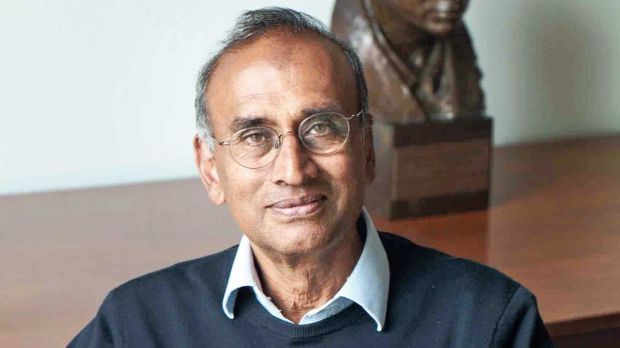
His mother, R. Rajalakshmi, was a teacher at Annamalai University. His father encouraged her to go abroad alone for a PhD, something that was unusual for an Indian family of that generation.
She won a fellowship at McGill University in psychology. One of her mentors was the psychologist Donald Hebb. Ramakrishnan believed his mother pushed herself partly because she felt guilty about leaving her family behind.
“Probably because she felt guilty about leaving my father and me behind, she finished her Ph.D. in under 18 months, which must be something of a record,” he wrote. Since his parents did not speak Gujarati either, they sent him to the Convent of Jesus and Mary School, then the only English-language school in town.
His sister Lalita was born in 1959. A year later, the family moved again, this time to Adelaide, Australia, for a year. Ramakrishnan remembered that period as “one of the most carefree years of my childhood.” He returned to India with an Australian accent that his classmates struggled to understand.
Science was always around him. “My childhood and adolescence were filled with visiting scientists from both India and abroad, many of whom would stay with us,” he wrote. “A life of science struck me as being both interesting and particularly international in its character.”
The student who slipped, struggled and found his way back
Ramakrishnan was not always the brilliant student the world would later know. Between the seventh and ninth grades, he fell from the top of his class to the bottom third. “Rather than studying, I spent my time playing and reading novels and other extracurricular books,” he wrote.
A teacher eventually helped him find his way back. T.C. Patel taught him science and mathematics during his final two years of school. He was strict, but Ramakrishnan remembered the spark behind his teaching.
“A strict disciplinarian, he nevertheless had a twinkle in his eye as he would expose us to clever ideas and difficult problems,” Ramakrishnan wrote. His interest in studies returned. He graduated second in his class. Hindi, however, remained a subject he never learned well.
When two doors closed, science opened another
For many Indian students, the years after school can feel like a verdict. Ramakrishnan got his early. At the end of his pre-science year, he sat for the national entrance examinations for the Indian Institutes of Technology and for the Christian Medical College in Vellore.
He did not make it. “I did not do well enough to qualify for admission to either institution,” he wrote. Those failures did not end his journey. They simply closed two doors. Another one opened when his mother learned about the National Science Talent Search Scholarship. The scholarship required students to major in basic science. She encouraged him to apply. His father wanted him to study medicine. He had even been offered a place to study medicine in Baroda. The two made a deal. If Ramakrishnan won the scholarship, he could choose science.
He won it. At just 16, he enrolled in physics at Baroda. The course was new and drew partly from the Berkeley Physics Course and the Feynman Lectures on Physics. His teachers were excited to be teaching it for the first time. “Their enthusiasm was infectious,” he wrote. He graduated in 1971.
The physicist who realised he had chosen the wrong path
At 19, Ramakrishnan left India for the United States. His academic journey did not immediately become easier. The University of Illinois initially accepted him, then told him he would have to enroll as an undergraduate after discovering that he was not yet 19 and had taken almost no non-science courses.
He eventually joined the physics programme at Ohio University. His doctoral work went badly. He was studying ferroelectric phase transitions in potassium dihydrogen phosphate, but he was increasingly convinced that he had chosen the wrong path. “It was the first time in many years that I felt I had chosen the wrong field,” he wrote.
He became fascinated by breakthroughs in biology and began wondering if physics was where he really belonged. His life outside the laboratory continued to grow. He hiked, rode freight trains with friends, played chess and went to concerts.
He did almost everything except make progress on his PhD. He was too embarrassed to tell his adviser, Tomoyasu Tanaka, how badly things were going.
“I often joke that if I had graduate students like me, I’d fire them!” he wrote. Ohio also brought something unexpected into his life. He met Vera Rosenberry, a painting student who would later become a children’s book author and illustrator. They married in 1975 after a courtship of 11 months.
Ramakrishnan was 23. He suddenly had a wife and a five-year-old stepdaughter, Tanya. “This sudden change in my responsibilities made me realise that I had to get on with my career,” he wrote. He completed his thesis and received his PhD in 1976, just a month before his son Raman was born. He later credited Vera with much of what came next.
She raised much of their family while repeatedly moving with him as his career took them across the United States and England.
Years of rejection before anyone gave him a chance
Equipped with a degree in physics but lacking formal training in biology, Ramakrishnan set out to start over. He scored in the 99th percentile in every subject of the medical school entrance examination. As a non-citizen, however, he received only one interview, at Yale, and was not selected.
He turned back to science. At the University of California, San Diego, he enrolled as a graduate student in biology. There, he came across a Scientific American article about ribosome research by Don Engelman and Peter Moore.
He wrote to Engelman. Moore offered him a postdoctoral position at Yale. “Thus began my lifelong interest in ribosomes,” Ramakrishnan wrote. Moore became an important influence on him. Ramakrishnan described him as “brilliant, rigorous, fair, straightforward and honest with his opinions,” and considered him a role model.
The next disappointment came soon after. During his final year at Yale, Ramakrishnan applied for a large number of faculty positions. He did not get a single interview. His career path was unusual. He had degrees from institutions that were not considered first-rate, and he was trying to combine physics and biology using a technique that few universities knew what to make of.
He kept going. He took a job at Oak Ridge National Laboratory, only to discover that the role was not what he had expected. The Biology Division viewed him mainly as an employee of its neutron scattering facility. The couple had just bought a house. The situation became so difficult that Ramakrishnan feared his scientific career might disappear before it had properly begun. Then Benno Schoenborn of Brookhaven National Laboratory told him to be patient.
A staff scientist position opened at Brookhaven in 1983. “I will always remain grateful to Benno for hiring me at Brookhaven and thereby rescuing me from scientific oblivion.” This came at a cost. The couple sold their Oak Ridge house a year later at a 25 percent discount. Brookhaven gave Ramakrishnan something more valuable than comfort.
It gave him freedom. His first independent paper, a single-author paper in Science, brought a letter from his father in India. His father was pleased with the progress. He told his son that if he continued working hard, he “might some day even have a paper in Nature!”
The risky decision that changed his life
The ribosome slowly became the centre of Ramakrishnan’s scientific life. Ribosomes are the cell’s protein factories. They translate genetic information from messenger RNA into chains of amino acids that eventually become proteins. Understanding their atomic structure was a problem that few scientists were willing to take on.
Ramakrishnan taught himself crystallography. He spent a sabbatical year at the MRC Laboratory of Molecular Biology in Cambridge before taking a job at the University of Utah in 1995. He liked Utah. The scientific problem he wanted to pursue, however, required something different. He wanted to determine the structure of the 30S subunit, the smaller half of the ribosome. He knew Utah was not the ideal place to pursue such a risky project without a safety net.
The MRC Laboratory of Molecular Biology had a reputation for supporting difficult problems that could take years to solve. Its director, Richard Henderson, and Tony Crowther spoke to him for hours about the ribosome problem. There was no discussion about space, salary or equipment.
The conversation was about science. When the offer came, Ramakrishnan faced one of the hardest decisions of his life. He would have to move to England, leave his grown children behind in the United States and accept a large pay cut. “Most people thought that it would be insane to move to England, staking all on this one risky project,” he wrote. Peter Moore and Steve Harrison encouraged him to go.
His family was unsure. His mother told him to put aside his fears and give it a shot. He and Vera took a 40 percent salary cut. Years later, he explained why he had taken the risk.
“I wanted to go to a place that had a reputation for tackling very, very hard problems that might take a long time to solve and that would not pull the rug out from under my feet when things were not going well. You get that here.” The fear did not disappear. “It takes a certain amount of courage to tackle very hard problems in science, I now realise,” he told The Guardian. “It is very stressful.”
When the race for the ribosome became personal
Ramakrishnan arrived in Cambridge in April 1999. His team was still partly in Utah. The time difference between the two countries unexpectedly became an advantage. His group began making progress on the ribosome. In June, Ramakrishnan presented their work at a ribosome meeting in Denmark. He could sense the surprise in the room. Almost nobody knew his group was working on the problem.
The work was published in Nature that August. The race was only beginning. The teams were now competing for high-resolution structures of the ribosome. Ada Yonath had moved to the 30S subunit. Tom Steitz, Peter Moore and their colleagues at Yale were making progress on the larger 50S subunit. “So instead of having a quiet niche to myself,” he wrote, “we were in a flat-out race.” The pressure increased. The team needed time on a new beamline at the Advanced Photon Source in Argonne, Illinois. Peter Moore asked Paul Sigler, who sat on the beamline’s advisory board, to help.
Beam time was awarded for late February 2000. Sigler died suddenly of a heart attack only days after stepping in to help them. The team pushed forward. Bil Clemons and Rob Morgan-Warren froze more than a thousand crystals in a cold room while listening to Johnny Cash.
Clemons then flew to Brookhaven and worked for 48 hours without sleep to check that the derivatives had bound. At the beamline, four people worked in 12-hour shifts.
Then came the moment they had been waiting for. Ramakrishnan saw strong peaks for the best derivative in a map calculated on site. He started dancing around the office. “We’re going to be famous!” he said. The maps were extraordinary. Within weeks, the team had built a complete atomic model of the subunit. Later, Andrew Carter crystallized it with three antibiotics. Seeing the drugs directly in the maps became another highlight. After years of uncertainty, rejection and risk, the work was finally speaking for itself.
The morning a Nobel Prize call sounded like a prank
Ramakrishnan had eventually accepted that he might never win a Nobel Prize. “People go into science out of curiosity, not to win an award,” he said in his autobiography. “But scientists are human and have ambitions.” He had made peace with the possibility.
Still, every October brought some nervousness. On October 7, 2009, his bicycle got a flat tyre. He arrived late, irritated and unaware that it was the day the Chemistry Prize was to be announced. Then the phone rang. The caller said it was an important call from the Royal Swedish Academy of Sciences. Ramakrishnan assumed it was a prank.
“We have quite a few pranksters in the lab and I thought this was one of them. I even congratulated the man, ironically, on his Swedish accent.” The caller was Gunnar Oquist. Only after Ramakrishnan asked to speak to Måns Ehrenberg, a scientist he knew personally, did he accept that the call was real.
Two members of his laboratory, Martin Schmeing and Rebecca Voorhees, had heard the conversation from their desks outside his open door. When he hung up, they were jumping up and down.Schmeing opened a bottle of champagne.
The people he wished he could call
The people Ramakrishnan most wanted to tell were not immediately reachable. Vera was out walking with Tanya and did not use a mobile phone. It was 2 am in Seattle, where his father and sister lived. He did not want to wake them. Then there was his mother.She was no longer there to hear the news.
“My mother, who first encouraged me to go into basic science and later to go to Cambridge, died two years before the Nobel Prize for the ribosome was awarded,” he wrote. The Nobel Prize was shared with Steitz and Yonath “for studies of the structure and function of the ribosome.”
Ramakrishnan was grateful for the honour, but he remained uncomfortable with the idea of turning scientific work into a contest. “science today is a highly collaborative exercise and to convert it into a contest, as the Nobel does, is a bad way to look at science.”
From a boy in Baroda to an inspiration back home
The Nobel Prize brought a wave of attention from India. Emails from strangers poured in for days. Ramakrishnan later wrote that he had overreacted to what he saw as an intrusion on his work. His reaction angered many people in India.
He later returned to the country with some hesitation. The warmth he received surprised him. “I need not have worried,” he wrote. The Government of India awarded him the Padma Vibhushan, the country’s second highest civilian honour, in 2010.
Then came a realisation that perhaps meant more than the prize itself. “I have come to realize that I have inadvertently become a source of inspiration and hope for people in India simply by the fact that I grew up there and went to my local university, but could nevertheless go on to do well internationally.”
The honours continued. He was knighted in 2012 for services to molecular biology. He served as president of the Royal Society from 2015 to 2020 and became a Member of the Order of Merit in 2022.
Learning to call Cambridge home
The move to Cambridge had not been easy. Ramakrishnan and Vera had left their families, especially their children, behind in the United States. They were alone in England. Housing prices shocked them. They lost out on several offers before Vera, while Ramakrishnan was away at a synchrotron, found a house in the village of Grantchester and managed to secure it.
Slowly, the place became home. They developed a car-free routine. They went on Easter walking holidays with laboratory colleagues and their spouses. They rode bicycles with friends.
“So over the years,” he wrote, “we have come to regard England as home.” His children built lives of their own. Tanya became a physician working in public health and caring for underserved communities. Raman became a cellist and a professor at Bard College in New York State.
Ramakrishnan had left India at 19. For almost three decades, he returned only a handful of times. His connection with India slowly grew again.
A memorial lecture in Chennai in 2002 and a visit to the Indian Institute of Science in Bangalore marked the beginning of that reconnection. In 2008, he was elected a foreign fellow of the Indian National Science Academy.
After studying life, he turned to the question of death
After spending years studying the machine that builds life, Ramakrishnan eventually turned to a much larger question. Why does life end? He wrote two books for general readers. ‘Gene Machine’, published in 2018, was a memoir of the race to understand the ribosome.
‘Why We Die: The New Science of Aging and the Quest for Immortality’ followed in 2024. In an interview with WIRED, he defined death this way: “By death, we mean the irreversible loss of the ability to function as a coherent individual.” He pointed out that most cells in the body are still alive when a person dies, which is why organs can be donated.
He also challenged the idea that death is simply programmed into us. “death, contrary to what one might think, is not programmed by our genes.” Evolution, he explained, does not care how long we live. It selects for traits that help us survive childhood and reproduce. Those same traits can contribute to ageing and decline later in life.
He remains cautious about the promises of the longevity industry. “Unfortunately, we are all afraid of growing old and dying, so we are very sensitive to any claim that promises to help us avoid it,” he said.
The record for human longevity is 122 years and 164 days, set by Jeanne Calment. Ramakrishnan has said that he sees no physical law that rules out a human reaching 150 or even 200, though he expects the obstacles to be formidable.
He also questions whether living forever would really be what people want. “Old age on the one hand terrifies us, but when we feel anxious, it is important to remember how terrible it would be to live forever.” In an essay in ‘A Touch of Genius: The Wisdom of India’s Nobel Laureates’, he wrote: “What we really mean when we say we die is that we stop functioning as a coherent whole.”
The Nobel laureate who never forgot the boy he once was
The phone kept ringing for two days after the Nobel announcement. Colleagues who had supported him when the ribosome was still only an idea organised the customary celebration in the laboratory canteen. Mike Fuller bought the champagne, just as he had for earlier Nobel winners.
Then Ramakrishnan and Vera walked his bicycle home in the rain. After everything, after the failures and the rejection, the risks and the recognition, that quiet walk home feels almost like the perfect ending.
Ramakrishnan closed his autobiography with a line that had little to do with prizes. “Looking back on my life so far, I feel a deep sense of gratitude for having been able to lead such a rich life, both intellectually and personally.”
The boy who once stood in a playground unable to understand what the other children were saying eventually found his place in a world of science. He was the student who failed entrance exams, the physicist who felt he had chosen the wrong field and the scientist who heard “no” from almost every direction.
He kept moving. Eventually, he helped reveal the structure of one of life’s most important molecular machines. The boy who once felt like an outsider ended up finding a home in a language the world had not fully understood before.
Disclaimer: This is an independent profile. The profile was reported using publicly available records, sources and news reports where applicable. While Zscaler’s representatives were contacted before this article’s publication, we did not receive a response. This content was produced in accordance with FinancialExpress.com’s editorial guidelines.