


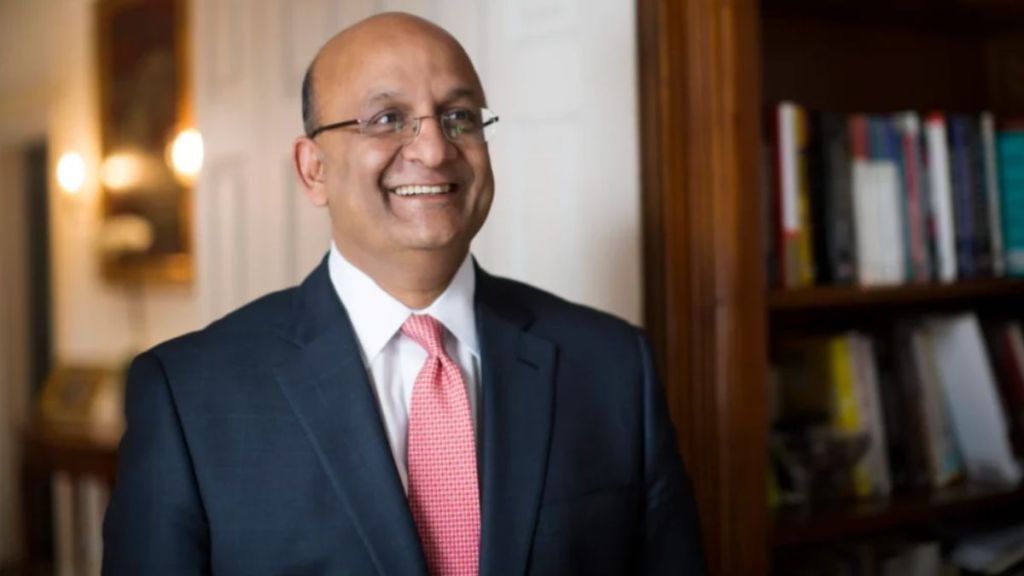

“The greatest lottery in life is the lottery that determines who your parents are,” believes the first Indian-origin dean of Harvard Business School in the United States.
A technocrat with a B.E. Elect. from Banaras Hindu University was the only one of six children in his family to get a college education and go abroad. The world may have known him as a prime driving force behind a company involved in the electrification of India, but his son saw a lot more in him.
As a child, he would travel with his father to new plants as they were set up across India, when less than 50% of the country had electricity. Not only did his father’s efforts help change the arc of India’s development, but also his own.
His father’s contributions sparked the realisation that all the toil he had gone through to light up an entire country had also granted his family a pool of opportunities unimagined. Possibly, the biggest takeaway for that young boy at an early age was that business could be a powerful force for good in society. Naturally, he wanted to walk that path himself, so he pictured the goal of becoming an entrepreneur and building a business of his own in India.
Given his father’s own past life experience, the young boy innocently envisioned the “Great American Dream” without a second thought, aspiring to make some money in the United States, accumulate some capital and fulfill his subsequent homecoming to India and build a company.
Life, however, had other plans. His early dreams aligned with his father’s, who also wanted him to be an entrepreneur at one point. But after taking on the path of an “accidental academic” instead of the more conventional businessman, as he had once thought, he was upfront with his father about his desire to teach. The elder patriarch had no objections, and simply told his son to do what made him happy.
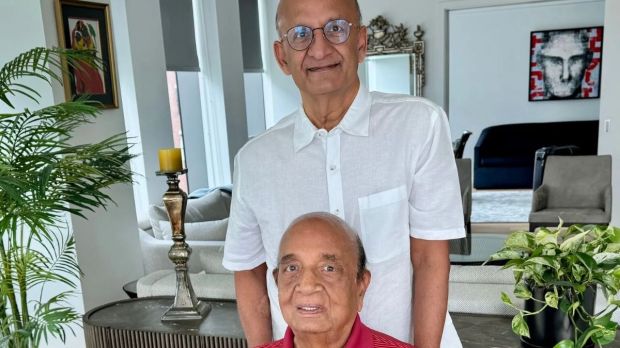
That man is Nitin Nohria, the first Indian-born person to head Harvard Business School, a more than 100-year-old elite institution of higher-education (2010-2020) in the United States. His father is the former Chairman & Managing Director of Crompton Greaves Ltd, Dr Kewal K Nohria.
From Rajasthan to the USA
Even before heading off to the United States for his higher studies, different chapters of Nitin Nohria’s early life took him to different parts of India. Born in Nohar, Rajasthan, he attended school in the country’s capital, New Delhi, before setting foot inside the Indian Institute of Technology (IIT), Bombay, to pursue a bachelor’s degree in chemical engineering.
In talks with The Harvard Gazette, Nohria once confessed that his dream was to go to Oxford or Cambridge. Although he acknowledged that getting into IIT Bombay was probably harder, he never really loved being a chemical engineer and ended up “being not good at it.” As he spent the entire five years in the course waiting to get out of it, he didn’t intend to graduate from engineering.
Hoping to fulfill something more self-fulfilling, he applied to graduate schools of business in the great hope of joining an MBA program. On the other hand, Nitin just couldn’t envision himself as a docoral student or a professor, as much as people around him couldn’t. The “accidental” part of his old confession manifested, as he simply applied to Ph.D. programs almost entirely because of the reason that they offered scholarships.
Half a dozen of his applications went to MBA programs, and the other half to PhD programs. Nohria still agrees that one of the happiest days of his life was when he got his letter from Massachusetts Institute of Technology, the only institution to offer him a scholarship. A letter that read “You’ve been admitted to the doctoral program…and you have a fellowship to come study,” offering him access to education in a “freeing” way that seemed unreal, ultimately became the single thing that turned his life around.
Becoming an ‘intellectual entrepreneur’
Nohria was originally interested in international finance as his application to MIT’s Sloan School of Management was accepted. He revealed in an old interview that once his advisor left to pursue a Wall Street career, he discovered certain other fields, which eventually became his intellectual passions. These were organisational behaviour and leadership.
The choice also possibly reflected an enduring influence of his 8th-grade teacher who once helped him connect with literature and philosophy, things that were not as precise as math, which, in turn, was something he was reasonably good at.
Even as he was going on to the PhD program, Nohria’s hopes to go out and create a company remained afloat for a while. At one point, he even signed a technology license with an Irish company to start his own business following graduation. However, his MIT journey helped him understand just as many things as it did in unlearning certain others. Even though Nitin never saw himself as a professor in the past, the elite Massachusetts school led him to the major discovery that being academic was just like being an “intellectual entrepreneur.”
“In an odd way, by accidentally discovering the field of leadership and organizational behaviour, I learned that I could study the things that fascinated me—which were people like my father, and the whole act of leadership and management,” Nohria told Poets and Quants over a decade ago.
Earning the Harvard Business School Dean mantle
After earning his PhD in management from MIT in 1988, Nohria went on to join the Harvard Business School faculty later that year. With an outstanding doctoral thesis award in behavioural and policy sciences, he was subsequently appointed associate professor in 1993, promoted to tenure in 1997 and then became the Richard P. Chapman Professor of Business Administration in 1999.
As a prolific scholar, Nohria eventually had more than a dozen books under his belt. By the time he was appointed the 10th dean of HBS, some of his recent books at the time explored how leaders from different backgrounds rose to power in US business, among other aspects.
The award-winning professor took on a series of senior roles at the elite school over the years. These included chair of the organisational behaviour unit from 1998 to 2002, director of the division of research from 2003 to 2004, and senior associate dean for faculty development from 2006 to 2009. In July 2009, he became co-chair of the HBS Leadership Initiative and sat on the executive committee of the University’s interfaculty initiative on advanced leadership.
By the time then-HBS President Drew Faust announced Nohria’s appointment as the successor to Jay Light, aka the 10th HBS dean, in May 2010, he had taught across the Business School’s MBA, doctoral, and executive education programs.
Once the top job at the school was his, Nohria openly admitted that it would’ve been harder to become the dean of the Indian Institute of Management (IIM) in Ahmedabad, India, than to be the dean of HBS.
Speaking on the immigrant experience in the US, he told India New England News in 2014: “One of the things I admire most about America is how much it is a meritocracy and how committed it is to providing opportunity to people irrespective of their backgrounds. In India, the Director of IIM is in the end a political appointment—it has to be approved by the Prime Minister. That creates the possibility of politics intervening in decisions.
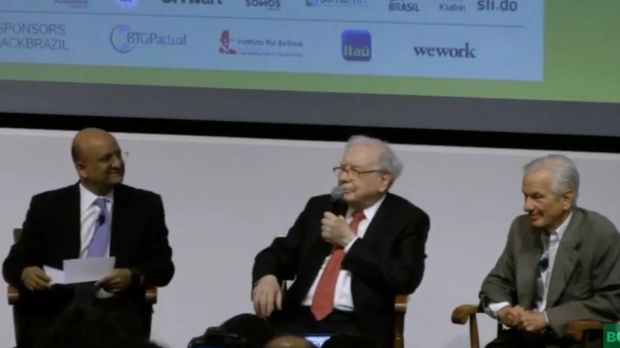
“Here at HBS, which is an iconic American institution, one might think it would be hard for a person of Indian origin to become a dean. Yet when a new dean had to be chosen, my background played no role in the decision. It was simply a question of whether I was capable of doing the job.”
A series of firsts
After stepping into the HBS dean’s shoes in 2010, Nohria retained that title for the following decade. His ten years of service as the school’s first Indian-origin dean was originally meant to conclude in June 2020. However, as the unprecedented takeover of the Covid-19 pandemic clouded the time with uncertainty, he decided to retain the position through the end of 2020.
His tenure was notably defined by a series of firsts. In addition to being the first Indian-born person to take on the Business School dean’s mantle, Nohria was the highest-paid dean at Harvard University. He was making $904,506 in fiscal 2019, according to a then-unveiled university tax filing with the government.
That sum included the value of his residence on campus. The IIT Bombay alum happened to have been the first HBS dean since Dean Lawrence Fouraker in the 1970s to live in the Dean’s house on campus.
“The Dean’s House was built as part of the original 1920s master plan so that the Dean and his family could be part of this residential environment,” Nohria said in a 2014 interview, noting that almost 90% of their students lived on the campus. “I wanted to return to this tradition and it has turned out to be a wonderful way for my family and me to feel more connected to our community.”
Yet another one of the firsts associated with Nohria’s deanship was that he was one of the first management professors to suggest a professional oath of conduct for management students, akin to the oath of Hippocrates for doctors. In a 2008 article co-authored with his fellow HBS colleague Rakesh Khurana, Nitin proposed the “Hippocratic Oath for Managers” in a bid to make management a profession. It subsequently directly inspired the creation of the voluntary MBA Oath in 2009 at the hands of graduating MBAs at Harvard at the height of that year’s financial crisis.
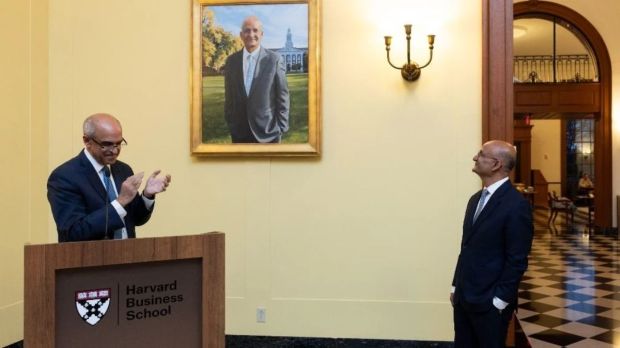
Explaining the rationale behind it, Nohria pointed out that just as “doctors are entrusted with society’s health, business leaders are entrusted with society’s economic prosperity and progress.” Echoing the same takeaways from how his father’s influence shaped his perspective his entire life, Nitin strongly believed that “business leaders would benefit from a similar shared framework that might provide guidance for how to think about their responsibility towards society.”
India connection
Last year, the IIT Bombay and MIT alum was conferred the prestigious Padma Shri Award, one of India’s highest civilian honours. The major milestone was especially empowered by Nohria’s track record of leading significant transformation in key areas as the former Harvard Business School’s dean.
During his time as dean, the Business School launched the field method, including a required course in the MBA Program—Field Immersion Experiences for Leadership Development (FIELD), providing students with opportunities to develop the “knowing” and “being” of leadership. FIELD ultimately sent over 900 students abroad each year to work on new product or process delivery projects with global partners, injecting them with real-world experience.
Moreover, the School’s digital learning platform, Harvard Business School Online (originally known as HBX), was also founded in 2014 under Nohria’s leadership. The Indian-origin academic also pushed HBS to deeply engage with other Harvard graduate and professional schools. It made way for joint degree programs such as the MS/MBA in Engineering Sciences and the MS/MBA in Biotechnology: Life Sciences in 2018 and 2019, respectively.
On top of that, Nohria was also behind the successful Campaign for Harvard Business School, a $1.4 billion fundraising effort focused on strengthening alumni engagement and boosting the School’s financial health.
Three years before he was appointed as a non-executive director of Tata Sons in 2013, Nohria’s continued relationship-building with India led HBS to a whopping $50 million gift from the Tata Group. At the time, it emerged as the largest offering from an international donor in the School’s over-100-year history.
Controversial headlines
With all the progress that was spearheaded during Nohria’s term at HBS, the Indian-origin scholar also ended up being the subject of headlines one could deem controversial.
In 2014, the then-Harvard Business dean came forward with a public apology for the school’s treatment of female students and professors. Stepping out for a function in San Francisco back then, Nohria conceded that there were times when the school’s offensive treatment made Harvard women, who were first admitted to the school in 1963, feel “disrespected, left out, and unloved by the school.”
Nohria also announced plans to raise the number of female protagonists in Harvard case studies, which are deemed the gold standard in business school courses globally, from 9% to 20% during the next few years at the time. While the promise would essentially help represent more financial problem-solvers as women, Nohria’s comments were also slammed for seeming performative.
A Slate.com author at the time wrote, “Frankly, I hope that any school charging $50,000 a year in tuition would be open and encouraging to everyone it admits.” Taking aim at his vow, the article called it out as “underwhelming in a world where we make up half of the population.”
In a separate incident, Nohria clashed with US President Donald Trump in 2017 over an issue that has become an even bigger headline-making issue in his second term: immigration. Given his own identity as the first Indian-American HBS dean, Nohria said in a self-authored Financial Times article that he “understood” why Trump’s “anti-immigration tone has found an audience” due to the rising competition for jobs.
However, he also asserted that rejecting globalisation would damage the US economy, stressing that “Isolationism threatens to strip away the negotiating leverage we’ve earned from our leadership over many decades.”
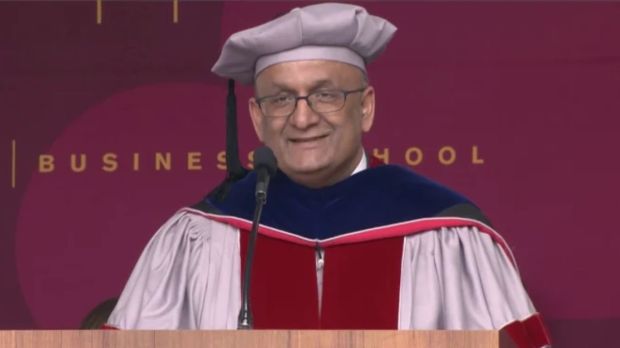
Nohria has repeatedly expressed his admiration of the American Dream through the years, based on the belief that the US embraced people of all backgrounds, giving everybody the chance to succeed. As someone who later concluded a more than two-decade term at the helm of Harvard’s Business School, his story already serves as an inspiration to other immigrants from India seeking opportunities abroad. And so, Nitin passionately stressed in the FT piece that “ambitions and aspirations” tied to globalisation were part and parcel of the American Dream.
How family values and business ethics shaped Nitin Nohria
On countless occasions, Nitin Nohria has traced his steps back to spending his formative years in India. He has specifically outlined the role his family, especially his father, played in shaping his own worldview. His HBS stint in the US, focused on solving real problems and creating real opportunities, was directly impacted by the many factory rounds he took with his father as a young boy.
While Kewal Nohria’s contributions to India’s electrification were a testament to how business innovations and ethics could very well go hand in hand, Nitin’s maternal grandfather left him with a lesson about family and respect.
Recounting scenes from Premchand Goel’s funeral in a 2010 Rediff interview, Nitin noted that his engineer grandfather “was not famous, did not make much money or reach the top of his profession.” And yet, his one-of-a-kind funeral left an indelible impression about the importance of generosity, especially in the context of how his grandfather was even admired in death.
It is the same bridging of sensibilities, centred around the matter of competence and strong character, that empowered Nitin Nohria’s appointment as a pioneering dean at Harvard Business School in 2010.
Notably, it was all palpable when former HBS President Faust named Nohria the HBS dean over two decades ago, describing him as “an outstanding scholar, teacher, and mentor, with a global outlook and an instinct for collaboration across traditional boundaries. He has an intimate knowledge of the School and a strong appetite for innovation.
“He cares deeply about the School’s commitment to both rigour and relevance — to serious scholarship that has a powerful impact on practice. And he’s a person who not only studies leadership but embodies the qualities of a leader in how he engages people and ideas, in how he thinks about organisational change, and in how he sees the consequential challenges ahead.”
Disclaimer: This is an independent profile. The profile was reported using publicly available records, sources and news reports where applicable. While Nitin Nohria was contacted via LinkedIn before this article’s publication, we did not receive a response. This content was produced in accordance with FinancialExpress.com’s editorial guidelines.