


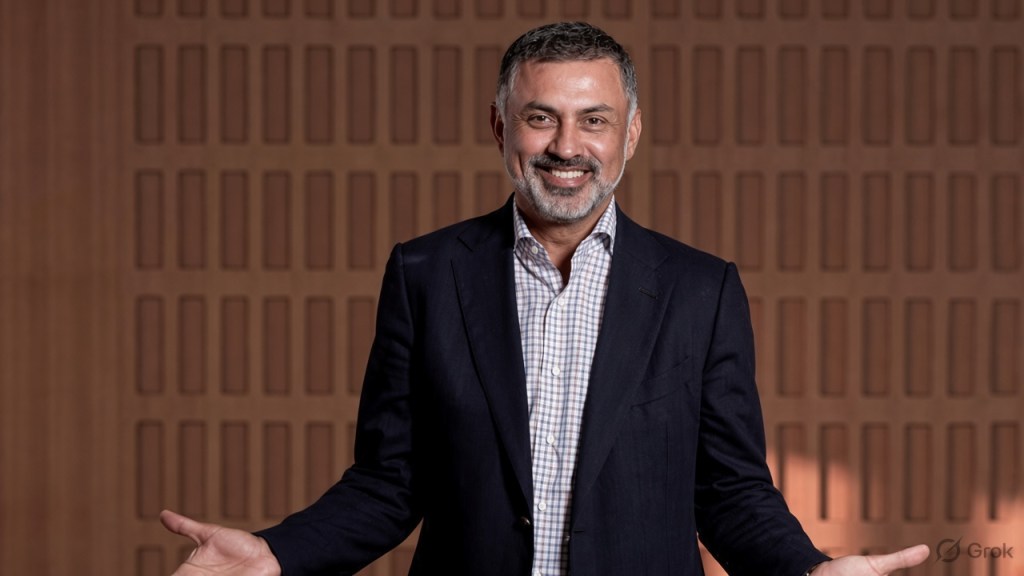

In 1990, a young engineering graduate landed in Boston with barely enough money to last him the semester and a stack of college applications chosen for one reason: they didn’t charge an application fee.
Two years later, after completing his studies in business school, he faced rejection from more than 400 companies. Today, that same man signs off on billion-dollar acquisitions from a corner office in Santa Clara, has out-earned Mark Zuckerberg and Sundar Pichai in a single fiscal year, and appears on Hurun India’s Rich List with a net worth exceeding ₹9,000 crore.
His name is Nikesh Arora, and his journey from an Air Force family in Ghaziabad to the chairman’s chair at Palo Alto Networks is a story of global success built the hard way, through years of rejection, persistence and finally, the breaks that changed the course of his career.
An Air Force childhood, and the making of a mindset
Arora was born on February 9, 1968, in Ghaziabad, Uttar Pradesh. His father was an Indian Air Force officer, which meant the family moved around as his father was posted to different places.
Arora went to several Kendriya Vidyalayas before completing his schooling at The Air Force School in Delhi. The defence background shaped much of his childhood. It was a life built around discipline and routine.
Years later, Arora would describe the role that growing up with limited resources played in his life. “Scarcity encourages you to be resourceful. It allows you to do a lot more with a lot less.” He made the comment during a conversation with Humans of Bombay.
That idea has remained an important part of how Arora talks about his journey.
From IIT (BHU) to America
Arora studied electrical engineering at IIT (BHU) in Varanasi and graduated in 1989. After college, he briefly worked at Wipro, where he sold minicomputers to government customers. The job was not exactly glamorous. He has recalled travelling around on a motorbike while trying to make government sales.
He soon decided that he wanted to study further and moved to the US. But getting there was not easy. Arora targeted universities that did not charge an application fee, what he has described as “zero-dollar” applications.
He eventually got into Northeastern University and received a scholarship. The scholarship itself came with another challenge. He was asked to teach computer science, which meant he had to learn the subject well enough to teach it.
“I was scraping around, teaching nights, doing all kinds of fun stuff just to survive,” he later recalled in a conversation with Humans of Bombay.
That period left a lasting impression on him. Arora has spoken about how difficult it was to finance his education abroad. In one of the interviews, he recalled using his father’s pension fund to help pay for his move.
“When I landed in America, all I had was a few hundred dollars & a dream that did not quite have a roadmap,” Arora recalled speaking to Humans of Bombay.
His early years in the US were far from comfortable. He had to find ways to support himself while studying and looking for work. With little money to depend on, he took up part-time jobs while continuing his studies.
“I came to The United States with two suitcases, $200, and I was willing to do anything, anything at all, to make sure that I made a life for myself because there was no way to go back. I was a security guard. I took notes to the disabled. I flipped burgers at Burger King. I had $200. I had to find a way of paying my tuition,” Arora said during an appearance on the 20VC with Harry Stebbings Podcast.
He eventually earned an MBA from Northeastern University and an MS in finance from Boston College. He also completed his CFA qualification.
Despite spending decades in the US, Arora has kept a strong connection with his old institute. In 2021, Arora and Palo Alto Networks helped establish the IIT (BHU) Foundation Access Fund with a $2 million endowment.
Arora contributed $1 million by giving up his annual salary, while Palo Alto Networks contributed another $1 million. The money was meant to help students from financially weaker backgrounds attend IIT (BHU).
Arora said at the time: “As alumni, we know firsthand the school’s remarkable programmes, facilities and faculty. Together with Palo Alto Networks, I’m proud to support IIT (BHU) as it broadens access to education and prepares future leaders in critical areas of technology.”
The fund has since supported hundreds of students. The IIT (BHU) Foundation says 188 students had received scholarships through the programme by the 2025-26 academic year.
More than 400 rejections
Nikesh Arora has a habit of remembering the things most successful people would probably prefer to forget. The rejection letters. He still has them at home, more than 400 of them.
After business school in the US, Arora applied for job after job. The answer was almost always no. At one point, he even had a rejection letter that had come out of a printer without enough ink. He knew what it was anyway.
“My rejection letters were only half printed because the printer ran out of ink,” he recalled. “But I knew it was the rejection letter.”
“I sent 400-plus applications and got rejected 400-plus times. I saved all the rejection letters. They’re my motivation,” Arora said in a conversation with Humans of Bombay.
At the time, however, the issue was not motivation. It was survival. He was trying to figure out how to build a career and repay the money his father had put into his education.
He once planned to leave America after making $100,000
When Arora first arrived in the US, he was not thinking about becoming one of the biggest names in technology. He was simply trying to find a job and build a life. His first salary was around $2,600 a year, and at one point, he and a friend made a simple plan: if they could make $100,000, they would return to India and live comfortably.
“I was gonna leave after I made $100,000,” Arora recalled in a conversation with Timeless Partners. “My friend and I sat down one day and said, ‘Listen, if I just make $100,000, I think we can go back to India, have a great life.’”
After finishing business school, Arora had been told that he was the kind of person who should be working on Wall Street. He believed it too. But when he started applying to financial firms, the response was very different. Companies told him he did not have enough experience in finance.
The response left him confused. “I graduated first in my class. What do you mean I don’t have enough finance?” he recalled.
The rejections kept piling up. By then, he was not thinking about becoming a top technology executive. He was thinking about getting through the next stage of his life. He had borrowed $2,000 from his father and wanted to repay him. Finally, in 1992, someone said yes. Fidelity Investments hired him.
Fidelity, Deutsche Telekom to Google
Arora spent the early part of his career in finance and technology. He worked at Fidelity Investments and later Putnam Investments before moving into the telecom sector.
He also founded T-Motion, a company that worked on value-added services for Deutsche Telekom’s 3G business. T-Motion was later merged with T-Mobile International.
These years gave Arora experience across finance, technology, sales and telecom. That combination would later become important as he moved into senior management roles at much larger companies.
Arora joined Google in 2004. One interesting fact: His Google interview did not take place in a boardroom. It happened while he was walking around the British Museum in London.
Google co-founder Sergey Brin interviewed him during the visit. Arora then travelled to California for more interviews. He got the job. Arora became Google’s first external vice president hired for Europe. Over the next 10 years, he moved through several senior roles, eventually becoming Google’s senior vice president and chief business officer.
He also served as president of Google’s Europe, Middle East and Africa operations and held senior responsibilities for global sales and business development. Google has credited Arora with helping grow its search business from around $2 billion in revenue to more than $60 billion during his time there.
By the time he left Google in 2014, he had become one of the company’s most senior executives. It was a major jump from the young graduate who had once struggled to get a job.
In October 2014, Arora moved to SoftBank. He became president and chief operating officer and worked closely with founder Masayoshi Son.
Son had recruited Arora as a senior executive and was reportedly considering him as a possible successor. There was a plan for Son to step back at 60. But when that time came, Son decided he wanted to continue for another decade. Arora was around 48. He did not want to wait another 10 years.
The two eventually went their separate ways, and Arora left SoftBank after around two years. The relationship did not end badly. Arora still speaks about Son with respect.
“Masa is someone whose risk appetite increases with age—that’s rare,” he said. But he also took lessons from Son’s investment style.
The Palo Alto Networks bet
In 2018, Arora took another big step.
Palo Alto Networks appointed him CEO and chairman, replacing Mark McLaughlin, who moved to the position of vice-chairman. Arora officially took over in June 2018.
The move was interesting for another reason. Arora did not come from a traditional cybersecurity background. He had spent much of his career in finance, telecom, internet advertising and technology investing.
Yet he was now running a cybersecurity company at a time when businesses were spending more and more on protecting their networks, cloud systems and data.
Under Arora, Palo Alto Networks expanded heavily into cloud security and AI-related cybersecurity.
The company says that during his tenure, it has gone through a major transformation and grown into a global leader in AI and cybersecurity. Arora has also continued to expand his presence in the corporate world. He serves on the board of Uber and is also a non-executive director of Richemont.
The $18 billion company becomes a cybersecurity giant
When Arora joined Palo Alto Networks, the company was valued at around $18 billion. It is now a much larger business. Palo Alto Networks currently describes itself as a global cybersecurity company with more than 16,000 employees, 70,000 customers and a market value of around $100 billion.
Arora pushed the company towards cloud security and AI early. Acquisitions became a major part of that strategy.
The company has made dozens of acquisitions as it expanded its security products and tried to stay ahead of changes in technology.
The $151 million paycheque
Then came the number that put Arora in a different league. For Palo Alto Networks’ fiscal 2023, Arora’s total compensation was $151.4 million.
The company’s official proxy statement shows that his salary was $750,000. But the bulk of his compensation came from stock awards, which were valued at about $145.4 million, along with incentive compensation and other payments.
That means the headline figure was not a $151 million cash salary. It was mainly tied to shares and other forms of compensation.
The huge package also put Arora among the highest-paid CEOs in the US that year. His compensation later fell sharply, although he remained one of the highest-paid Indian-origin executives in global technology.
Arora’s wealth has also put him ahead of some of the world’s most famous Indian-origin technology executives. The Hurun India Rich List 2025 placed Arora third among Indian and Indian-origin professional managers, with wealth estimated at ₹9,190 crore.
Arista Networks’ Jayshree Ullal was first with ₹50,170 crore, while Microsoft’s Satya Nadella was second with ₹9,770 crore. Google CEO Sundar Pichai was seventh, with ₹5,810 crore.
Arora is married to Ayesha Thapar, a businesswoman from the Thapar family. They married in Italy in 2014. He has three children, including a daughter from his first marriage.
Now he wants to fight AI with AI
That thinking is behind Palo Alto Networks’ latest move.
On September 22, the company announced Unit 42 Continuous Frontier AI Defence, a new subscription service that will use several AI models to continuously search for security weaknesses.
The service will use Anthropic’s Claude Mythos 5, OpenAI’s GPT-5.6-Cyber and open-weight models. It will test web applications, APIs and cloud infrastructure and look for possible ways an attacker could break into a system.
The company will also suggest fixes, including changes at the code level and virtual patching. There is a reason Palo Alto is taking this approach. The company said its own testing found that no single AI model could identify more than 40% of vulnerabilities in a complex environment.
Arora’s view is that different models have been trained on different data, so using several of them together can produce better results. Human expertise will still have a role.
The new service will be sold globally through annual subscriptions, with pricing based on the mix of OpenAI, Anthropic and open-source models chosen by customers.
The timing is important. Hackers are also using AI to find and exploit weaknesses.
He thinks India’s AI opportunity is different
Arora has also been thinking about what AI could mean for India. He does not believe Indian companies necessarily need to build the biggest AI models in the world. Instead, he sees an opportunity in making global AI work for India’s very different conditions.
“You’ll be able to rent powerful models eventually, but differentiation will come from localised data and domain knowledge, our languages, our traffic, our culture,” he said in an interview published by The Indian Express.
His example was self-driving cars. A car trained using American roads and conditions may struggle badly on Indian roads. That is where, he believes, Indian companies can build an advantage by adapting global technology to local needs.
“You don’t have to be first; you have to be smart. And I think there are enough smart people in India who will figure out how to make AI work locally,” he said.
Editorial Note: This is an independent profile. Mr. Arora and their representatives were contacted but did not respond prior to the time of publication. In the absence of direct comment, this article was reported using publicly available records and regulatory filings, where applicable. This content was produced in accordance with FinancialExpress.com’s editorial guidelines.