


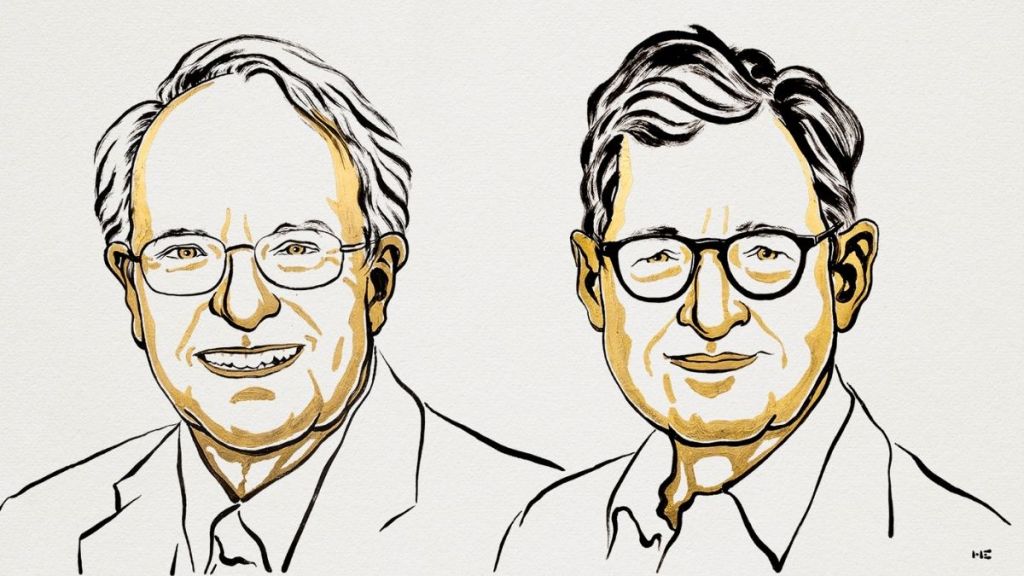

Nobel Prize in Economics 2026 Winner: American economists Robert E Hall and Michael Woodford won the 2026 Nobel Prize in Economic Sciences for their work on the “micro-economic foundations of macro-economic stabilisation”. The Royal Swedish Academy of Sciences announced the award on Monday.
Their research helped develop economic models that governments and central banks use to understand economic shocks and assess policy responses. These shocks can include energy crises, changes in consumer spending and disruptions to production.
The award carries 12 million Swedish kronor or about $1.2 million prize.
The Nobel Prize tweeted on X that the economists’ work changed how researchers study economic stabilisation by linking the decisions of households and businesses to the wider economy.
Who is Robert E Hall?
Robert E Hall is an American economist at Stanford University, where he is a professor of economics and a senior fellow at the Hoover Institution.
His research covers employment, inflation, technology, competition and economic policy. His work examines how changes in economic conditions affect businesses, workers and the wider economy.
Hall served as president of the American Economic Association in 2010. He also directed the National Bureau of Economic Research’s programme on economic fluctuations and growth from 1978 to 2013. He continues to chair its Committee on Business Cycle Dating, which maintains the chronology of US business cycles.
Hall has advised several US government institutions, including the Justice Department, Treasury Department, Federal Reserve Board and Congressional Budget Office. He has also testified before congressional committees on economic policy.
Before joining Stanford in 1978, Hall taught at the Massachusetts Institute of Technology and the University of California, Berkeley. He earned his bachelor’s degree from the University of California, Berkeley, and his PhD from MIT, according to his Stanford biography.
Who is Michael Woodford?
Michael Woodford is the John Bates Clark Professor of Political Economy at Columbia University in New York. His research focuses on monetary policy, macroeconomics and how economic decisions influence overall economic performance.
Woodford is best known for his book “Interest and Prices: Foundations of a Theory of Monetary Policy”, published in 2003. The book examines the theoretical basis of monetary policy and received the Association of American Publishers Award for Best Professional or Scholarly Book in Economics that year.
His other honours include the Deutsche Bank Prize in Financial Economics in 2007, the Banque de France/TSE Prize in Monetary Economics in 2018 and the Erwin Plein Nemmers Prize in Economics in 2024.
In 2025, Woodford shared the BBVA Foundation Frontiers of Knowledge Award in Economics, Finance and Management with Olivier Blanchard and Jordi Galí.
Woodford earned his bachelor’s degree from the University of Chicago, a law degree from Yale Law School and a PhD in economics from MIT, according to his Columbia University biography. He is also a fellow of the American Academy of Arts and Sciences and the Econometric Society.
What does their Nobel-winning research mean?
The Nobel Prize recognises research that helps economists understand how decisions made by individuals and businesses affect the wider economy, and how governments can respond when economic conditions change.
Macro-economics examines the economy as a whole, including inflation, employment, production and economic growth. Microeconomics focuses on the decisions of individual households and businesses.
Hall and Woodford’s research helped connect these two areas through economic models that examine how individual decisions influence broader economic trends. These models, associated with New Keynesian economics, help policymakers assess how changes in interest rates, government spending and other measures may affect economic activity.
The Nobel Prize account said the models developed from the laureates’ research help policymakers understand business cycles and assess the effects of stabilisation policies. It cited the pandemic and recent energy crises as examples of disruptions that require effective economic responses.
The 2026 award recognises Hall and Woodford’s contributions to the economic models used to analyse instability and guide policy responses.