


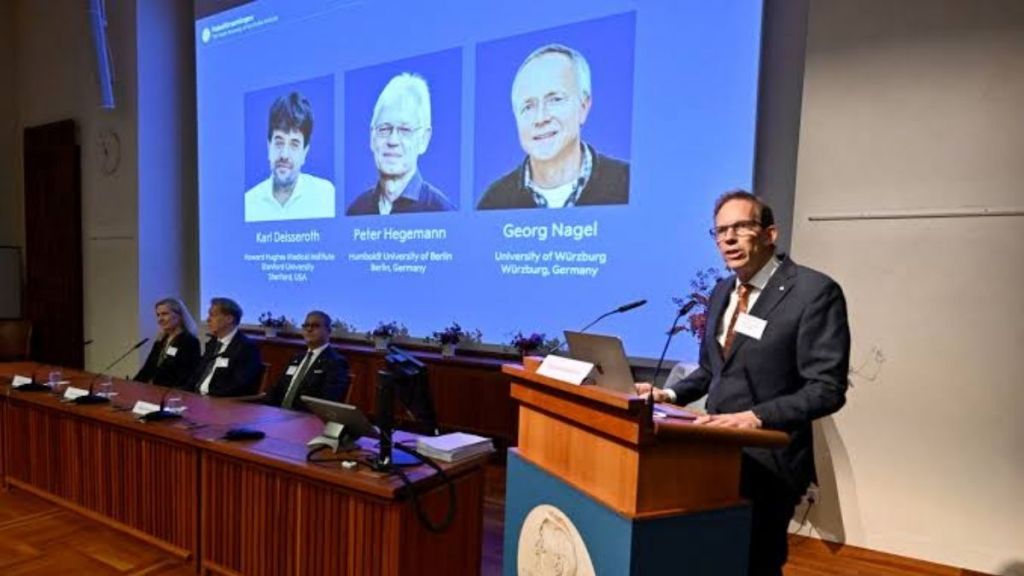

The 2026 Nobel Prize in Physiology or Medicine has been awarded to American scientist Karl Deisseroth and German scientists Peter Hegemann and Georg Nagel for discoveries concerning light-gated ion channels and optogenetics.
The Nobel Assembly at Karolinska Institutet announced the award in Stockholm on Monday. Their work helped create optogenetics, a technique that allows scientists to use light to switch individual nerve cells on or off inside a living brain.
The Nobel committee said the method is now used in laboratories around the world to study the brain. The three scientists will share prize money of 12 million Swedish kronor, worth about $1.2 million, reported Reuters.
What is optogenetics?
Optogenetics combines genetics and optics to control nerve cells using light-sensitive proteins.
Neurons communicate through electrical signals. But studying individual groups of neurons has long been difficult because activating one set of cells can also affect nearby cells.
Optogenetics provides a more precise approach. Scientists can introduce genes that cause selected neurons to produce light-sensitive proteins. When light is directed at those cells, the proteins open or close channels in the cell membrane, changing the neuron’s electrical activity.
Researchers can therefore activate or silence specific nerve cells and observe what happens. That has allowed scientists to study how particular neural circuits contribute to movement, memory, behaviour and other brain functions.
Who is Karl Deisseroth?
Karl Deisseroth is an American neuroscientist, psychiatrist and bioengineer at Stanford University. He is the DH Chen Professor of Bioengineering and of Psychiatry and Behavioral Sciences and an investigator at the Howard Hughes Medical Institute.
Deisseroth trained in both medicine and neuroscience. He earned his undergraduate degree in biochemical sciences from Harvard University in 1992, followed by a PhD in neuroscience in 1998 and an MD in 2000 from Stanford.
He completed his medical internship and psychiatry residency at Stanford and later became board-certified in psychiatry. He continues to practise psychiatry, with Stanford listing affective disorders and autism-spectrum disease among his clinical interests.
Deisseroth played a major role in turning discoveries about light-sensitive proteins into a practical neuroscience tool.
His laboratory developed and advanced optogenetics to study neural circuits, including cell types and connections linked to adaptive and maladaptive behaviour. Stanford says his group has also shared the technology with thousands of laboratories around the world.
The significance of the technique is that researchers can activate a particular group of neurons with light, observe the resulting response and then silence the same cells to compare the effects.
This allows scientists to investigate cause and effect in brain circuits rather than simply observing which neurons are active.
Deisseroth had already received several major scientific honours, including the Kyoto Prize in 2018, Lasker Basic Medical Research Award in 2021, Luisa Gross Horwitz Prize in 2022, Japan Prize in Life Sciences in 2023 and Asan Award in Basic Medicine in 2025.
Who is Peter Hegemann?
Peter Hegemann is a German biophysicist associated with Humboldt-Universität zu Berlin. His research focused on rhodopsins, light-sensitive proteins found in organisms such as algae and microbes.
Hegemann studied how these proteins respond to light and control the movement of ions across cell membranes. That work helped scientists understand how light can alter the electrical activity of cells.
His research provided an important foundation for the development of optogenetics. The key insight was that some microorganisms contain proteins that respond directly to light.
When activated by light, these proteins can alter the movement of charged particles, or ions, across a cell membrane. That changes the cell’s electrical state.
Scientists realised that such proteins could potentially function as biological switches. If they could be introduced into nerve cells, researchers could use light to control those neurons. That idea became central to optogenetics.
Who is Georg Nagel?
Georg Nagel is a German scientist and professor at the University of Würzburg. His work focuses on photoreceptors and optogenetics. Nagel and his colleagues studied the electrical properties of microbial photoreceptors by expressing them in animal cells.
Their work led to the discovery and naming of channelrhodopsins. The University of Würzburg says the team identified Channelrhodopsin-1 (ChR1) in 2002 and ChR2 in 2003.
Channelrhodopsins are light-sensitive proteins that form channels in cell membranes. When exposed to light, they allow ions to pass through the membrane, changing the electrical state of the cell.
Their importance became clear when researchers used them in nerve cells. The University of Würzburg says subsequent experiments showed that ChR2 could produce strong light-induced membrane depolarisation when expressed in human cells.
Researchers later demonstrated that light could trigger activity in neurons containing these proteins, leading to light-induced action potentials and eventually light-controlled behaviour in genetically modified animals.