


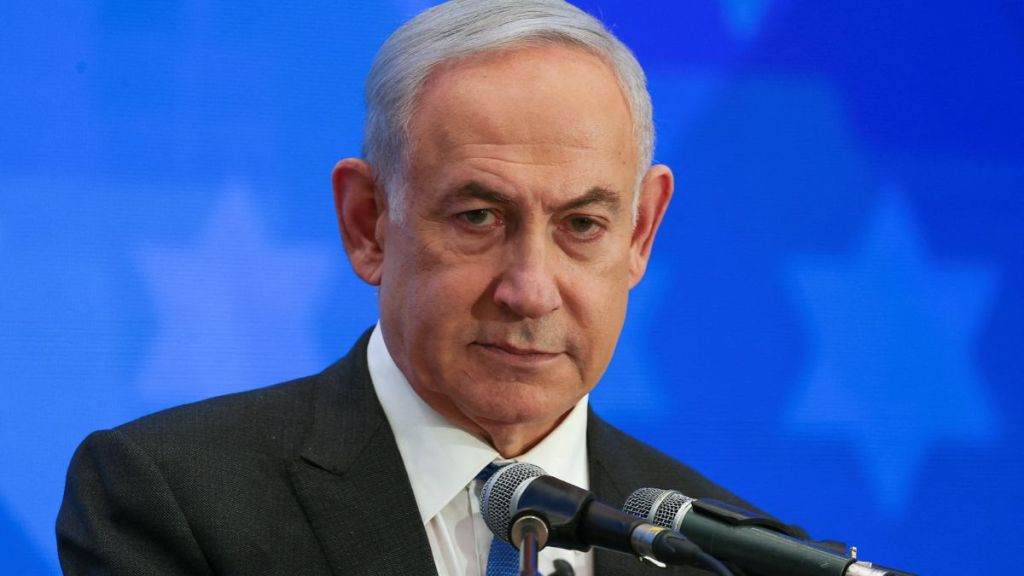

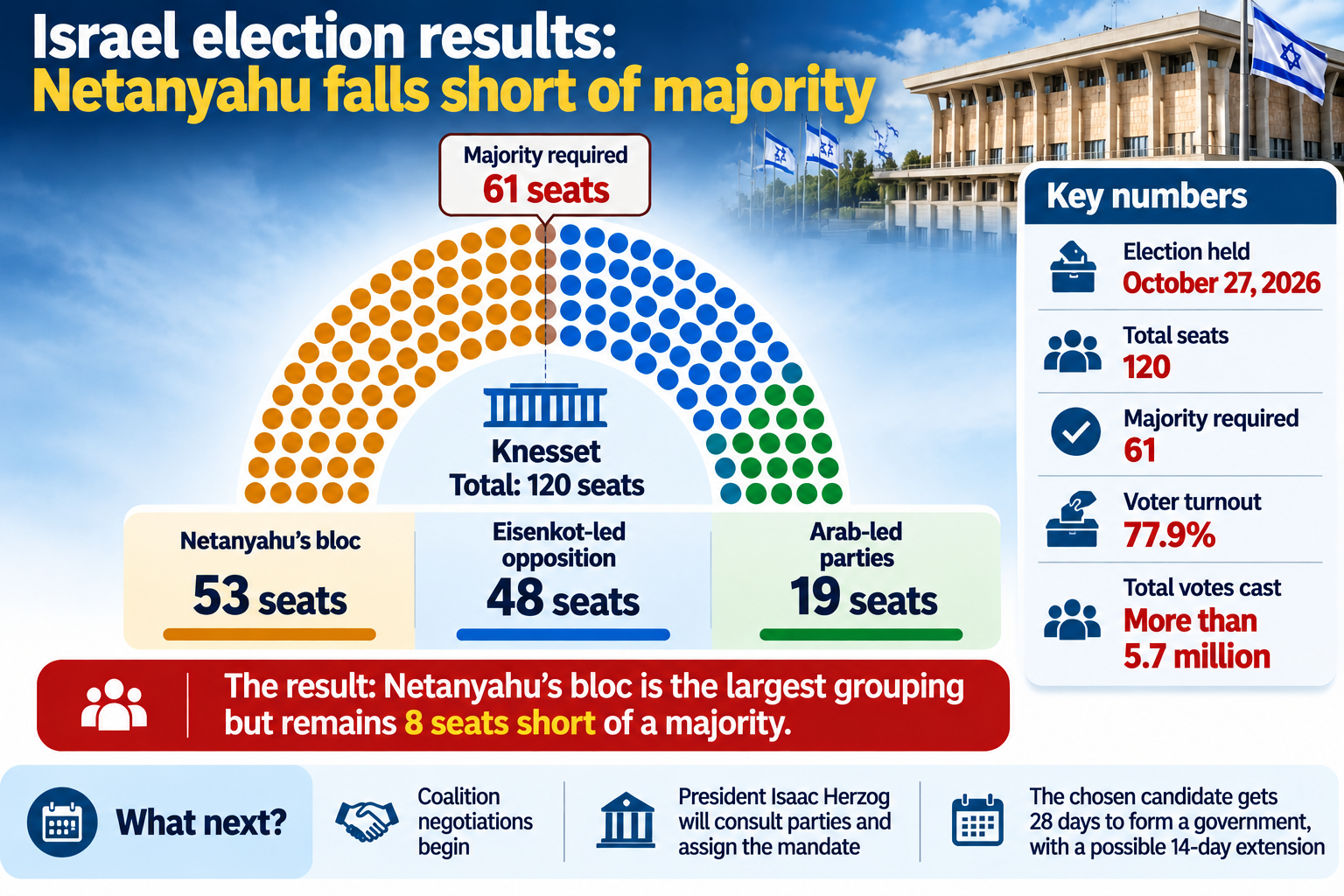
Israeli Prime Minister Benjamin Netanyahu‘s political bloc fell short of the numbers needed to form a government. The final results of the elections held on October 27 gave his bloc 53 seats in the 120-member Knesset, compared with 48 for the opposition led by Gadi Eisenkot. The two main Arab-led parties secured the remaining 19 seats.
No bloc has the 61 seats required for a parliamentary majority. The result has opened the way for coalition negotiations, but it does not mean Netanyahu has automatically lost office. He remains prime minister while political parties explore possible alliances and the next steps in government formation.
The outcome could influence Israel’s political direction at a time when the country faces security challenges, disagreements over military service and international scrutiny of its policies towards Palestinians.
For India, the immediate question is whether the political uncertainty could affect agreements reached during Prime Minister Narendra Modi’s visit to Israel in February 2026. The two countries had agreed to expand cooperation in defence, artificial intelligence, cybersecurity, trade, agriculture, water management, payments and employment.
The Prime Minister’s Office had described the relationship as a “Special Strategic Partnership for Peace, Innovation & Prosperity”. A change in Israel’s political leadership could influence the pace and priorities of some initiatives. However, many of these agreements involve government departments, businesses and research institutions, so their implementation does not depend solely on the prime minister’s office.
What happens next in Israel after Netanyahu falls short?
The final results leave Netanyahu’s Likud-led bloc with 53 seats, while the opposition grouping led by former military chief Gadi Eisenkot has 48. The two main Arab-led electoral lists, Ra’am and the Joint List, together secured 19 seats.
According to the Associated Press (AP), Likud won 27 seats, while Eisenkot’s Yashar party secured 21. Netanyahu’s bloc has the largest combined seat count, but it does not have the parliamentary majority needed to govern.
The Times of Israel reported that voter turnout reached 77.9%, with more than 5.7 million votes cast. The Arab-led parties secured 19 seats, giving them a potentially important role in the government-formation process.
The result marks a significant change from the outgoing parliament, where Netanyahu’s governing bloc held 68 seats. It now has 53, leaving it 15 short of a majority.
Israel follows a parliamentary system in which parties must secure the support of at least 61 members of the 120-seat Knesset to form a government. The election result alone does not determine who becomes prime minister.
President Isaac Herzog will play a central role in the next stage. Once the results receive formal certification, he will consult representatives of the elected parties and assign the task of forming a government to the lawmaker he believes has the best chance of securing a majority.
The Congressional Research Service (CRS), in its October 30 report titled “Israel: 2026 Elections and Government Formation”, said the selected candidate is expected to get 28 days to form a government. The president may grant an extension of up to 14 days.
If the first candidate fails, another member of the Knesset may get an opportunity. If the attempts to form a government are unsuccessful, Israel could face another election. The CRS said a prolonged stalemate could leave Netanyahu’s current government in a caretaker role until another vote, which could take place in early 2027.
The new Knesset is expected to convene on November 10. According to AP report, the opposition and Arab-led parties could also work together to elect a parliamentary speaker and influence the legislative agenda before a new government takes office.
Can Netanyahu still form the next government?
The election result does not rule out another Netanyahu-led coalition. His bloc could try to attract smaller parties or persuade opposition lawmakers to join a unity government. However, this would require compromises among parties with differing positions on security, religion, military service and judicial reforms.
A second possibility is a broad unity government involving Netanyahu and Eisenkot. Such an arrangement could bring together parties from different political camps. However, Eisenkot has rejected the idea of allowing Netanyahu to continue as prime minister under a power-sharing arrangement.
A third possibility is for the opposition to seek support from Arab-led parties. Eisenkot’s 48-seat bloc would need at least 13 additional votes to reach the 61-seat majority. The 19 seats held by Ra’am and the Joint List could provide enough support, either through participation in the government or backing from outside.
But this route faces political obstacles. Both Netanyahu and Eisenkot have ruled out working with the two main Arab-led lists, according to Al Jazeera’s October 30 report. Several other opposition figures have also rejected such an arrangement.
Avigdor Lieberman, leader of the right-wing Yisrael Beytenu party, has ruled out partnering with the Arab-led parties. His party won seven seats, making it harder for Eisenkot to assemble a coalition that relies on Arab-party support while keeping all his other potential partners on board.
Arab-led parties could support a government in different ways. They could join the ruling coalition, back it in a parliamentary confidence vote without taking cabinet positions, or agree not to vote against it. Each arrangement would require negotiations over policy commitments and the role of Arab representatives.
Al Jazeera quoted political analyst Nimrod Flaschenberg as identifying these as possible routes for cooperation. However, the report said it remained unclear whether Eisenkot would accept such support.
The Arab-led parties have also outlined their demands. According to Al Jazeera, representatives of the Joint List have linked possible support to commitments on equality, crime in Arab communities, home demolitions and the wider Palestinian issue.
Netanyahu could also try to persuade one or more opposition parties to join his government. Al Jazeera quoted Yossi Mekelberg, a senior consulting fellow at Chatham House, as saying Netanyahu could seek an agreement with Eisenkot and other opposition leaders while making it harder for them to form an alternative government with Arab parties.
The CRS report also raised the possibility of a power-sharing arrangement, potentially involving a rotation in the prime minister’s office. It said the election result could give Eisenkot’s bloc leverage in negotiations, particularly because the new Knesset could consider legislation affecting Netanyahu’s ability to remain prime minister if another election takes place.
The political differences go beyond who leads the government. Eisenkot has called for a formal state commission of inquiry into the security failures surrounding Hamas’ October 7, 2023, attack. He has also sought changes to judicial reforms passed under the previous government and a national service framework addressing exemptions for ultra-Orthodox Jewish men from military service.
These issues could shape coalition negotiations. Parties will have to decide whether they can agree on a common programme or whether their differences make a stable government difficult.
The outcome could also affect Israel’s approach to the West Bank, Gaza and regional security. The CRS said it remains unclear whether a new government would change the policies followed by Netanyahu’s administration since October 2023. It added that Eisenkot has opposed the establishment of a Palestinian state under his leadership, even though a change in government could lead to changes in some policies towards the West Bank.
The CRS also pointed to wider questions about Israel’s relations with the United States and other Western countries. Any new government will have to balance domestic security priorities with international concerns over regional stability, humanitarian issues and the future of Gaza, the West Bank, Lebanon and Syria.
What does Israel’s political uncertainty mean for India?
India has built a wide-ranging relationship with Israel over the past decade. Defence and security cooperation remain important, but the partnership now also covers technology, trade, investment, agriculture, water management, education and employment.
The latest major step came during PM Modi’s state visit to Israel on February 25-26, 2026. The joint statement issued by the Prime Minister’s Office said the two leaders had agreed to elevate the relationship to a “Special Strategic Partnership for Peace, Innovation & Prosperity”.
The statement described Israel as a technology and innovation centre and India as a hub of talent, manufacturing and entrepreneurship. It outlined plans to combine the strengths of both countries in artificial intelligence, cybersecurity, semiconductors, quantum computing, biotechnology, agriculture, water management, defence platforms and space exploration.
A change in government could affect the pace of some initiatives, particularly those requiring ministerial decisions, budget approvals or fresh policy direction. However, the joint statement also established institutional mechanisms involving ministries, research bodies, businesses and universities. These could help maintain cooperation through a political transition.
Will defence and technology cooperation continue?
Defence is likely to remain one of the important areas to watch. India and Israel signed a memorandum of understanding on defence cooperation on November 4, 2025. During Modi’s February 2026 visit, the two prime ministers welcomed the agreement and discussed a roadmap for future cooperation.
The joint statement did not provide a detailed procurement schedule or list every defence project. It did, however, reaffirm the importance both governments attach to the partnership.
A change in Israel’s government could lead to a review of priorities, depending on which parties form the coalition. However, defence cooperation involves long-term requirements, procurement processes and institutional links. Any policy change would need to be assessed through actual decisions by the new government rather than assumed from the election result alone.
Technology is another area where India has a direct interest. The February joint statement included cooperation in artificial intelligence, semiconductors, quantum computing, biotechnology and space research.
The two countries welcomed a memorandum of understanding on artificial intelligence. They also agreed to increase their contributions to the India-Israel Joint Research Calls from $1 million to $1.5 million each. The programme supports joint research by Indian and Israeli universities, including access to research facilities and exchanges between scientists.
The governments also agreed to strengthen the India-Israel Industrial R&D and Innovation Fund, which supports collaboration between companies and research institutions. The joint statement called for greater industry participation and partnerships that can turn research into commercial products.
Cybersecurity cooperation is also part of the agenda. India and Israel agreed to develop a multi-year programme covering cyber research, training, artificial intelligence and security standards. They also welcomed a letter of intent to establish an India-Israel Centre of Excellence in Cybersecurity in India.
These projects could create opportunities for Indian technology companies, start-ups, researchers and universities. Their progress will depend on the continuation of bilateral mechanisms and the priorities of the next Israeli government.
What could happen to trade, investment and payments?
Trade and investment are equally important parts of the relationship. India and Israel signed a bilateral investment agreement in September 2025. The two governments also began negotiations for a free trade area agreement, with the first round of talks held in India.
The February 2026 joint statement called for faster negotiations and an early conclusion of the proposed FTA. A completed agreement could provide a framework for greater trade and investment, improve market access and give businesses more clarity on investment rules.
However, the election result does not automatically change the status of these negotiations. The next Israeli government will have to decide how quickly it wants to pursue the agreement. India’s negotiating position and the work of both countries’ trade teams will also matter.
The two governments have also discussed linking India’s Unified Payments Interface (UPI) with Israel’s fast payment system. The National Payments Corporation of India International and Israel’s MASAV signed an agreement to examine the possibility of connecting the systems.
If implemented, the link could make cross-border payments easier for individuals and businesses. It could also support trade, tourism and other financial transactions between the countries.
How could agriculture, water cooperation and Indian jobs be affected?
Agriculture and water management are other areas where Israeli expertise has relevance for India. The joint statement covered cooperation in water conservation, wastewater treatment, desalination and the use of treated water in agriculture.
The two countries also agreed to establish an India-Israel Innovation Centre for Agriculture. The initiative involves the Indian Council of Agricultural Research and Israel’s Agency for International Development Cooperation. It aims to strengthen agricultural research and education.
The February statement also referred to cooperation in fisheries and aquaculture, including plans for a joint centre of excellence. These initiatives could support Indian farmers, researchers and businesses through technology exchange and joint projects.
The election outcome also matters for Indian workers in Israel. The February 2026 joint statement recognised the contribution of Indian workers in construction and caregiving. It also referred to agreements signed in November 2023 to facilitate the safe and secure movement of Indian workers to Israel.
During Modi’s visit, the two countries signed additional implementation protocols covering commerce and services, manufacturing and restaurant sectors. The prime ministers agreed that up to 50,000 additional Indian workers could arrive in Israel over the next five years.
The statement also called for stronger safeguards for workers, including their safety, security and legal rights. The two sides discussed opportunities for Indian professionals in higher-skilled fields such as data science, artificial intelligence and technology.
For India, this is an important part of the relationship because it links diplomatic agreements with employment opportunities. The pace of recruitment will depend on labour demand, Israeli policy, security conditions and the work of the joint coordination mechanism.
A change in government could affect labour policy or the speed at which new sectors open to Indian workers. However, existing framework agreements provide a basis for continued cooperation. The next government will have to decide how to implement these commitments and whether to expand them.
Air connectivity is another issue. India and Israel have expressed interest in increasing direct flights between Tel Aviv and major Indian cities. Better connectivity could support tourism, business travel and the movement of workers.
The two governments have also discussed the India-Middle East-Europe Economic Corridor (IMEC). The February joint statement said the leaders wanted to advance regional connectivity and explore Israel’s role in the initiative.
Progress on the corridor depends on wider regional conditions and cooperation among several countries. Political uncertainty in Israel is one factor, but regional security and the positions of other participating countries will also shape its future.
The broader diplomatic context matters as well. India and Israel have discussed regional security, terrorism and the Gaza conflict. The February joint statement condemned the October 7, 2023, attack on Israel and the April 22, 2025, attack on Indian tourists in Pahalgam. It also referred to the need for a just and durable peace in the region through dialogue and mutual understanding.
A new Israeli government could review its approach to Gaza, the West Bank and relations with neighbouring countries. The CRS report said the extent of any policy change remains uncertain. It also pointed out that the opposition has not set out a clear alternative to several central elements of Netanyahu’s regional security approach.
For India, developments in the region matter because they can affect trade routes, energy security, connectivity projects and diplomatic engagement across West Asia. New Delhi has relationships with Israel as well as Arab countries, and has an interest in regional stability and freedom of navigation.
The immediate task for Israel is to form a government that can command the support of at least 61 members of the Knesset. Netanyahu has not yet lost office, and the election result alone does not determine who will lead the next government.
Disclaimer: This article is based on publicly available election results, government statements and agency reports. The coalition arrangements discussed are possible scenarios and not confirmed political agreements. The impact on India-Israel cooperation will depend on the composition and policy decisions of Israel’s next government. Financial Express Digital does not endorse or oppose any political party or candidate.