


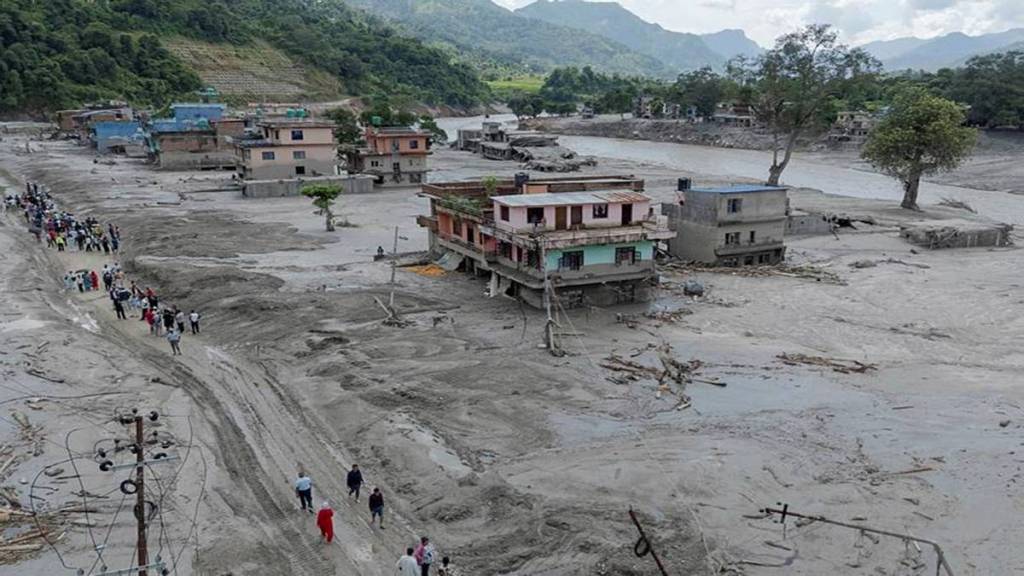

Mountains are changing in ways that can make them more dangerous. In Nepal, a major flood and landslide disaster in August showed how quickly a mountain hazard can turn into a human catastrophe. In the French Alps, record heat has weakened ice and permafrost, with rockfalls making parts of Mont Blanc more difficult and dangerous to reach.
The two incidents took place thousands of kilometres apart and had different immediate triggers. But they point to the same wider problem – warming is changing the frozen systems that help hold high mountains together.
The Inter-governmental Panel on Climate Change (IPCC) has warned that mountain regions face growing risks from glacier loss, permafrost thaw, changing snowfall and extreme rainfall. Its Sixth Assessment Report found observable changes in mountain regions, including rising temperatures, glacier mass loss and increasing permafrost thaw.
The consequences can extend far beyond the mountains themselves. When glaciers shrink or frozen ground thaws, slopes can become less stable. Heavy rain can then move loose rock and soil downhill, triggering landslides and debris flows that can damage homes, roads, hydropower plants and other infrastructure.
What happened in Nepal?
A major collapse in Nepal’s Langtang region sent rock, ice, mud and water down the Trishuli valley on August 26.
A glacier collapse at Langtang Lirung mountain, about 25 miles upstream, triggered a landslide that created a huge wall of water, reported Reuters. The disaster struck a network of hydropower projects in Nepal’s Rasuwa district.
More than 1,300 people were killed and thousands remained missing across Nepal and neighbouring Tibet, reported Reuters. About 900 workers had been inside 12 hydropower projects when the disaster struck.
Two workers, Kabir Maharjan and mechanical foreman Sanjay Sah, survived for nine days inside a tunnel at the Upper Trishuli 3A hydropower project.
Floodwater and debris blocked their escape route, leaving the men inside an air-filled chamber. Maharjan drank muddy water to survive, while Sah recited Hindu prayers to maintain his courage, Reuters reported.
Rescuers eventually heard noises from inside the tunnel. On the 10th day, soldiers opened a small hole and heard the men say, “Hunuhuncha”, which loosely translates as “we are here”.
The two workers were eventually pulled out alive. Their rescue offered a rare moment of hope after a disaster that devastated the valley. But the incident also exposed the vulnerability of infrastructure built in steep Himalayan valleys, where hydropower projects are located close to fast-flowing rivers and unstable slopes.
The rescue itself was complicated by the scale of the debris. Some sections of the tunnels were buried under 15 to 30 metres of mud, rock, timber and other material. Rain repeatedly filled excavated areas with fresh water and debris.
Did climate change cause Nepal disaster?
Scientists have cautioned against describing the August 26 disaster as a straightforward case of “climate change caused the flood”. Carbon Brief reported that no formal rapid attribution study had quantified the contribution of human-caused climate change to the disaster.
The immediate trigger involved a failure of the mountain and glacier system. Scientists have also said the underlying rock, rather than the glacier alone, played a major role.
Dr Jakob Steiner, a geoscientist at the University of Graz, told Carbon Brief that the mountain beneath the glacier collapsed and the glacier moved with it. He said the exact trigger remained uncertain and that the failure appeared to involve stresses that had built up over a long period.
That does not rule out a role for warming. Scientists have identified several ways in which climate change can alter mountain stability, including glacier retreat, melting ice and thawing permafrost.
Carbon Brief stated that the glacier involved in the Nepal disaster retreated by about 450 metres between 1990 and 2020, citing comments from Professor Maria Shahgedanova of the University of Reading.
Researchers told Carbon Brief that glacier retreat can remove mechanical support from underlying slopes, while thawing permafrost can increase pressure inside cracks in rock and make unstable slopes more vulnerable to failure.
Why is Mont Blanc becoming more dangerous?
A similar process is visible in the European Alps, although the immediate hazard is different. Record heat this summer accelerated changes around Mont Blanc, Europe’s highest peak, reported AP.
The mountain rises to 4,805 metres on the border between France and Italy. Summer heat damaged permafrost – permanently frozen ground that helps hold mountain slopes together, reported AP.
When permafrost thaws, the ice within the ground that acts as a natural cement weakens. That can release rocks from steep mountain faces.
The effect became increasingly visible around Mont Blanc this year.
Stephane Bozon, deputy mayor of Chamonix-Mont-Blanc and the official responsible for safety, told AP that rockfalls have increased since the middle of July. Glacial retreat, snowmelt, opening crevasses and rock collapses made some areas difficult to access.
The temperature record adds context. July 2026 produced the highest monthly average temperature ever recorded at the Aiguille du Midi, at an altitude of 3,842 metres, reported AP. The average temperature reached 3.3 degree Celsius, compared with 1.6 degree Celsius in July 1994.
Ludovic Ravanel, a researcher at Savoie Mont Blanc University, told AP that successive heat waves had weakened permafrost and contributed to a large increase in rockfalls and collapses.
Ravanel expects major collapses in the Mont Blanc massif to reach around 400 in 2026, AP reported – about 10 times the level from two decades ago. The previous particularly bad year was 2022, when nearly 300 collapses were recorded.
The changes have also affected mountaineering. Chamonix-based mountain guide Stuart MacDonald told AP that melting ice and falling rocks made his work much more difficult this summer and forced him to cancel plans to lead a group to the Mont Blanc summit.
The concern is not limited to climbers. Bozon told AP that Chamonix needs to prepare for serious scenarios in which parts of glaciers or mountains could fall towards inhabited areas.
What is happening to the world’s mountains?
Mountains are particularly sensitive to warming because relatively small temperature changes can shift the boundary between snow, ice and liquid water. Snow can turn into rain at elevations where it once accumulated, while glaciers retreat and permafrost thaws.
The IPCC said mountain cryosphere systems – glaciers, permafrost and seasonal snow – are among the natural systems most sensitive to climate change. Its 2022 assessment found observed increases in temperatures, glacier mass loss and permafrost thaw, along with changes in snow cover.
These changes can affect both slope stability and water systems.
Glaciers act as natural stores of water. Their loss changes when and how water reaches rivers. In some regions, increased melting can temporarily raise runoff, but continued glacier loss eventually reduces the amount of ice available to provide water during dry periods.
A mountain hazard can also trigger a chain of incidents. Landslides can block rivers, while glacier retreat can create or enlarge lakes. A sudden release of water from such a lake can produce a glacial lake outburst flood.
The IPCC has warned that glacier retreat and permafrost thaw can reduce slope stability and increase the number and size of glacier lakes. Landslides, floods and other cascading hazards can affect places without a previous record of such events.
A mountain slope can fail in a remote location and still damage communities many kilometres downstream. Floodwater can destroy roads and bridges, sediment can damage hydropower equipment, and landslides can cut off villages.
These risks are particularly important in High Mountain Asia, where the IPCC says glacier mass loss and permafrost thaw have already affected the region and are projected to continue.
Carbon Brief reported that glacier retreat in the Langtang catchment accelerated sharply between 1964 and 2023, with the rate of glacier area loss increasing more than fourfold over that period.
The Alps face similar changes. Alpine glaciers in Lombardy have lost more than 40% of their surface area since 1991, according to the region’s glacier service, reported AP.
Vanda Bonardo, head of the Italian branch of the International Commission for the Protection of the Alps, told AP. That shift affects the stability of terrain as well as water storage and runoff.
The IPCC has warned that changing mountain water systems can affect hydropower and agriculture, particularly in snow- and glacier-fed river basins where the timing of runoff is changing.
The risks are not identical everywhere. Some mountain regions may receive more precipitation while others become drier. Some slopes may become more unstable, while other hazards could decline.
What is changing, however, is the physical environment in which these hazards occur.
What does climate change mean for mountain hazards?
Mountains have always experienced rockfalls, avalanches, floods and landslides. Climate change does not make every mountain collapse inevitable.
Warmer temperatures can remove ice from slopes, thaw permafrost, accelerate glacier retreat and shift precipitation from snow to rain. Extreme rainfall can then interact with these changes, producing combinations of hazards that are difficult to predict.
Carbon Brief quoted climate scientist Bethan Davies as saying that individual events can have multiple drivers, but continued warming of permafrost and glacier systems makes future mountain hazards more likely.
That is the central lesson from Nepal and Mont Blanc. The mountains are not simply losing ice. They are losing some of the frozen structures that have helped regulate water and stabilise steep slopes for centuries.
As those systems change, the risks can move from remote high-altitude terrain into valleys, towns, power projects and transport routes.
The August 26 disaster in Nepal and the surge in Mont Blanc rockfalls in 2026 do not prove that climate change caused either incidents on its own. But they show why scientists increasingly view warming mountains as a major risk to people and infrastructure.